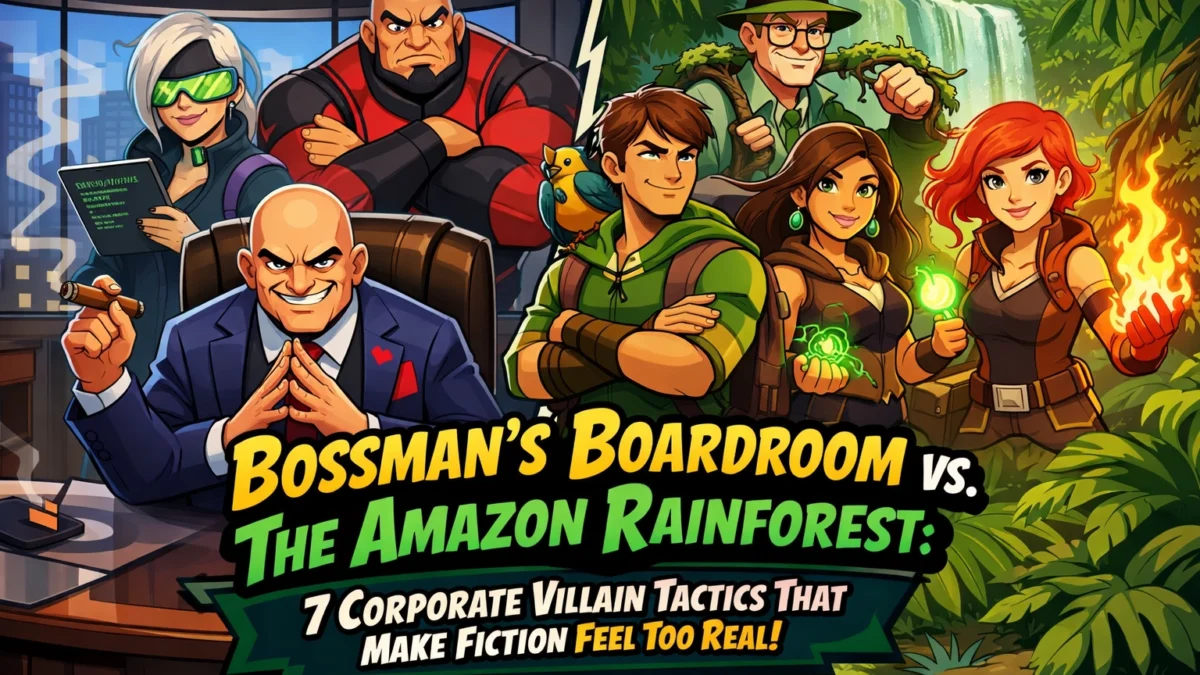
Meta Description: Corporate greed makes the scariest villain motivation. Discover 7 real-world tactics that inspired The Rainsavers' boardroom antagonists, and why fiction fans in 2026 can't look away.
Remember when villains wore capes and laughed maniacally? Yeah, 2026 readers aren't buying that anymore.
The scariest antagonists today don't have superpowers, they have PowerPoint presentations. They don't plot world domination from volcanic lairs; they do it from mahogany conference rooms with overpriced espresso machines. And honestly? That hits way harder.
Corporate greed as a villain motivation isn't just compelling fiction, it's Tuesday afternoon headlines. When you're reading about a CEO who prioritizes quarterly profits over, you know, the actual planet, it's getting harder to tell where the news cycle ends and the thriller begins.
So let's talk about why corporate villains make your skin crawl in the best possible way, and how The Rainsavers nails that uncomfortable sweet spot between "this is terrifying fiction" and "wait, this actually happened last month."
1. The "Plausible Deniability" Defense
The Tactic: Create so many shell companies, subsidiaries, and legal firewalls that no single person can be held accountable for environmental destruction. It's the corporate equivalent of playing hot potato with a lawsuit.
Why It's Terrifying: Because it works. In real life, tracing responsibility through layers of corporate structure is like untangling Christmas lights, frustrating, time-consuming, and you're pretty sure someone did this on purpose.
In The Rainsavers: When our team uncovers illegal operations in the Amazon, they're not facing a mustache-twirling villain, they're facing a web of LLCs, offshore accounts, and boardroom executives who all claim they "had no idea" what the subsidiary's subsidiary was doing. The most chilling line any villain can deliver? "I'll have my lawyers look into that."

2. Greenwashing as Performance Art
The Tactic: Slap some rainforest imagery on your marketing materials, sponsor a few tree-planting initiatives, and suddenly you're an "eco-conscious company", never mind the mining operation poisoning the river two miles away.
Why It's Terrifying: It weaponizes our desire to believe the good guys exist. In 2026, we're drowning in "sustainable" branding while carbon emissions keep climbing. The cognitive dissonance is exhausting.
In The Rainsavers: The corporate antagonists don't just destroy the rainforest, they fund documentaries about rainforest conservation while doing it. They're at every environmental summit, smiling for photos, while their extraction teams work overtime. It's villainy with a PR department, and it's infuriatingly realistic.
3. The "Local Community Liaison" Who Isn't
The Tactic: Hire someone who looks good in press photos to claim they're "working with indigenous communities" while systematically ignoring every concern those communities actually raise.
Why It's Terrifying: Performative allyship is everywhere, and corporate versions are especially insidious. It's the illusion of representation without any actual power transfer.
In The Rainsavers: When the team encounters corporate "liaisons" who speak for communities without actually listening to them, it mirrors frustrations readers recognize instantly. The best villain motivations don't require explanation, you've already seen this play out in real time.
4. Speed as a Weapon
The Tactic: Move so fast that by the time regulatory approval catches up, the damage is already done. Oops, sorry, can't un-cut those thousand-year-old trees. But hey, we'll pay the fine!
Why It's Terrifying: Fines become the cost of doing business. When a corporation makes $50 million from illegal logging and pays a $2 million penalty, that's not justice: that's a business expense.
In The Rainsavers: Corporate antagonists don't wait for permits. They operate on the principle that asking forgiveness (or paying nominal fines) is cheaper than asking permission. Our heroes race against extraction timelines that ignore every legal safeguard, creating nail-biting tension because we know this urgency isn't fictional.

5. Data as the New Oil (and Oil as the Old Oil)
The Tactic: Whether it's literal petroleum extraction or harvesting biometric data about indigenous plant knowledge, modern corporate villainy understands that information is power: and taking it without consent is just "business intelligence."
Why It's Terrifying: Biopiracy is real. Companies have literally patented plants that indigenous communities have used for centuries. In 2026, we're watching corporations try to own everything from genetic sequences to traditional knowledge systems.
In The Rainsavers: The antagonists aren't just after resources: they're documenting, cataloging, and attempting to patent the very biological diversity that makes the Amazon irreplaceable. When Dr. Mubari and the team fight to protect ancient plant compounds, they're battling intellectual property law as much as armed security forces.
6. The "Progress" Narrative
The Tactic: Frame every criticism as anti-development, anti-jobs, anti-progress. Anyone opposing your environmental destruction must hate poor people and economic growth, right?
Why It's Terrifying: It's an effective false dichotomy. Plenty of real communities do need economic development: but framing extraction industries as the only path forward is manipulation, not economics.
In The Rainsavers: Corporate villains deploy this rhetoric constantly, positioning themselves as heroes bringing jobs and infrastructure while our protagonists are painted as privileged outsiders. The series doesn't shy away from this complexity: real communities have real economic needs, and corporate antagonists exploit that truth to justify devastating environmental practices.
7. The "Too Big to Stop" Endgame
The Tactic: Become so embedded in regional economies, political systems, and infrastructure that stopping your operations becomes unthinkable. You're not just a company anymore: you're "essential to economic stability."
Why It's Terrifying: Because once a corporation reaches critical mass, even governments hesitate to intervene. The entity becomes simultaneously public enemy and economic cornerstone.
In The Rainsavers: The ultimate villain isn't just greedy: they've made themselves functionally indispensable to multiple governments and economies. Stopping them isn't as simple as "arrest the bad guy." It requires dismantling systems, navigating political pressure, and finding alternatives that won't collapse communities. That's what makes the stakes real.

Why Corporate Greed Hits Different in 2026
Here's the thing: we're tired of fiction that requires us to suspend disbelief about villain motivations. Why is this person trying to destroy the world? Because they're… evil? Bored? Had a bad childhood?
Corporate antagonists need exactly zero backstory because we see their motivations play out daily. Quarterly earnings reports are their origin story. Shareholder value is their character arc. The motivation is so mundane, so ordinary, so real that it becomes genuinely unsettling.
The Rainsavers understands that the best thrillers don't invent fears: they reflect them. When readers follow the team through the Amazon, encountering corporate security forces with better equipment than most small nations' militaries, it doesn't feel like fantasy. It feels like investigative journalism with really good pacing.
The Villain You Can't Punch
Traditional action-adventure gives us satisfying conclusions: defeat the villain, save the day, roll credits. But corporate antagonists are hydras: cut off one head, and three more board members vote themselves bonuses.
That's what makes stories about corporate greed so compelling in 2026. Victory isn't simple. Justice isn't clean. And the antagonists never just give up because the heroes made an inspiring speech about doing the right thing.
In The Rainsavers, our team can't just fight their way out: they have to navigate legal systems, counter propaganda, build coalitions, and sometimes settle for partial victories that feel frustratingly realistic. It's the kind of storytelling that respects readers' intelligence instead of offering easy escapism.
Fiction That Feels Too Close to Home
The most common reader feedback we get? "This feels uncomfortably accurate." And honestly? Mission accomplished.
When the line between thriller fiction and business news gets blurry, you've tapped into something readers can't ignore. Corporate villainy doesn't require exotic locations or impossible technology: just board meetings, cost-benefit analyses, and a willingness to prioritize profit over basically everything else.
The Amazon rainforest in The Rainsavers isn't just a setting: it's a character under siege by antagonists who view ancient ecosystems as "untapped resources" and indigenous knowledge as "intellectual property opportunities." Every tactic these fictional villains deploy has a real-world precedent, and readers recognize that immediately.
That recognition is what keeps pages turning at 2 AM.
Meet the Corporate Villains
Want to see how boardroom tactics translate to pulse-pounding adventure? Dive into The Rainsavers and discover why readers say these are the villains that actually keep them up at night: not because they're monsters, but because they're professionals.
No capes. No elaborate death traps. Just quarterly projections and an unsettling willingness to rationalize anything if the numbers look good.
Turns out that's way scarier.
