
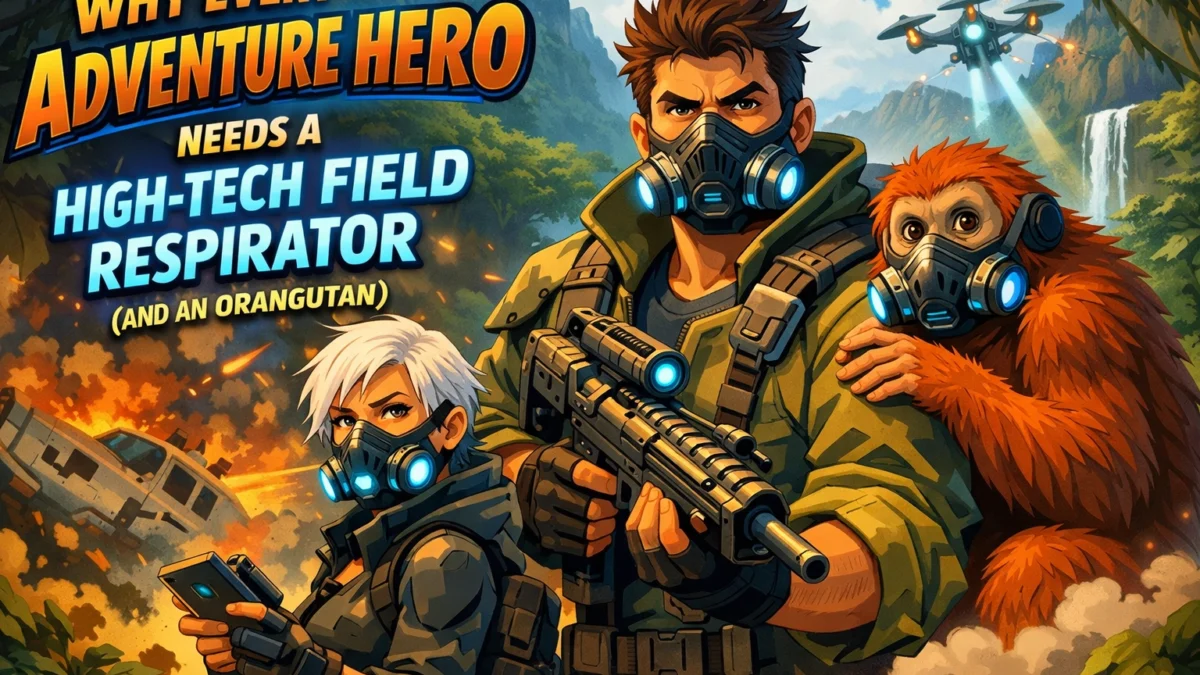
Look, we need to talk about adventure gear in 2026.
Because somewhere between "Indiana Jones hat and whip" and "Batman's entire utility belt budget," modern adventure heroes got lost. They're running into burning rainforests, toxic industrial sites, and underground cavern systems with nothing but determination and a really expensive watch.
That's not brave. That's just bad planning.
If you're going to save the world, or in the case of The Rainsavers team, save the planet from environmental disasters one mission at a time, you need two things: a high-tech field respirator and an orangutan named Alpha who has better tactical instincts than most special ops teams.
Yes, I'm serious. Let me explain.
The Respirator Problem Nobody Talks About
Here's what adventure fiction got wrong for decades: clean air is not a given.
In 2026, our heroes aren't just dodging poison darts in ancient temples. They're navigating wildfire smoke, chemical spills, airborne pathogens from disturbed ecosystems, and the general delightful cocktail of toxins that modern environmental crises throw at you. The romantic notion of the rugged adventurer breathing in whatever mysterious fog rolls through? That's called "acute respiratory failure," and it's significantly less cinematic than you'd think.

Modern field respirators aren't your grandfather's gas mask. We're talking about tactical gear with 99.7% filtration efficiency, CBRN protection (that's chemical, biological, radiological, and nuclear for those keeping score at home), and integrated communication systems so you can still coordinate with your team while not inhaling whatever fresh nightmare the universe has cooked up today.
The Rainsavers team learned this the hard way during the Singapore Haze Incident. Spoiler: running into a smoke-filled biodome without proper respiratory protection makes for a very short adventure. And by short, I mean "passing out in under three minutes" short.
Tactical Specs That Actually Matter
Let's get practical for a second. Because if you're going to geek out about adventure gear, you might as well know what you're geeking out about.
High-tech field respirators in 2026 feature:
Adaptive filtration systems that automatically adjust to environmental threats. Particulate matter? Filtered. Toxic gases? Neutralized. That weird smell coming from the underground lake? Probably best not to ask, but yeah, filtered.
Low-profile design that doesn't make you look like you're auditioning for a post-apocalyptic movie. Modern respirators integrate with tactical helmets, communication gear, and: this is important: don't fog up your vision when you're trying to swing across a ravine. (Ask me how we know this matters. Actually, don't. It's embarrassing.)
Extended wear capability because real missions don't wrap up in 22 minutes plus commercials. We're talking 8-12 hour comfort ratings, ergonomic designs, and ventilation systems that don't make you feel like you're breathing through a straw.
Smart sensors that monitor air quality in real-time and alert you to threats before your human senses catch up. Your nose might not detect that carbon monoxide leak, but your respirator will, and it'll start yelling at you (metaphorically) before you make any permanent life mistakes.

Enter Alpha: The Orangutan Factor
Now, about that orangutan.
Alpha isn't just along for the ride. She's not a mascot or a cute sidekick who occasionally provides comic relief. Alpha is a 120-pound tactical genius wrapped in orange fur, and she has saved the team's collective backside more times than anyone's comfortable admitting.
Here's the thing about orangutans: they're brilliant. Problem-solving intelligence that rivals dolphins, tool-use capabilities that put most humans to shame, and upper body strength that makes rock climbing look like a casual Tuesday. In the wild, orangutans can navigate dense canopy systems that would confound most experienced climbers. They understand spatial relationships, can plan multiple steps ahead, and have been observed teaching each other new skills.
In other words, they're perfect for tactical expedition work.
But here's where it gets interesting. While humans need respirators for toxic environments, Alpha's respiratory system and natural instincts give her early warning capabilities that no tech can match. She can detect air quality changes before the sensors kick in. She navigates through smoke and haze with an intuitive understanding of air currents. And when the gear fails: because gear always fails at the worst possible moment: Alpha's natural abilities become mission-critical.
The Dynamic Duo: Tech Meets Primate
The real magic happens when you combine high-tech respirator systems with orangutan tactical support.
Picture this: You're deep in a collapsed industrial complex, searching for survivors after an environmental disaster. The air is thick with chemical particulates. Your respirator is handling the filtration, your comm system is keeping you connected to the team, and your sensors are mapping air quality in real-time.
Then Alpha spots something your tech missed: a thermal vent that's releasing toxic gases at irregular intervals, right in your planned path. She redirects the team, her natural climbing abilities opening up a route through overhead infrastructure that your mapping system hadn't identified as navigable.

Or consider the Malaysia mission, where Alpha's ability to move through canopy systems while the team navigated the forest floor below created a two-tier reconnaissance advantage that no amount of drone surveillance could match. While everyone else relied on respirators to handle the particulate matter from illegal burn operations, Alpha's elevated position gave her access to cleaner air streams and visual perspective that transformed the entire tactical approach.
The Gear-Primate Partnership Protocol
The Rainsavers team has developed what they call the Gear-Primate Partnership Protocol (GPPP, because apparently everything needs an acronym). It's a tactical framework that integrates high-tech equipment capabilities with Alpha's natural abilities.
Communication integration: Alpha wears a specialized harness with sensor arrays that feed data back to the team. Heart rate, position tracking, environmental readings: all integrated into the same systems that manage human respirator data.
Redundancy planning: When electronics fail (and they will), Alpha becomes the primary navigation and threat detection system. When Alpha needs support (because even genius orangutans have limitations), the tech takes over.
Complementary deployment: Humans handle tasks requiring respirator-protected environments. Alpha handles elevated reconnaissance, route finding in complex vertical spaces, and accessing areas too unstable for human weight loads.
The result? A hybrid tactical approach that's more effective than either technology or biology alone.
Why This Matters for Modern Adventure Stories
Here's the real question: why are we talking about respirators and orangutans in a blog post about fiction?
Because modern adventure stories need to evolve past the "lone hero with plot armor" model. The Rainsavers series gets this. Real environmental challenges are complex, multi-faceted, and require both cutting-edge technology and unconventional thinking. They require teams that combine different strengths, gear that actually makes sense for the mission profile, and partnerships that go beyond traditional human-only frameworks.
The tactical expedition aesthetic isn't just about looking cool (though let's be honest, respirators and orangutans definitely look cool). It's about building adventure narratives that feel grounded in the actual challenges of 2026. Climate disasters are real. Environmental threats are escalating. And the heroes who step up to face these challenges need more than determination: they need proper equipment and unconventional allies.

The Bottom Line
Every adventure hero needs a high-tech field respirator because modern adventures happen in environments that are actively trying to kill you on a molecular level. Clean air isn't guaranteed. Toxic exposure isn't dramatic, it's just stupid and preventable.
And every adventure hero needs an orangutan because sometimes the best tactical advantage isn't the newest tech: it's partnering with a brilliant primate who sees the world from a completely different angle.
The Rainsavers series builds this dynamic into every mission, creating adventure narratives that are both thrilling and grounded in the real challenges of environmental crisis response. It's tactical, it's unconventional, and it's exactly the kind of storytelling that 2026 needs.
Want to see how respirators, orangutans, and environmental adventure actually work together? Dive into The Rainsavers universe and discover why the future of adventure fiction is tactical, team-based, and definitely includes an orangutan named Alpha who's tired of your nonsense.
Ready for your own tactical expedition into environmental adventure fiction? Start your journey with The Rainsavers and discover stories where the gear is real, the stakes are high, and the orangutan is always right.
Trust us on that last part. Alpha would insist.
