
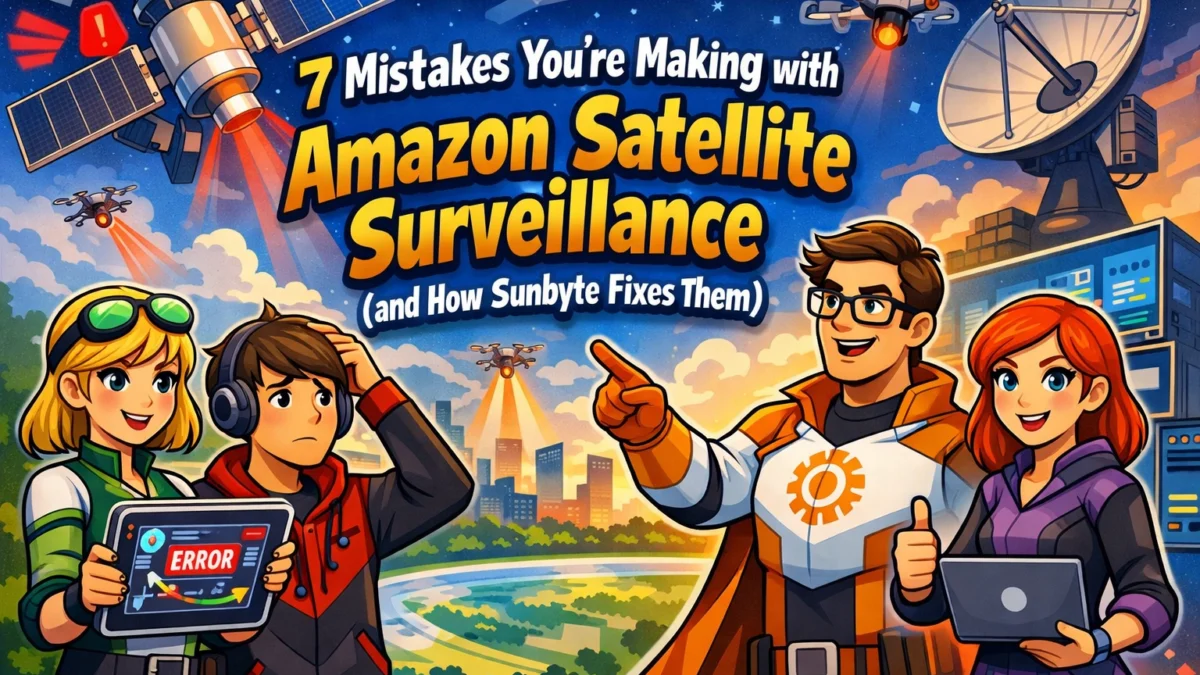
Meta Description: Are you tracking the rainforest or just getting lost in the noise? Sunbyte reveals the 7 biggest mistakes people make with Amazon satellite surveillance and how he keeps The Rainsavers invisible.
Hey there, eco-adventurers and tech-heads. It’s 2026, and if you think the sky is just for clouds and birds, you’re about three firmware updates behind the curve.
Up there, orbiting our big green marble, is a mesh of silicon and glass that can spot a gum wrapper from two hundred miles up. But here’s the thing: everyone thinks they’re a pro at "eye-in-the-sky" tech until they actually have to use it in the thick of the Amazon.
When you’re working with The Rainsavers, you quickly realize that the rainforest isn't just a place: it's a fortress. And the biggest mistake people make is thinking that a standard Amazon satellite feed is going to give them the truth.
I’m Sunbyte, the guy who keeps our team’s tech running while we’re deep in the mud. I’ve seen some pretty hilariously bad surveillance attempts by the "bad guys" (and some rookies), so I figured it was time to drop some knowledge.
Here are the 7 mistakes you’re making with satellite surveillance and how I: your friendly neighborhood tech genius: fix them.
1. Trusting Optical Feeds (The "Cloud Cover" Trap)
Most people open up their high-res optical feed and expect to see clear ground. In the Amazon? Good luck. It’s 2026, and the weather is weirder than ever. If you’re relying on standard photography, you’re just looking at a very expensive picture of a white cloud.
The Sunbyte Fix: I don't use optical. I bypass the standard visual spectrum and tap into Synthetic Aperture Radar (SAR). SAR doesn't care about clouds, smoke, or the middle of the night. It bounces signals off the ground and builds a 3D map. While the villains are waiting for a clear day, I’m already seeing their secret bases through a thunderstorm.

Image Description: Close-up of Sunbyte’s forearm-mounted interface glowing with a blue SAR wireframe map of the jungle. He is wearing a high-tech field respirator with a matte-black tactical finish, blending into the dark green foliage.
2. Ignoring the "Green Ghost" Effect
Digital sensors are great, but they get confused by the sheer density of the canopy. This leads to "Green Ghosting": where the software interprets swaying trees as moving vehicles or people. I’ve seen teams spend six hours chasing a "ghost" that turned out to be a particularly windy mahogany tree.
The Sunbyte Fix: I’ve written a custom script that filters for biological rhythms. If the movement doesn't match the wind speed or the typical sway of a tree trunk, it flags it. If you want to see how we use this to track real threats, you should Read Book One now.
3. Forgetting About Thermal Bleed
You think because you’re under the trees, your heat signature is hidden? Nope. In the humid heat of the rainforest, the ground actually retains heat, but humans are hotter. Standard thermal surveillance can spot a campfire or a running engine through a mile of leaves if they know what to look for.
The Sunbyte Fix: I designed our team’s tactical gear to include heat-sink lining. We don’t just block the heat; we disperse it to match the ambient temperature of the surrounding mud. We become part of the background radiation. No thermal ping, no problem.
4. Relying on Low-Earth Orbit (LEO) Cycles
People think satellites are just… there. Like a permanent security camera. But satellites are moving fast. Most of the cheap surveillance ones only pass over the same spot once every 90 minutes. That’s a massive window for someone to move a whole convoy without you seeing a thing.
The Sunbyte Fix: I don't wait for the cycle. I use a technique called "Satellite Hopping." By daisy-chaining signals from different private and environmental monitoring arrays, I can get a near-constant feed. It’s a bit like a Down the Rabbit Hole moment: you start with one feed and end up controlling the whole sky.

Image Description: Sunbyte standing in a clearing, looking up. He is wearing a tactical expedition outfit with a specialized respirator. He is holding a ruggedized tablet that displays multiple satellite orbits crisscrossing the Amazon.
5. Underestimating AI "False Positives"
In 2026, everyone is using AI to analyze their data. The problem? Most of those AIs were trained on suburban landscapes or deserts. When you throw them into the chaos of the Amazon, they start seeing "roads" where there are just rivers and "buildings" where there are just rock formations.
The Sunbyte Fix: I don't trust the automated alerts. I use a hybrid system where the AI flags anomalies, but I’ve taught it to recognize the specific signatures of illegal logging equipment and encroaching corporate machinery. It’s about specialized training, not just raw processing power. Our missions often involve identifying these ancient mysteries vs. modern threats, and you can’t do that with a generic AI.
6. Broadcasting Your Own Signature
This is the rookie mistake of the century. You’re sitting there, pulling down satellite data, but you’re using an unshielded uplink. You’re essentially screaming, "I AM RIGHT HERE" to every electronic warfare suite in the hemisphere.
The Sunbyte Fix: I use "Bursted Uplinks." I compress the data requests, send them in a micro-second burst using a directional laser aimed at the bird, and then shut it down. By the time their scanners ping the area, we’re already three miles downriver. It’s how we keep The Rainsavers safe while the big corporations try to track us down.
7. Thinking the Forest Doesn't Fight Back
The biggest mistake isn't even technical. It's the assumption that the Amazon is just a static map. In 2026, the forest is alive in ways we’re only beginning to understand. Between the rapid growth, the magnetic anomalies, and the local "interference," your tech is going to fail at the worst possible moment.
The Sunbyte Fix: Redundancy. I always have a backup that isn't digital. Sometimes, a high-tech respirator and a good pair of boots are more reliable than a trillion-dollar satellite. We combine the best of both worlds: modern tech and raw survival instincts.

Image Description: Sunbyte adjusting his high-tech field respirator. He is surrounded by dense, glowing flora that seems to interfere with the holographic HUD hovering near his mask. Tactical, gritty, and very "field-ready."
Why Does This Matter?
You might be wondering why a guy like me is giving away these secrets. It's because the stakes are higher than ever. The rainforest isn't just about trees; it's the lungs of our planet. When the "villains" use their satellites to find and destroy what’s left of our wilderness, someone has to be there to jam their signals and protect the green.
If you’re into tech, adventure, and seeing the underdog take on the giants with nothing but a custom OS and a lot of nerve, you’re in the right place.
We aren't your typical superheroes. We don't wear capes or have logos on our chests. We’re just a team trying to save the world before it’s too late. Are you interested in why modern eco-heroes are saving fiction? It’s because the fight is real, and it’s happening right now.
Join the Mission
The Amazon is full of secrets, and most of them aren't visible from space: even with my help. If you want to see how we put these fixes into action, you’ve got to get into the story.
We’re more than just a blog; we’re a movement. Whether you’re here for the TV commercial vibes or you want to dive deep into the episodes, there’s always something happening at The Rainsavers HQ.
Ready to see what happens when the satellites fail and the real work begins?
Stay stealthy out there.
: Sunbyte (via Steven G. Samuels, CEO)
Want more behind-the-scenes tech? Check out our blog page for more field notes, or join our latest poll to tell us what tech Sunbyte should build next!
