
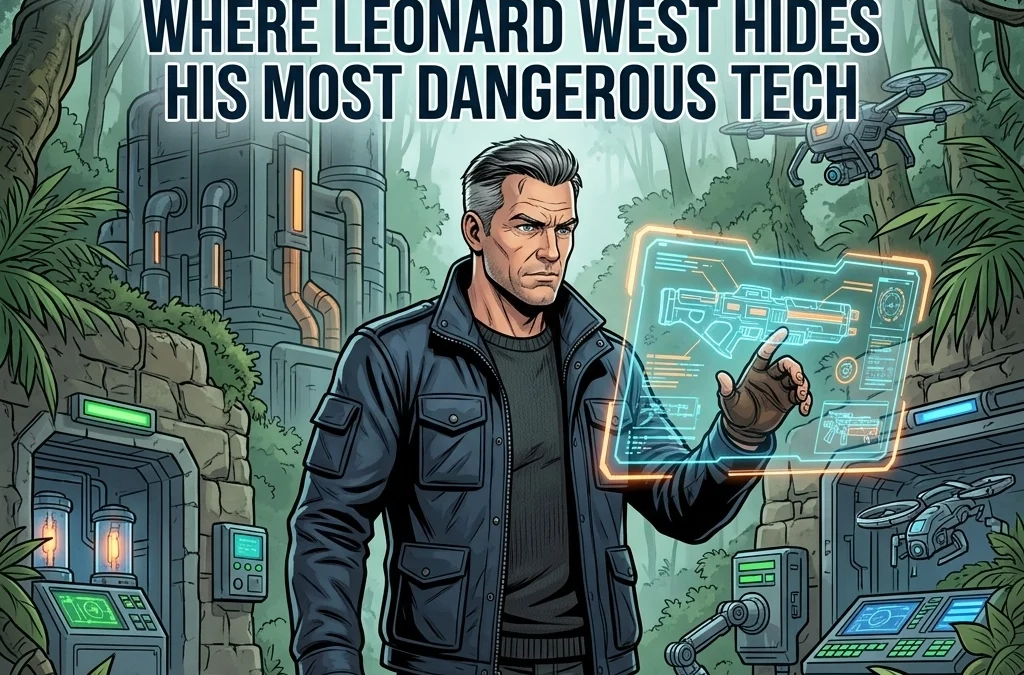
Meta Description: Deep in the heart of the rainforest, Leonard West has been building more than just a legacy. Discover the secret, high-tech caches hidden beneath the canopy and the dangerous technology that keeps The Rainsavers on their toes in 2026.
If you’ve been following the exploits of The Rainsavers, you know that the jungle isn’t just a place of ancient trees and rare birds. In 2026, the Amazon and the Congo basins have become the world's most high-tech hide-and-seek arenas. And the person winning that game? Leonard West.
We all know West as the enigmatic figure with a "save the world at any cost" attitude, but it’s his hardware that really keeps us up at night. He doesn't just build labs; he weaves them into the ecosystem. If you’re hiking through the brush and think you’ve spotted a particularly shiny rock, you might have just stumbled upon a multi-million dollar piece of climate-altering tech.
Let’s take a look at where Leonard hides his most dangerous toys and why they’re so hard to find.
The "Ghost Station" Philosophy
Leonard West doesn't do traditional architecture. You won't find a concrete bunker with a big "W" on the door. Instead, his "Ghost Stations" are built using bio-mimicry. We’re talking about structures that pulse with the rhythm of the forest.
His tech caches are usually hidden in three specific types of locations:
- The Root Systems: Massive, hollowed-out buttress roots of ancient Ceiba trees.
- Underwater Ravines: Hidden beneath the silt of seasonal tributaries.
- The High Canopy: Suspended platforms that look, from a distance, like nothing more than a dense collection of bromeliads and moss.
By using the natural world as his blueprint, West ensures that even the most advanced thermal imaging from The Rainsavers satellites struggles to pick up a signature. It’s brilliant, it’s terrifying, and it’s exactly why he’s always three steps ahead.

Alt-text: A sleek, metallic drone shaped like a giant dragonfly resting on a tropical leaf.
The Hardware: What’s Inside the Boxes?
So, what is he actually hiding? It’s not just laptops and backup drives. West is obsessed with atmospheric manipulation and "defensive ecology." Here are a few of the "gadgets" our team has encountered, or narrowly avoided, in the field.
1. The Atmospheric Siphons
These are perhaps the most dangerous pieces of tech in West’s arsenal. They look like copper-colored vines climbing the tallest trees. In reality, they are sophisticated air-scrubbers that don’t just clean the air, they harvest specific isotopes. Why? We’re still figuring that out, but when you see a tree "breathing" blue mist, you know West is nearby.
2. Bio-Mimetic Drones (The "Dragonflies")
If you hear a buzz in the jungle, it’s usually a bug. But if that buzz sounds a bit too rhythmic, it’s likely one of West’s bio-drones. These units are built with translucent wings and iridescent bodies, making them nearly invisible against the dappled light of the forest floor. They don't just record video; they carry localized EMP emitters. One wrong move and your GPS is a paperweight.
3. The German "Legacy" Modules
Here’s where the lore gets really deep. Rumor has it that West discovered a series of underground vaults dating back to the 1940s. These weren't just any bunkers; they contained experimental German engineering focused on "Vril" energy and early atmospheric science. West hasn't just preserved this tech; he’s modernized it. He’s taken 80-year-old blueprints and infused them with 2026 processing power. The result is a terrifying hybrid of old-world mechanical brawn and new-world digital brains.
Why Satellites Can’t See a Thing
You’d think with the sheer amount of hardware West is moving, we’d see him from space. But West uses a "Chameleon Shielding" technique. Each cache is covered in a specialized polymer that mimics the surrounding foliage’s chlorophyll levels. To a satellite, a high-tech lab looks exactly like a clump of ferns.
Even the heat signatures are masked. West uses the natural geothermal vents of the jungle floor to vent his servers. The heat blends right into the humid, tropical environment. It’s the ultimate "green" tech, literally.

Alt-text: A glowing blue holographic map of the Amazon rainforest projected inside a dark, vine-covered bunker.
The Rainsavers’ Game of Cat and Mouse
For our heroes, finding these caches is like looking for a needle in a haystack, if the needle was trying to kill you and the haystack was 2.1 million square miles of dense forest.
The Rainsavers have had to get creative. Instead of relying on high-altitude scans, they’ve started looking for "ecological anomalies." Is there a patch of forest where the monkeys refuse to go? Is there a stream where the fish swim in perfect geometric patterns? These are the breadcrumbs West leaves behind.
It’s a high-stakes game. Every cache they find brings them closer to understanding West’s ultimate goal. Is he trying to save the planet, or is he trying to control it? The line is getting thinner every day.
Dealing with the "Oops" Moments
In the field, things rarely go to plan. Our team once spent three days trekking toward what they thought was a major tech hub, only to find a very confused, very large jaguar sitting on a discarded (and highly encrypted) German radio unit from the 40s.
West has a sense of humor, too. Some of his "caches" are nothing more than decoys, empty boxes filled with old-school rickroll memes or coordinates to a different, even more dangerous location. It keeps the team on their toes and the readers turning pages.
How to Spot a West Cache (A Quick Guide)
If you ever find yourself in the deep jungle in 2026, keep an eye out for these tell-tale signs of Leonard West’s handiwork:
- The "Hum": A low-frequency vibration that you feel in your teeth more than you hear in your ears.
- Perfect Leaves: If a plant looks too symmetrical or doesn't have any insect bites, it’s probably a sensor.
- Cool Breezes: In the middle of a 100-degree jungle, a sudden, localized draft of 68-degree air usually means there’s an AC unit hidden nearby.

Alt-text: A character from The Rainsavers examining a glowing, high-tech artifact hidden inside a hollowed-out log.
Why This Matters for the Future
The technology Leonard West is hiding isn't just about winning a fight; it’s about the future of the Earth. As the climate shifts, whoever controls the tech that can manipulate the weather and the ecosystem holds all the cards.
The Rainsavers aren't just trying to stop a "villain"; they’re trying to ensure that the power to change our world doesn't stay hidden "beyond the canopy" in the hands of one man. The mystery of the caches is the mystery of our survival.
West’s tech is a double-edged sword. It could be the key to reversing climate change, or it could be the ultimate weapon of ecological warfare. Finding out which one it is… well, that’s where the adventure begins.
Want to see what happens when the team finally cracks open one of West’s most dangerous vaults?
Read Book Two now and join the hunt!
