
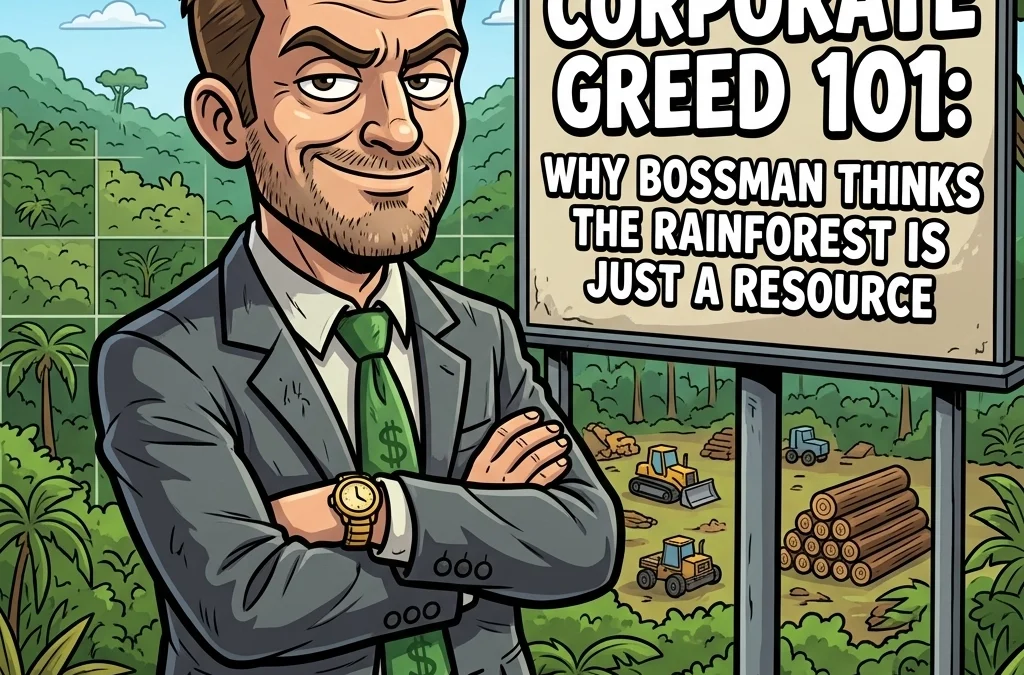
Meta Description: Get inside the mind of Bossman, the corporate titan of 2026 who views the Amazon as his personal bank account. Discover why he sees trees as timber and biodiversity as bio-data in this deep dive into the villain of The Rainsavers.

It’s Sunday, April 26, 2026, and while most of us are enjoying a slow morning coffee and thinking about maybe going for a hike, there’s a guy in a high-tech penthouse in New York looking at the Amazon through a very different lens.
To us, the rainforest is the "lungs of the planet." It’s a place of mystery, ancient wisdom, and incredible beauty. But to Bossman, the primary antagonist in our series, the Amazon isn’t a sanctuary. It’s a warehouse. And right now, the inventory is just sitting there, "unoptimized."
If you’ve been following the adventures of The Rainsavers, you know that the battle for the planet isn't just about picking up trash or planting a few saplings. It’s a high-stakes war against a corporate machine that views the natural world as a collection of assets waiting to be liquidated.
Today, we’re putting the spotlight on the man behind the machine. Let’s dive into Corporate Greed 101 and see why Bossman thinks the way he does.
The Spreadsheet Mentality: Everything has a Price
In the world of Bossman, if you can’t measure it, it doesn’t exist. And if it doesn’t have a price tag, it’s worthless. This is the "Spreadsheet Mentality," and it’s the foundation of his entire corporate philosophy.
When Bossman looks at a thousand-year-old Ceiba tree, he doesn't see a majestic giant that supports thousands of life forms. He sees:
- Board-feet of high-quality timber.
- Potential carbon credit revenue (if he can "lease" the air around it).
- Space occupied that could be better used for a rare-earth mineral mine.
To a corporate titan in 2026, sentimentality is a bug in the software. He views the environmental concerns of The Rainsavers not as noble efforts, but as "operational inefficiencies." In his mind, he’s not the villain; he’s the ultimate pragmatist. He believes that the world’s problems can only be solved by money, and to get that money, you have to extract value from wherever it’s hiding, even if it's hiding under a canopy of green.

Visual: A close-up of a holographic display showing a 3D map of the Amazon, highlighted with glowing orange "extraction zones."
The Bio-Data Gold Rush
We often talk about the rainforest in terms of oxygen and water, but Bossman is looking for something much more lucrative: bio-data.
In the 2026 landscape of The Rainsavers, technology has reached a point where the genetic code of a rare frog or the chemical properties of an undiscovered orchid are worth more than gold. Bossman’s corporations aren't just there to cut down trees; they are there to "index" the jungle.
He wants to own the patents on nature itself. If a plant in the Amazon holds the cure for a new global virus, Bossman wants to make sure his company owns the rights to that chemical structure before anyone else even knows it exists. This isn't just greed; it’s a land grab for the future of humanity. By turning the rainforest into a resource for bio-pharmaceuticals and synthetic data, he’s effectively trying to put a subscription model on survival.
German Engineering and High-Tech Domination
Bossman isn't using rusty chainsaws and old bulldozers. No, his operations are powered by the pinnacle of modern technology. Drawing on advanced German engineering and precision-guided robotics, his extraction teams move with a terrifying efficiency.
He uses "Silent Swarm" drones to survey areas for mineral deposits and automated "Harvester" units that can clear-cut with surgical precision. This tech-forward approach makes him a much more dangerous threat than the villains of the past. He isn’t just destroying the forest; he’s "upgrading" it into a controlled industrial zone.
For Bossman, the "primitive" state of the jungle is an insult to modern progress. He believes that humanity’s destiny is to control and tame every square inch of the Earth. When The Rainsavers step in with their "save the trees" attitude, he sees them as Luddites trying to stop the inevitable march of the 21st century.

Visual: A sleek, chrome-and-glass office interior with a view of a rainy cityscape, reflecting the cold, calculated nature of Bossman’s world.
Why 2026 is the Tipping Point
Why is this battle happening now? In our timeline, 2026 is the year where the "Resource War" reaches a boiling point. The world’s traditional resources are dwindling, and the corporate giants are getting desperate.
Bossman’s board of directors is demanding growth. In the corporate world, if you aren't growing, you’re dying. And since there are no new continents to discover, Bossman has turned his sights on the last truly "untapped" regions of the globe.
The Amazon represents the ultimate "unclaimed" asset on the global balance sheet. He knows that if he can secure the rights to these territories now, he will be the most powerful man on Earth for the next fifty years. It’s a winner-take-all game, and he has no intention of losing to a group of "eco-warriors" who care more about monkeys than margins.
The Rainsavers: A Glitch in the System
To Bossman, our heroes: the Rainsavers: are nothing more than a glitch in his perfectly designed system. He doesn't understand their motivation. Why would anyone risk their life for a forest they don't even own?
This fundamental misunderstanding is Bossman’s greatest weakness, though he doesn't know it yet. He calculates human behavior based on greed and self-interest. He can't factor in things like courage, sacrifice, or a deep, spiritual connection to the Earth.
When The Rainsavers sabotage a drone or block a mining operation, Bossman sees it as a temporary setback: a math problem to be solved. He hasn't realized that he’s not fighting a business rival; he’s fighting a movement.

Visual: A group of eco-adventurers (The Rainsavers) looking out over a lush green valley, standing in stark contrast to the cold boardroom imagery.
The "Efficiency" of Extinction
Perhaps the most chilling part of Bossman’s perspective is how he views extinction. To him, the loss of a species is just "collateral damage." If a species can't adapt to the modern world he’s building, then it wasn't "efficient" enough to survive in the first place.
He applies a brutal version of Darwinism to his business model. If the rainforest has to die so that his corporation can live, then that’s just the way the market works. He’s convinced himself that he’s doing the world a favor by clearing out the "old" to make room for the "new."
This is why the conflict in The Rainsavers is so intense. It’s not just about trees; it’s about what kind of world we want to live in. Is the Earth a living being that we are a part of, or is it just a pile of materials for us to use up and discard?
How Bossman Rationalizes His Actions
If you sat down for a drink with Bossman (assuming you could get past his six tiers of security), he wouldn't tell you he’s a bad guy. He’d tell you about the jobs he creates. He’d show you the "clean energy" initiatives his company funds (which are usually just a front for more extraction). He’d talk about "human progress" and "conquering the final frontier."
He’s a master of corporate speak. He’s the king of greenwashing. He can make a strip mine sound like a "landscape rejuvenation project" if you give him enough time and a flashy enough PowerPoint presentation. This ability to twist reality is what makes him so effective at manipulating governments and the public.

Visual: A futuristic drone, sleek and predatory, hovering silently above a canopy of ancient trees.
The Battle is Just Beginning
Understanding Bossman is key to understanding why The Rainsavers do what they do. You can't fight an enemy you don't understand, and Bossman is an enemy that won't stop until every tree is logged and every stream is dammed for power.
He represents the peak of corporate greed in 2026: a man who has everything but wants more, and who sees the natural world as the only thing standing between him and total global dominance.
But here’s the thing about "resources": they run out. And here’s the thing about greed: it’s never satisfied. The Rainsavers know that the Amazon isn't a resource; it’s life itself. And you can’t put a price on that.
The conflict is heating up, and the stakes couldn't be higher. Bossman has the money, the tech, and the power. The Rainsavers have the heart, the jungle, and the truth. Who do you think will win in the end?
See the battle begin in Book One and join the fight to save the heart of the planet!
