Meta description: In 2026, eco-hope feels less like a lone savior story and more like a well-coordinated crew. Here’s why teamwork beats solo heroism, and how The Rainsavers blends both.
Format today: a “Mission Debrief” memo pulled from the imaginary desk of a field coordinator who’s seen one too many lone-wolf plans implode.
Mission Debrief (2026): The Year “We” Got Louder Than “Me”
Timestamp: April 2026
Weather: Weird (as usual)
Vibe check: People still love a bold hero moment… but they trust systems and squads more.
Here’s the thing about eco-hope in 2026: it isn’t naive. It’s operational.
It’s not “Someone will save us.”
It’s “Who’s on the team, what’s the plan, and what happens when Step 3 goes sideways?”
Solo heroism still sells because it’s clean: one face, one mission, one dramatic cape-flap. But real-world environmental wins, and the stories that feel truest right now, keep landing on the same lesson:
Big problems don’t fold to big egos. They fold to coordination.
So let’s talk about why teamwork hits harder in 2026, and why the best eco-adventure stories (yes, ours included) are leaning into crews, combos, and messy collaboration.
Exhibit A: Why the “Solo Save” Doesn’t Scale
Solo hero logic:
- Identify threat
- Confront threat
- Win
- Walk into sunset
Eco-reality logic (2026 edition):
- Identify threat (data + observation + local context)
- Get alignment (communities, stakeholders, politics, budgets, time)
- Pilot a solution (small, testable, reversible)
- Scale it (supply chains, training, compliance, maintenance)
- Keep it running (forever, basically)
The solo-save fantasy breaks at the “keep it running” part.
Because ecosystems aren’t bosses you defeat. They’re living systems you maintain. That’s a team sport.
Quick reality check:
- A river cleanup without waste policy = the river re-pollutes.
- A tree planting without long-term stewardship = sad sticks.
- A breakthrough tech without adoption support = cool demo, zero impact.
The win isn’t the dramatic moment. It’s the boring follow-through.
And follow-through loves teams.
Exhibit B: Teamwork Creates “Redundancy,” Which Is Secretly Hope
In 2026, “resilience” is a default word in climate conversations. But in plain language, resilience means:
If one part fails, the whole thing doesn’t collapse.
That’s redundancy. That’s backup. That’s “We planned for the fact that humans are tired and weather is chaotic.”
Teams naturally build redundancy:
- Someone forgets the maps? Someone else has them.
- Someone panics? Someone else steadies the room.
- Someone gets injured or overwhelmed? The mission continues without them being treated like a disposable battery.
Solo heroes don’t have redundancy. They have plot armor.
And readers are getting savvier. They can feel when a story’s stakes are real, when a plan includes backups, compromises, and roles beyond “punch harder.”
The 2026 Shift: People Want “Tactical Unity,” Not Just Big Feelings
In the last few years, eco-hope has matured from inspirational posters to playbooks:
- mutual aid networks
- community science
- local policy pushes
- repair culture
- coalition-building across weird bedfellows
The hope isn’t “someday.”
The hope is “Tuesday at 7:00 p.m. in a community center with bad coffee and a shared spreadsheet.”
That’s why teamwork stories are popping: they mirror how change actually happens now.
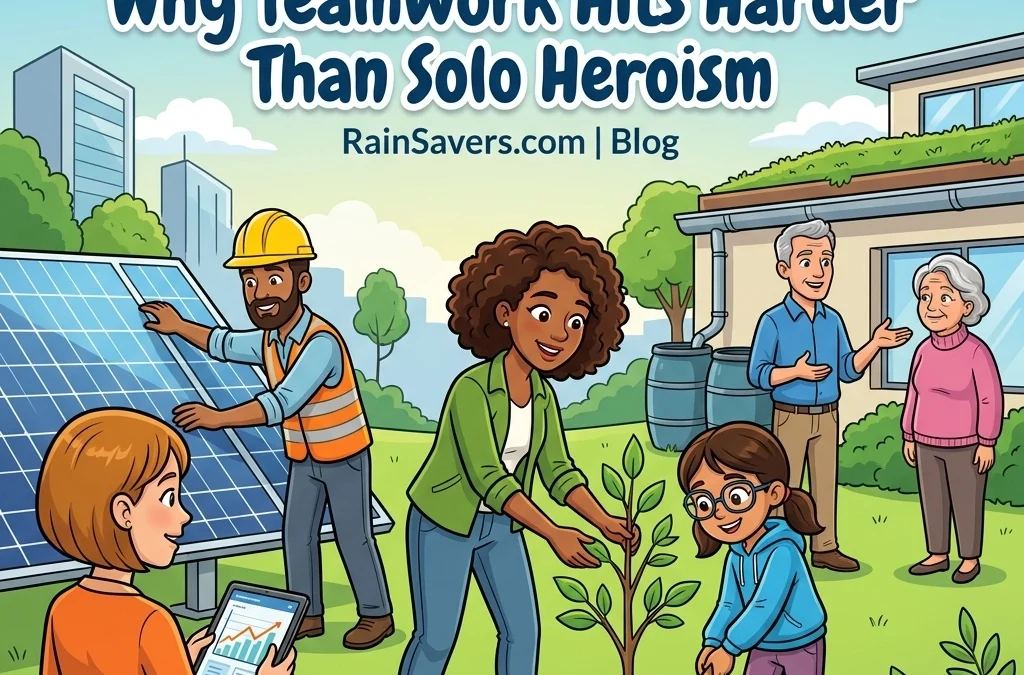
And visually? Teamwork looks like:
- coordinated movement
- hand signals
- gear checks
- someone watching the perimeter while someone else does the delicate thing
That’s not just heartwarming. It’s competence, which is wildly comforting in 2026.
 )
)
Team Roles: The Real “Superpowers” Readers Recognize Now
If you want eco-hope that feels current, give your team different kinds of power, not just different flavors of the same punch.
Here are roles that hit especially hard in 2026 storytelling (and in real life):
- The Listener: Earns trust, spots what others miss, doesn’t bulldoze communities with “solutions.”
- The Builder: Can turn a half-formed idea into something that works under pressure.
- The Translator: Bridges science ↔ public ↔ politics ↔ culture without making anyone feel dumb.
- The Risk Manager: The unsexy genius who asks, “Okay, but what if it rains for three weeks?”
- The Connector: Knows who to call, how to coordinate, how to make a coalition happen fast.
- The Wild Card: Not reckless: just creative enough to find the third door when the first two are locked.
A solo hero can only embody so much without becoming a magical Swiss Army person.
A team makes capability feel believable.
And believable hope is the best kind.
“But Don’t We Still Need a Hero?” Yes. Just Not a Lonely One.
Let’s be honest: people still crave the hero moment.
They want the scene where someone steps forward, takes responsibility, and says:
“I’ve got this.”
Teamwork doesn’t erase that. It reframes it.
In 2026, the hero moment looks more like:
- volunteering to be the negotiator
- owning a mistake publicly
- staying behind to stabilize the plan
- choosing the team’s safety over personal glory
- making the call that keeps the mission aligned with its values
The new hero flex is accountability, not isolation.
Micro-Scene Break: “Solo Mode” vs “Squad Mode”
SOLO MODE (classic):
Hero: “I work alone.”
Mission: explodes
Hero: “I meant I explode alone.”
SQUAD MODE (2026 eco-hope):
Team: “We work together.”
Mission: partially explodes anyway
Team: “Cool. Containment plan. Everybody breathe. Next step.”
If you want eco-hope, you need characters who can handle imperfect wins: because that’s what environmental progress often looks like:
- less harm
- slower damage
- better systems
- fewer losses next time
Teamwork holds space for that kind of victory without turning it into a downer.
Why This Hits in Fiction: Teamwork Lets You Tell Bigger, Richer Stories
From a storycraft angle, teams give you:
- More angles on the same problem (science, culture, ethics, humor, grief)
- More tension (conflicting priorities, different risk tolerances)
- More earned wins (solutions stitched together, not conjured)
- More replay value (readers pick favorites, argue about decisions, re-read for dynamics)
And if you’re writing eco-adventure, teamwork lets you show that “saving the day” isn’t one action: it’s a sequence:
- detect
- plan
- act
- adapt
- repair
- learn
That’s modern eco-hope: iterative courage.
Where The Rainsavers Fits: Adventure With a “Crew Brain” (and Big Heart)
At The Rainsavers, we’re obsessed with the spark of a bold individual… and the realism of a mission that takes coordination.
Because the truth is:
- A single character can inspire you.
- A team can convince you change is possible.
If you want to explore the world, characters, and the kind of eco-adventure where teamwork isn’t background decoration, start here:
https://rainsavers.com
And if you’re the type who likes to meet the crew first (valid), you can browse character info here:
https://rainsavers.com/characters
Field Toolkit: 7 Teamwork Principles That Make Eco-Hope Feel Real (Not Corny)
1) Shared mission, different motives
Everyone can want the same outcome for different reasons. That’s not weakness: it’s realism.
2) Conflict that isn’t betrayal
Not every argument is a plot twist. Sometimes it’s just… people caring differently.
3) Trade-offs acknowledged out loud
Eco-hope in 2026 doesn’t pretend solutions are free. It shows the cost: and chooses anyway.
4) Local knowledge treated like a superpower
No “outsider genius fixes everything.” Teams win by listening.
5) Plans that include failure
Not pessimistic: prepared. A good team expects turbulence.
6) Small wins counted
Because small wins are what add up to momentum.
7) Credit is shared
Nothing kills eco-hope faster than “one person gets the glory while everyone else becomes furniture.”
Debrief Addendum: The Real Reason Teamwork Feels Hopeful in 2026
Because it answers the quiet fear people carry:
“What if I can’t do enough?”
Team stories respond with:
“Good. You were never supposed to do it alone.”
That’s the emotional core of eco-hope right now. Not denial. Not perfection. Not a lone savior.
Just a group of people: messy, skilled, stubborn: choosing to coordinate anyway.
CTA (Pinned to the top of the mission board)
Solo bravery is cool. Team bravery is how things actually change.
See how we blend both: https://rainsavers.com
