Hey there, Rainsavers family! Steven G. Samuels here.
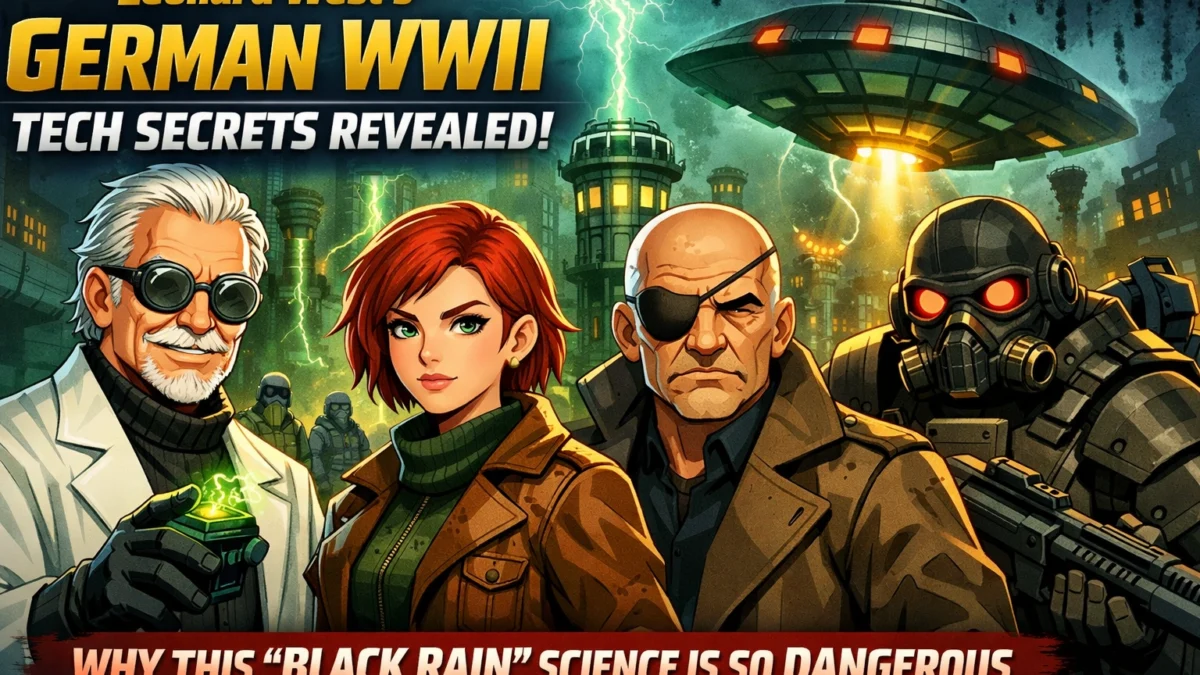
It’s Sunday, March 15, 2026, and if you’ve been keeping up with our latest releases, you know the world of The Rainsavers is getting a little more intense by the day. We’ve had a lot of questions hitting our inbox about the "science" behind our latest antagonist, Leonard West. Specifically, everyone wants to know: Is the German WWII tech featured in Black Rain based on reality? And why is it so much more dangerous now, in 2026, than it was eighty years ago?
Grab a coffee, settle in, and let’s go "down the rabbit hole." We’re declassifying the secrets of Leonard West’s arsenal today.
The Ghost of Operation Paperclip
To understand Leonard West, you have to understand where he gets his toys. Most history buffs know about Operation Paperclip: the secret program that brought German scientists to the U.S. after World War II to help us win the Space Race.
But in the world of The Rainsavers, there was a "secondary tier" of tech that never made the history books. While some scientists were building rockets, a darker cell was working on "Atmospheric Influence." They weren't just trying to predict the weather; they were trying to weaponize it.
Leonard West didn't just stumble upon this. He spent decades: and a massive fortune: tracking down lost journals and hidden bunkers. What he found wasn't just old blueprints; he found the foundation for what we now call Black Rain Science.

What Exactly is "Black Rain"?
In 2026, we’re already dealing with unpredictable climate patterns. But Leonard West’s "Black Rain" isn't a natural phenomenon. It’s a synthetic, aerosolized compound derived from experimental German WWII tech.
Here is the breakdown of why this science is a total game-changer for a villain:
- Molecular Bonding: The compound attaches to natural water vapor in the atmosphere. Once it bonds, it changes the weight and acidity of the rainfall.
- The "Black" Effect: It’s not actually ink-black. The name comes from the way the chemical reaction absorbs light, making the clouds look unnaturally dark and heavy: a visual warning that something is very wrong.
- The Bioweapon Component: This is where it gets scary. The original WWII research focused on dispersing nerve agents through rain. West has modernized this, using 2026 nanotechnology to ensure the "rain" doesn't just wet the skin; it permeates it.
If you want to see how our heroes react to this threat, check out our character bios to see who has the guts to face a literal poison sky.
Why 2026 is the Perfect Storm for This Tech
You might be wondering: "If this tech existed in the 40s, why didn't the Nazis use it?"
The answer is simple: The environment wasn't broken enough yet.
In the 1940s, the atmosphere was relatively stable. To trigger a "Black Rain" event back then, you would have needed an impossible amount of energy. But in 2026, with our current climate instability, the atmosphere is like a tinderbox. Leonard West doesn't need to create a storm from scratch; he just needs to "nudge" the ones that are already forming.
By using modified German WWII tech, West can hijack a standard tropical depression and turn it into a targeted biological strike. He’s not fighting the weather; he’s leading it like an army. This is why the eco-adventure genre is so relevant right now: the threats aren't just guys with capes; they are the very elements we depend on for life.

The Tactical Field Respirator: A 2026 Necessity
If you look at the cover art for Black Rain, you’ll notice the Rainsavers team isn't just wearing standard gear. They are equipped with high-tech tactical field respirators.
Why? Because Leonard West’s tech makes the very air you breathe a weapon. In a high-tech lab setting, this science looks like progress. In the field, it looks like a nightmare. These respirators are the only thing standing between our heroes and a lungful of West’s "synthetic atmospheric catalyst."
It’s a classic battle of ancient technology vs. modern threats. West is using the ghosts of the past to haunt the survivors of the present.
Who is Leonard West, Really?
We’ve had some fans ask in our recent poll if West is just a "crazy scientist" trope.
Honestly? He’s much more than that. West represents the ultimate corporate greed mixed with a god complex. He doesn't want to destroy the world; he wants to "reset" it. He believes that by using this German WWII tech, he can wash away the "failures" of modern society and start over with himself as the architect.
He’s the kind of villain that makes you question the ethics of scientific discovery. Just because we can unlock these secrets, should we?

How The Rainsavers Fight Back
Our team doesn't have superpowers. They have grit, expertise, and a deep love for the planet. While West uses science to dominate, The Rainsavers use it to protect.
This team-based approach is what makes the series so compelling in 2026. As we’ve discussed in our blog post about why team-based adventures are taking over, no one person can stop a threat like Black Rain. It takes a hydrologist, a former spec-ops pilot, and a tech genius working in perfect harmony to even stand a chance.
Join the Adventure
If you’re feeling that "climate anxiety" (which, let’s be real, most of us are in 2026), diving into a story where heroes actually do something about it can be incredibly cathartic. We’ve even written a guide on how eco-fiction can help with climate anxiety.
Leonard West’s secrets are out, but the battle is just beginning. The "Black Rain" is falling: are you ready for it?
Quick Links for the Super-Fans:
- Want the gear? Check out the shop.
- Missed an episode? Catch up here.
- Think you can solve the mystery? Enter our Down the Rabbit Hole contest before it’s too late!
The science is dangerous, the stakes are high, and the rain is starting to fall. Don't get caught without your respirator.
Read Book Two: Black Rain and see if the world survives Leonard West’s vision.
Stay safe out there,
Steven G. Samuels
CEO, The Rainsavers

Curious about more eco-adventure thrills? Visit rainsavers.com for the latest updates on our mission to save the planet, one book at a time.
