
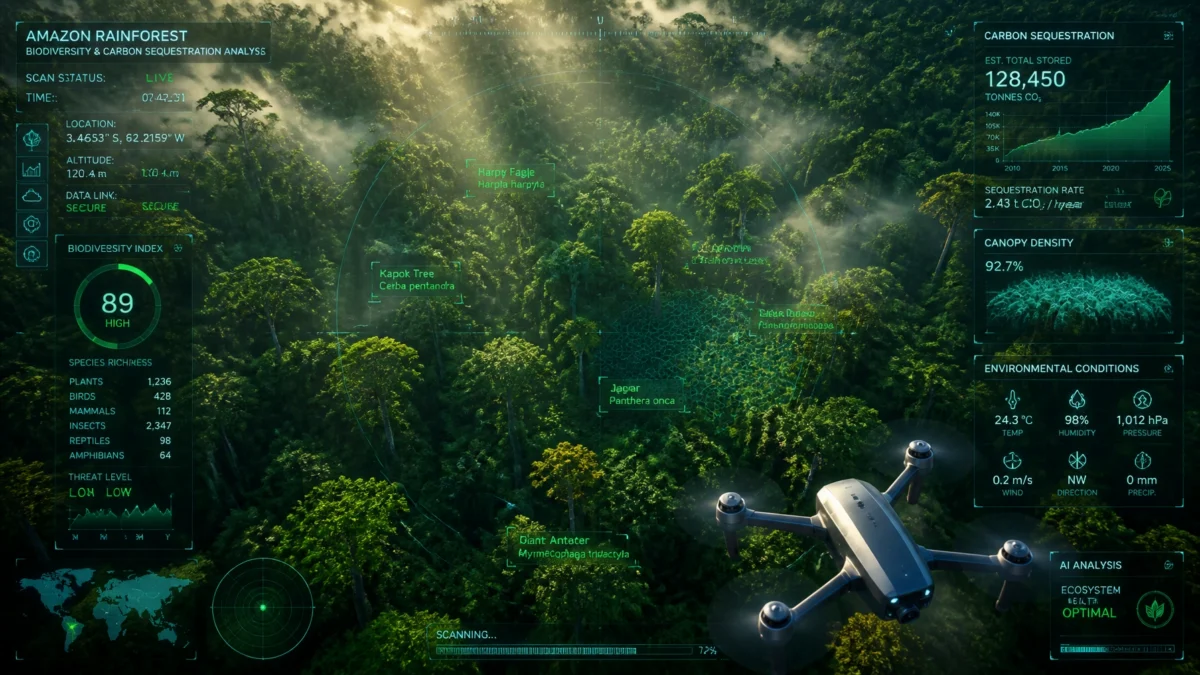
It’s May 2026, and if you haven’t checked the news lately, the Amazon is still the hottest topic on the planet, literally and figuratively. But here’s the thing: we’ve spent decades looking at the rainforest through the lens of dry statistics and sad commercials. In 2026, there's a new way to see the "lungs of the world," and it involves ancient tech, superhuman heroes, and high-stakes science fiction.
At The Rainsavers, we believe that fiction can sometimes tell a more powerful truth than a spreadsheet. By blending environmentalism with the thrill of a sci-fi epic, we’re changing the way readers connect with the wild.
Here’s why science fiction is the secret weapon for saving the Amazon.
1. It Turns the Rainforest Into a Main Character
In most stories, the jungle is just a backdrop, a place where the action happens. In sci-fi environmentalism, the forest is the story.
In our six-book series, the Amazon isn't just a bunch of trees; it’s a living, breathing system under siege. When you read about the Spirit Tree in Book Five: Curse of the Spirit Tree, you aren’t just reading about a plant. You’re reading about the heart of an ecosystem. Sci-fi allows us to personify nature, making the loss of a single acre feel as personal as a wound to a friend.

2. Tropes Make the Message "Stick"
Let's be real: climate anxiety is heavy. Most people tune out when they hear the words "biodiversity loss." But give them a hero like Tom "Primal" Swift, a man granted superhuman strength, and an intelligent orangutan named Alpha, and suddenly the mission to stop deforestation feels like an adventure you want to be part of.
- Superhuman Strength: Represents the "muscle" humanity needs to exert to protect the wild.
- The Tech: Characters like Sunbyte show how we can use digital tools to defend physical spaces.
- The Stakes: It's not just "save the trees"; it's "stop the bioweapon before it mutates the planet."
By using these high-octane tropes, we make the environmental message exciting rather than exhausting.
3. Ancient Tech vs. Modern Greed
One of our favorite things to play with is the idea of German technology from the 1940s hidden deep in the jungle. Why? Because it represents the ghosts of our past coming back to haunt our future.
In Book Two: Black Rain, the team is chasing exotic weapons and bioweapons developed by rogue agents like Leonard West. This isn't just cool sci-fi fluff, it’s a metaphor for how old-world thinking (extraction at any cost) is still clashing with the modern need for conservation.

The search for Red Mercury crystals powers the plot, but it also highlights how we treat natural resources. Are they just fuel for our "weapons," or part of something more sacred?
4. The "Spirit Tree" as the Ultimate Metaphor
If you’ve followed the series through to Book Six: Wrath of Mortalis, you know that the Spirit Tree is the ultimate prize.
In the real world, the Amazon is at a "tipping point." If we lose too much, the whole system collapses into a dry savanna. In The Rainsavers, that tipping point is represented by the Spirit Tree. If Mortalis seizes its power, the rainforest is gone.

This kind of storytelling helps us visualize what "tipping point" actually means. It’s not just a line on a graph; it’s a battle for the soul of the Earth.
5. Why Sci-Fi is Perfect for 2026
The world has changed. We’re more connected than ever, but we’re also more aware of how fragile our environment is. Sci-fi environmentalism works because it:
- Escapism with a Purpose: You get the thrills of an action movie, but you leave with a deeper respect for the Amazon.
- Global Stakes: It shows that what happens in a remote corner of Brazil affects a Nazi-era moonbase (yes, really!) and the entire globe.
- Hope: Even when things look dark: like when Mortalis activates a reactor under the Giza Pyramid: the Rainsavers keep fighting. It reminds us that action is always possible.
Meet the Villains: Bossman and West
No good story is complete without the people who want to see the world burn (or, in this case, be paved over). Bossman represents corporate greed, while Leonard West is the rogue agent who takes it to a sci-fi extreme.
Their assault on the rainforest in The Rainsavers mirrors the real-world threats of illegal mining and land grabbing, but with much cooler (and scarier) gadgets.

Conclusion: The Adventure is Just Beginning
The Amazon is more than just trees. It's a mystery, a treasure, and our best defense against a changing climate. By looking at it through the lens of science fiction, we don't just see a "problem" to be solved: we see a world worth fighting for.
Are you ready to join the mission?
See how we blend action with a mission: Read Book One now.
