
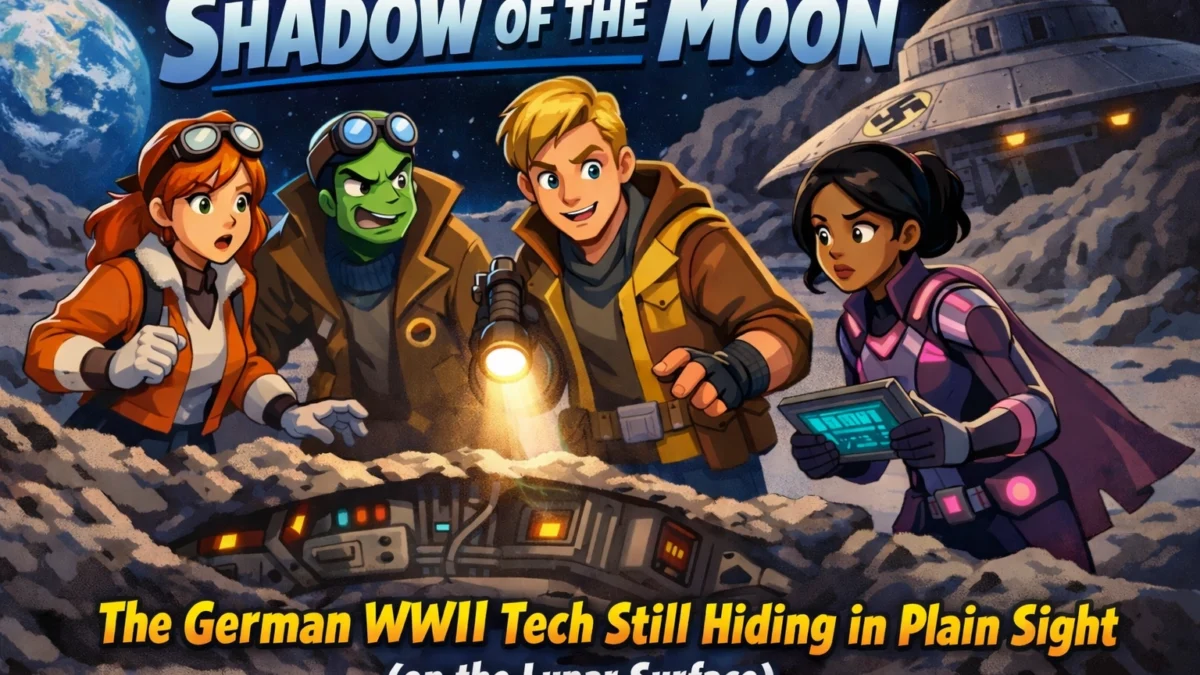
It’s Friday, March 13th, 2026. You’d think by now we’d have all the answers about what’s sitting up there on that big glowing rock in the sky. We’ve got rovers, private lunar tourism is almost a thing, and we’re closer than ever to permanent colonies. But here at The Rainsavers, we’re obsessed with the stuff that doesn't make it into the official NASA press releases.
You’ve seen the headlines about "unidentified lunar structures." You’ve heard the whispers in the darker corners of the internet. But if you want to understand what’s actually happening on the lunar surface today, you have to look back at the shadows of the 1940s.
Is there actually German tech on the Moon? It depends on how you define "on the Moon."
The Paperclip Connection: A Legacy That Never Left
Let’s get the "real world" history out of the way first, because the truth is actually weirder than the fiction. Back in the day, after WWII, the US government initiated Operation Paperclip. They scooped up over 1,600 German scientists: many of whom had deep ties to the German party: and brought them stateside to jumpstart our rocket program.
Wernher von Braun, the guy who designed the V-2 rockets that rained down on London, literally became the architect of the Saturn V. Every time you see that iconic footage of the Apollo 11 launch, you’re looking at technology born from a very dark era.
In a way, German tech didn't just land on the Moon in 1969; it built the ladder to get there. But in the world of The Rainsavers, we like to ask the question: What if they didn't stop at the blueprints?

The 2026 Mystery: Why We’re Looking Up Again
Flash forward to today. It’s 2026, and the world is a different place. We’re dealing with climate shifts, resource wars, and a desperate need for new solutions. In our book series, our heroes often find themselves clashing with threats that blend ancient mysteries vs. modern threats.
Lately, our research (and a bit of creative liberty) has us looking at the lunar poles. There are "permanently shadowed regions": craters where the sun never shines. If you were going to hide high-yield tech, experimental energy modules, or a tactical base, that’s where you’d put it.
Why the Moon? Because the Moon is the ultimate "high ground." In the tactical world, if you control the Moon, you control the orbital lanes of Earth.
Tactical Gear for the Lunar Frontier
If you were a member of a specialized recovery team heading to the lunar surface to investigate a "ghost" signal from a 1940s-era frequency, you wouldn't be wearing a puffy white marshmallow suit. You’d be looking at high-stakes, tech-integrated tactical gear.
We’re talking:
- Aero-Graphene Plating: Lightweight enough for 1/6th gravity but strong enough to stop micro-meteoroids (or a stray kinetic round).
- Integrated Heuristics: HUDs that can highlight thermal signatures through three meters of lunar regolith.
- Closed-Loop Recyclers: Because when you’re hunting ghosts in a crater, you can’t exactly pop out for a breath of fresh air.
Our brand is all about the "Eco-Adventure" vibe, but let’s be real: sometimes saving the planet requires a little bit of tactical intervention. Whether it's stopping a modern villain from using ancient tech or uncovering a secret that’s been buried since 1945, the gear has to be top-tier.

The "Hidden" Tech: Is It Still Active?
Here is where the "weird-fun internet energy" kicks in. There have been persistent rumors about the "Schwarze Sonne" (Black Sun) projects. While mainstream science says it’s all bunk, the fiction world knows better.
In the 2026 landscape of The Rainsavers, we explore the idea that some of this tech wasn't just abandoned: it was parked.
- Long-range frequency emitters buried under the Sea of Tranquility.
- Subsurface bunkers designed to withstand centuries of radiation.
- Autonomous drones that use vintage logic gates but modern power cells.
Mixing historical mysteries with sci-fi creates the kind of unstoppable villains that keep our readers up at night. If you want to dive deeper into why these kinds of threats are so effective in fiction, check out our guide on Ancient Technology vs. Modern Threats.
Why The Rainsavers Are Involved
You might be wondering: "What does a group of eco-adventurers care about German tech on the Moon?"
It’s simple. Everything is connected. In our universe, the environmental stability of Earth is often tied to external influences. If there’s a device on the lunar surface messing with Earth’s magnetic field or tidal patterns, it becomes an "Eco-Emergency."
Our team doesn't just plant trees; they dismantle global (and extra-global) threats. We believe the hero of 2026 isn't a lone wolf with a cape, but a specialized team with the right tools and the right mindset. That’s why we’ve moved past the "solo hero" trope. You can read more about that shift here: Are Solo Hero Stories Dead?.

What’s Hiding in the Crater?
Imagine a tactical team descending into the Shackleton Crater. Their lights cut through a darkness that hasn't seen a photon in billions of years. Suddenly, the beam hits something metallic. It’s not a modern alloy. It’s stamped with a serial number that shouldn't exist. It’s a piece of specialized tech that looks like it belongs in a 1940s lab but is powered by a cold fusion core.
That’s the "Shadow of the Moon." It’s the idea that the past isn't just behind us: it's potentially hovering right over our heads, waiting to be rediscovered.
Join the Mystery
If you’re a fan of high-stakes adventure, tactical gear, and mysteries that span decades, you’re in the right place. We’re currently running our Down the Rabbit Hole Contest, and we’d love to see where your imagination takes you regarding these lunar mysteries. You can jump in right here: Join the Contest.
The world of 2026 is full of wonders, but it’s also full of secrets. At The Rainsavers, we’re committed to digging them up: one page at a time.

Final Thoughts from the CEO
Look, we know the "German WWII Moon Base" thing sounds like something from a late-night radio show. But when you look at the real history of Operation Paperclip and the sudden leap in tech we had in the mid-20th century, it’s fun to pull at the threads.
Whether you’re here for the tactical gear, the environmental message, or just a damn good story, we’re glad to have you in the crew. Keep looking up, keep asking questions, and maybe keep a tactical flashlight handy. You never know what’s lurking in the shadows.
Stay adventurous,
Steven G. Samuels
CEO, The Rainsavers
P.S. If you want to see our team in action (and maybe spot some of that lunar tech we've been hinting at), go check out our latest episodes over at rainsavers.com/episodes. See you in the craters!
