
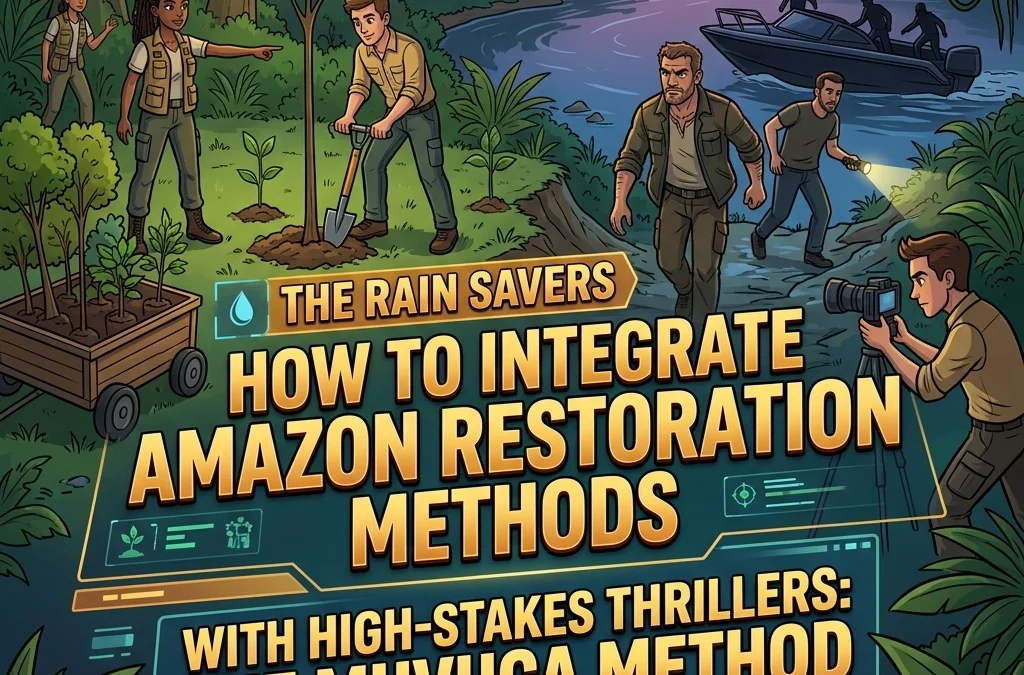
Meta description: Discover how the Muvuca method, a revolutionary Amazon restoration technique, powers the high-stakes eco-adventures of The Rainsavers. Real science meets page-turning thrills!
ALT text: A tactical expedition team in rugged gear carefully planting diverse native seeds in a cleared Amazonian forest plot.
Hey everyone, Steven G. Samuels here!
As the CEO of The Rainsavers, I get asked a lot about how we balance the "science" part of our eco-thrillers with the "thriller" part. You know, the explosions, the narrow escapes, and the high-tech gadgetry. People often think that environmental restoration is just… well, slow. They imagine a guy with a shovel planting one tree at a time while a villain in a helicopter laughs in the distance.
But what if I told you there’s a restoration method so aggressive, so efficient, and so "chaotic" that it actually fits perfectly into a high-octane adventure?
Enter the Muvuca method.
In the world of The Rainsavers, we don't just save the forest; we rebuild it using the same tactical precision our heroes use to take down environmental criminals. Today, I’m pulling back the curtain on how we integrate this real-world Brazilian restoration technique into our high-stakes narratives.
What on Earth is "Muvuca"?
If you’ve been hanging out in our eco-adventure community, you might have heard this term tossed around. In Portuguese, "muvuca" roughly translates to "a lot of people in a small place" or "a scramble."
In the world of forestry, it’s a direct-seeding technique that is absolute genius. Instead of nursing individual saplings in a greenhouse for months and then gingerly placing them in the ground, you create a "seed soup." You take hundreds of thousands of seeds from over 200 native species, pioneer trees, slow-growing hardwoods, shrubs, and ground cover, and you mix them all together.
Then, you spread them across the land all at once.

ALT text: A close-up of a diverse "seed soup" mixture containing hundreds of different tropical seeds ready for planting.
Why Muvuca is the "Action Hero" of Reforestation
Traditional reforestation is like a carefully choreographed ballet. Muvuca is a mosh pit. And that’s why it works so well for a thriller series. Here’s why it’s a game-changer for our characters:
1. It’s Fast (Like, Really Fast)
In a thriller, time is always running out. Our team doesn't have weeks to plant a forest. The Muvuca method can be up to 20 times faster than traditional planting. Whether it’s being spread by a tractor or, in the case of our more "expedited" missions, dropped via tactical drones, it covers ground at a pace that keeps the plot moving.
2. It’s Resilient
In the Amazon, the environment is hostile. Between the heat, the pests, and the occasional villainous plot, a single sapling doesn't stand a chance. But when you plant a "muvuca," you’re letting natural selection do the heavy lifting. The seeds compete and collaborate. The ones that are meant to survive, do. It’s survival of the fittest, which is a theme we love to explore.
3. It’s Cost-Effective
Saving the world is expensive. Real-world data shows that Muvuca is significantly cheaper than traditional seedlings. This allows our fictional "Rainsavers" organization to maximize their impact even when their funding is being squeezed by corrupt politicians or shadowy corporate interests.
Integrating "The Scramble" into the Narrative
When I’m working with the writing team on a new installment, we look for ways to make the restoration feel like part of the action. We don’t want a "commercial break" where the heroes stop to plant trees. We want the planting to be the climax.
Imagine this: The team has just secured a massive tract of land from an illegal logging operation. They know the loggers are coming back with reinforcements in 24 hours. They can't wait for a rainy season. They deploy the "Muvuca Protocol."
We’ve even discussed how Alpha Orangenius, our resident genius orangutan, might use his knowledge of forest layers to help "calibrate" the seed mix for specific soil types. It’s that blend of high-tech strategy and raw nature that makes The Rainsavers feel different from your average adventure book.

ALT text: A high-tech Rainsavers tactical drone flying over a cleared Amazonian area, releasing a specialized seed mix.
Field Notes: The "Oops" Moments
Because we like to keep things a bit lighthearted (and because things rarely go according to plan in the jungle), the Muvuca method provides some great comedic fodder.
In one of our upcoming "Field Notes" segments, you might see a certain team member accidentally mixing the seed bag with the "experimental spicy trail mix" bag. Let’s just say the resulting "forest" had a very different kick to it. These "oops" moments remind us that even the most advanced eco-heroes are human (or orangutan).
Why This Matters for Readers
You might be wondering, "Steven, why do you care so much about the specific method of planting?"
It’s simple: eco-fiction changes the way you think. When you read a thriller that uses real-world science like the Muvuca method, the stakes feel more real. You realize that the tools to save our planet actually exist. We aren't just making up "magic green beams" to fix the Amazon. We're highlighting techniques like the ones used by the Instituto Socioambiental (ISA) in Brazil, which has already restored over 11,000 hectares using these methods.
It turns the reader from a passive observer into someone who understands the how of environmental restoration.

ALT text: Local community members and the Rainsavers team working together to sort native seeds into large bags.
The Community Connection
One of the coolest parts of the Muvuca method is the "Redário" or Seed Networks. It requires thousands of people, often indigenous and local communities, to collect the seeds.
In our books, this is a major plot point. The Rainsavers aren't "lone wolves" (though some of our characters might act like it). They rely on local knowledge and community strength. This mirrors the real world, where seed networks have generated millions in income for local collectors in the Amazon and Cerrado regions.
It’s a team-based approach to saving the world, which we firmly believe is the future of the genre.
What’s Next for the Team?
As we move forward with the series, the "Muvuca Method" will continue to be a staple in the Rainsavers' toolkit. We're looking at ways to adapt it to different biomes, maybe a "Muvuca of the Seas" for coral restoration? (Okay, that one might need a different name, but you get the idea).
If you’re struggling with climate anxiety, I always recommend diving into stories where people are actually doing something about it. Seeing a team use real-world techniques to fight back against the odds is a great way to manage those feelings while getting your adrenaline fix.

ALT text: A flourishing, young, diverse forest showing multiple levels of growth just a few years after a Muvuca planting.
Ready to Join the Mission?
The Amazon is a big place, and the threats are real. But with the right methods, and the right team, there’s always hope. Whether it’s through the pages of our books or the real-life efforts of organizations in Brazil, the "Muvuca" is a reminder that beauty often comes from a bit of organized chaos.
If you want to see the Muvuca method in action (well, fictional action), there’s no better time to start than right now.
Read Book One now and see how the team handles the "scramble" for the first time!
Stay adventurous,
Steven G. Samuels
CEO, The Rainsavers
