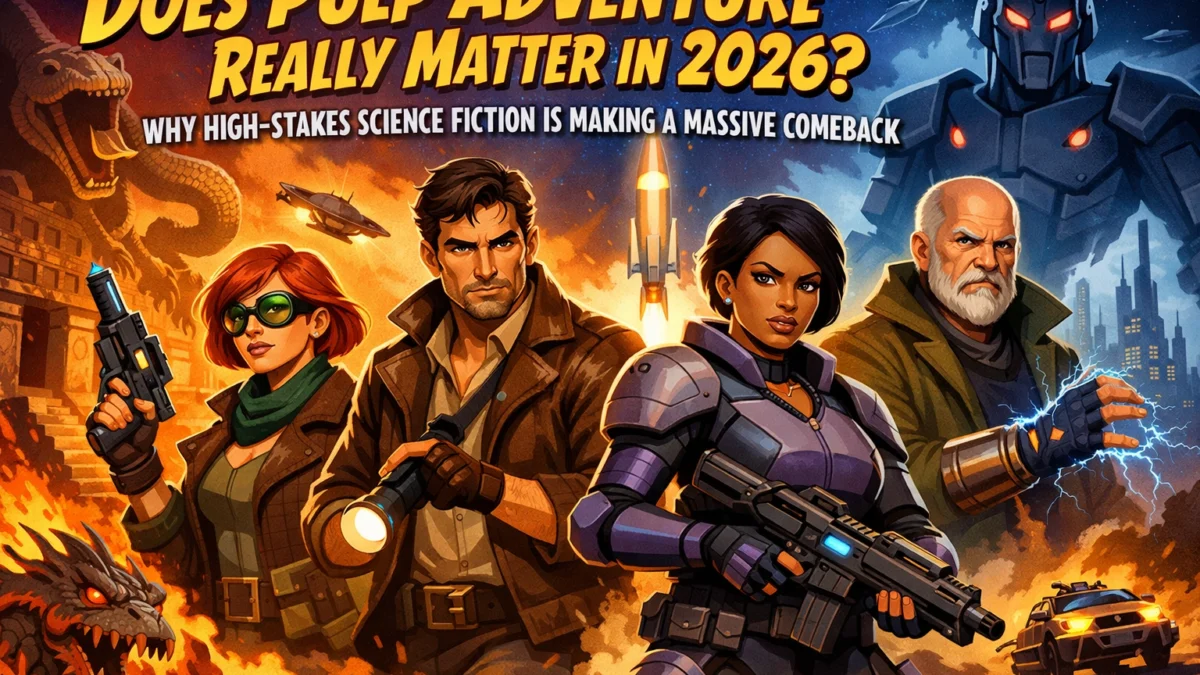
Meta Description: Is pulp adventure dead in 2026? Not a chance. Dive into why high-stakes science fiction and character-driven stories are making a massive comeback and how The Rainsavers are leading the charge into a new era of adventure.
Hey there, fellow adventurers!
It is officially March 2026, and if you take a look at the bestseller charts or the trending topics on your feed, you might notice something a little… retro. Amidst all the high-tech AI breakthroughs and the latest VR headsets, there’s a rumble coming from the world of fiction. It’s the sound of a roaring engine, the hiss of a mysterious chemical compound, and the frantic footsteps of a hero running through a jungle.
Pulp adventure is back, baby.
Now, I know what some of the "serious" critics are saying. They’ll tell you that pulp is a relic of the past, something meant for dusty paperbacks from the 1940s. They might even point to the fact that mainstream markets are "struggling" with new genres. But here at The Rainsavers, we see the truth on the ground. People aren't tired of adventure; they’re tired of boring adventure. They’re tired of stories where nothing is truly at stake.
In 2026, we’re seeing a massive pivot toward high-stakes science fiction that actually means something. Let’s talk about why the "New Pulp" movement is the only thing saving our reading lists this year.
The "New Pulp" Energy: It’s Not Just Your Grandpa’s Sci-Fi
When we talk about pulp adventure in 2026, we aren't talking about carbon copies of old stories. We’re talking about that specific energy. It’s the feeling that every chapter ends on a cliffhanger, the villains are genuinely terrifying, and the technology feels just a little bit too dangerous to be real.
In a world where we’re constantly bombarded with digital noise, there’s something incredibly refreshing about a story that just goes for it. High-stakes science fiction in 2026 is leaning hard into the "What If?" factor. What if a secret society has been hiding German WWII technology for eighty years? What if the key to saving the Amazon lies in a piece of ancient tech that defies modern physics?

ALT: A high-tech laboratory hidden deep inside a tropical rainforest, glowing with eerie blue light.
This kind of storytelling matters because it demands your attention. It’s not background noise. It’s immersive. Whether it’s Black Rain technology or the hunt for occult objects, these stories provide an escape that actually feels like an adventure.
Why Characters Come First (And Why Solo Heroes are Out)
One of the biggest shifts we’ve seen in 2026 is the move away from the "invincible solo hero." Let’s be real, watching one guy punch his way through an entire army without breaking a sweat is getting a little old. Today’s readers want to see a team. They want to see chemistry, conflict, and a group of people who actually need each other to survive.
That’s why we focus so much on our characters. In high-stakes sci-fi, the stakes only matter if you care about the people involved. If the world is ending but the main character is a cardboard cutout, who cares? But if you’ve got a team of eco-adventure experts, each with their own baggage, skills, and secrets, suddenly, every narrow escape feels personal.
We’ve actually talked about this quite a bit over on the blog, especially regarding why team-based adventure series are taking over. In 2026, the "pulp" vibe is being kept alive by the dynamic between the characters. It’s about the banter in the face of certain death. It’s about the tactical decisions made under pressure.
The Villains: Secret History and German WWII Tech
You can’t have a comeback for pulp adventure without great villains. And let’s be honest, 2026 has given us a craving for villains who are more than just "misunderstood." We want villains with resources, history, and a terrifying vision for the world.
In The Rainsavers universe, we lean into the mystery of "Secret History." There’s something inherently pulpy about discovering that the "impossible" technology of today actually has roots in the occult experiments and secret science of the German WWII era.

ALT: A shadowy figure inspecting a rusted but humming piece of German WWII machinery in a secret bunker.
When you mix historical mysteries with modern threats, you get a villainous motivation that feels grounded but also larger-than-life. It adds a layer of "truth is stranger than fiction" that keeps readers hooked. It’s not just about a bad guy wanting to take over the world; it’s about a legacy of dangerous ideas resurfacing in a time when the planet is at its most vulnerable.
High-Stakes Environmentalism: Eco-Adventure is the New Frontier
If there’s one thing that makes 2026 pulp different from the 1926 version, it’s the focus. Back then, it was often about "conquering" the unknown. Today, it’s about saving it.
We are living in an era of climate anxiety. It’s everywhere. But instead of just reading depressing news reports, people are turning to high-stakes eco-fiction. Why? Because it gives us a sense of agency. It turns the struggle for environmental protection into a thrilling, tactical mission.
The Rainsavers isn't just a book series; it’s a reflection of the idea that protecting the planet requires more than just good intentions, it requires action, tech, and a lot of courage. Whether it's protecting the Spirit Tree or stopping a bioweapon, these stories take real-world fears and turn them into a battle we can actually win (at least on the page!).
Is the Moon the Final Frontier for Pulp?
As we look toward the rest of 2026, the scope of pulp adventure is only getting bigger. We’re not just staying on Earth. There’s a reason people are getting excited about secrets under the lunar dust. The moon represents the ultimate "locked room" mystery.
Pulp has always been about the frontier. In the past, it was the deep ocean or the center of the Earth. In 2026, as private space flight becomes more common, the moon is the new "undiscovered country." If there’s ancient tech or a hidden base up there, you can bet a pulp hero is going to be the one to find it.

ALT: An astronaut standing at the edge of a lunar crater, looking at a glowing structure hidden in the shadows.
Why You Should Care
So, does pulp adventure really matter in 2026?
Absolutely. It matters because it reminds us why we fell in love with reading in the first place. It’s not about literary pretension; it’s about the thrill of the chase. It’s about the excitement of seeing a plan come together, or fall apart in the most spectacular way possible.
In a world that feels increasingly complicated, there’s a lot of power in a story that identifies a clear threat and sends a group of brave (and slightly snarky) people to stop it. It’s cathartic. It’s fun. And most importantly, it’s a wild ride.
If you’re struggling with "reading slumps" or just need an escape that actually gets your heart racing, it’s time to look back at the pulp roots and see how we’ve leveled them up for the modern age.
Ready to join the adventure? Check out our latest episodes and see how we’re redefining the genre. And hey, if you think you’ve got what it takes to join the team, keep an eye on our contests. The world isn't going to save itself, and we could always use more boots on the ground.
Stay adventurous,
The Rainsavers Team
Want more?
- Check out the Shop for the latest gear and books.
- Take our poll on the best sci-fi villains.
- Watch our TV commercial to see the action in motion!

ALT: The Rainsavers team standing together against a sunset, ready for their next mission.
Visit us at https://rainsavers.com to start your journey!
