
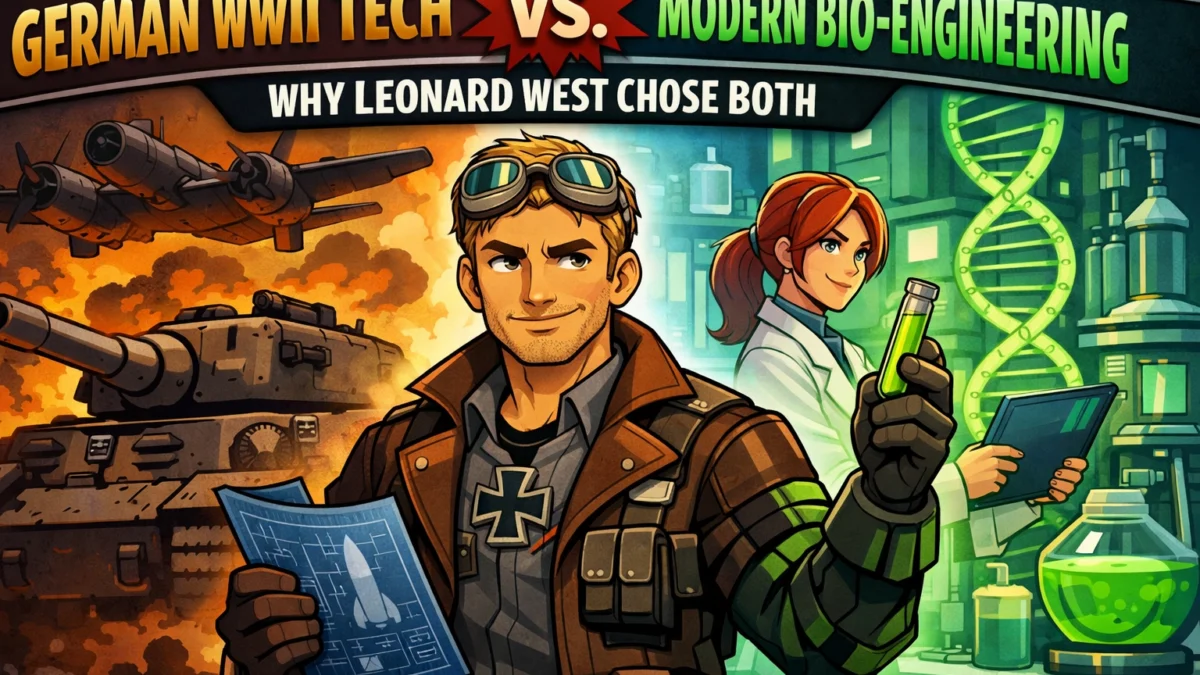
Meta Description: Compare the terrifying legacy of German WWII tech with modern bio-engineering. Discover why the villain Leonard West uses both to threaten the world in 2026.
It’s 2026, and you’d think we’d have moved past the ghosts of the 1940s. We have self-driving labs, AI that can predict the weather with 99% accuracy, and bio-printing that can replace a kidney in a weekend. But for Leonard West, the chilling antagonist in our latest adventures, the future isn’t just about looking forward. It’s about digging up the bones of the past and giving them a high-tech heartbeat.
If you’ve been following the journey at The Rainsavers, you know that West isn't your run-of-the-mill billionaire with a grudge. He’s a man who understands that to truly dominate the world, you need the raw, terrifying power of German WWII tech combined with the surgical, invisible precision of modern bio-engineering.
Why choose both? Why not just stick to the cutting-edge stuff? Let’s break down the method behind the madness.
The Brutality of the Past: Why German WWII Tech Still Scares Us
There is something inherently visceral about mid-century German engineering. It wasn't just about winning a war; it was about creating "Wunderwaffe", Wonder Weapons. These were machines designed to be so technologically superior that they felt like they belonged in a different century.
Leonard West recognizes that while modern tech is sleek and quiet, WWII tech was loud, heavy, and built with a terrifying singular purpose.
1. The Psychology of "Unstoppable" Machines
The V-2 rocket and the Me 262 jet weren't just weapons; they were statements of intent. When West digs into the archives of 1944, he’s looking for that "unbreakable" philosophy. He doesn’t want gadgets that break if they get dropped; he wants systems that can survive a nuclear winter.
2. The Prototype Factor
A lot of the tech we use today, from rocket engines to stealth coating, actually has its roots in secret German labs from the 40s. West isn't just a historian; he’s a scavenger. He finds the projects that were "too advanced" for the 1940s and realizes that with 2026 resources, they finally work.

The Stealth of the Future: Modern Bio-Engineering in 2026
Fast forward to today. Bio-engineering in 2026 isn't just about medicine; it’s about modification. It’s about CRISPR, gene-editing, and synthetic biology. While the old-school tech provides the "armor," the bio-engineering provides the "brain."
1. The Invisible Weapon
You can see a tank coming from miles away. You can’t see a genetically modified pathogen or a bio-engineered "sleeper" cell. For a villain like West, bio-engineering is the ultimate stealth tool. It allows him to infiltrate systems and ecosystems without firing a single shot. This is a recurring theme we explore in our posts about how eco-fiction changes the way you think about adventure.
2. Human Optimization
West isn’t just interested in machines. He’s interested in people. By using modern bio-engineering, he can create operatives who are faster, stronger, and more resilient than any natural human. He’s essentially trying to build the "Super Soldier" that the 1940s labs could only dream of, but with the benefit of 80 years of genetic research.

The Synthesis: Why Leonard West Chose Both
So, why the mashup? Why put a 1940s-inspired propulsion system inside a 2026 bio-drone? Because West understands the fatal flaw of relying on only one era.
Modern tech is fragile. It relies on satellites, global internet grids, and delicate microchips. One good EMP and your 2026 tech is a paperweight.
Old-school tech is clunky. It’s heavy, inefficient, and easy to track.
By merging the two, West creates a hybrid threat. He uses the analog reliability of German WWII tech to ensure his systems stay online when the world’s digital infrastructure fails. Then, he uses bio-engineering to give those systems an adaptive, "living" edge.
Think of it like this: If modern bio-engineering is the software, German WWII-inspired hardware is the unbreakable server it runs on. It’s a terrifying combination that forces The Rainsavers to look at history and science simultaneously. If you want to see how this plays out, check out our piece on ancient technology vs modern threats.
The 2026 Conflict: A World on the Edge
In the world of The Rainsavers, 2026 is a year of reckoning. The climate is shifting, and the traditional ways of protecting the planet are failing. Leonard West sees this chaos as an opportunity. He doesn’t just want to save the world; he wants to rebuild it in his own image, using his hybrid "Bio-Steel" philosophy.
This isn't just about gadgets. It’s about the philosophy of power. West believes that the "soft" world of 2026 has forgotten how to be "hard." He brings the brutality of the 1940s back to remind everyone what happens when science is left unchecked.

How The Rainsavers Fight Back
Our heroes don't have the luxury of a lab like West’s. They have to rely on teamwork, ingenuity, and a deep respect for nature. While West tries to dominate biology, the Rainsavers try to work with it. It’s a classic clash that we dive deep into when we talk about how team-based adventures are dominating 2026 fiction.
Field Notes: The "Oops" Factor in Villany
Even a genius like Leonard West has his off days. When you’re trying to weld a V-2 rocket engine to a synthetic heart, things tend to… well, explode.
One of our favorite (and funniest) moments in the drafting of Black Rain involved West trying to "bio-engineer" a more loyal guard dog, only to accidentally create a creature that was so intelligent it refused to work on weekends. It turns out that even with the best WWII blueprints and the latest CRISPR kits, nature still has a sense of humor.
We love these "oops" moments because they remind us that no matter how much tech you have, you can't control everything. That’s a lesson West has yet to learn, but one that the Rainsavers know all too well.
Why This Matters to You
You might be wondering, "Why should I care about a fictional villain's tech preferences?"
Because the stories we tell in 2026 reflect the world we live in. We are currently standing at the crossroads of history and a very fast-moving future. By looking at how Leonard West uses the past to weaponize the future, we get to ask ourselves: How do we want to use the tools we have today?
Are we going to build more "Wunderwaffes," or are we going to use our bio-engineering to heal the planet? At The Rainsavers, we’re betting on the latter.

Final Thoughts
Leonard West is a formidable foe because he isn't afraid of the dark parts of history. He embraces the terrifying efficiency of the past and marries it to the terrifying potential of the future. It’s a combination that makes him one of the most complex villains in modern eco-fiction.
If you’re ready to see this tech in action and watch the Rainsavers try to survive West’s "Bio-Steel" nightmare, there’s only one thing left to do.
Read Book Two: Black Rain
Grab your copy and see if the Rainsavers have what it takes to stop a villain who has 80 years of science on his side.
Hungry for more? Check out our blog page for more deep dives into the science and lore of the series, or jump into the Down the Rabbit Hole Contest to see if you can solve the mysteries yourself!
