
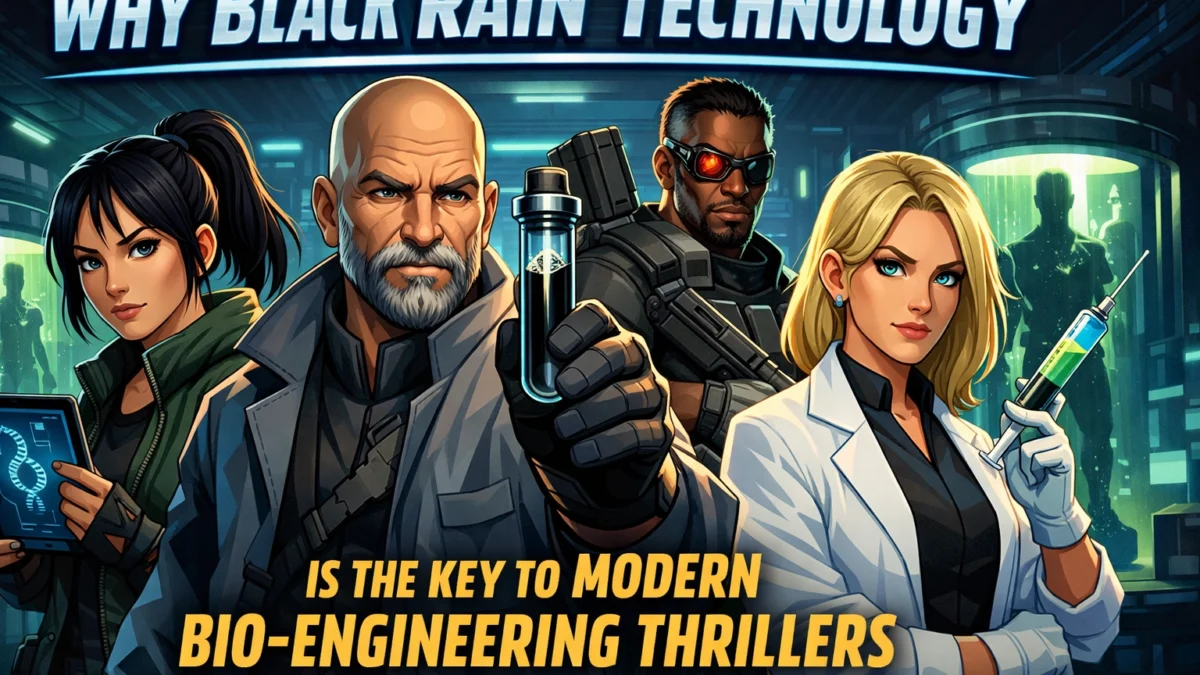
Meta Description: Dive into the high-stakes world of bio-engineering thrillers. Discover why Black Rain technology is the ultimate 2026 fictional threat and how The Rainsavers face a bioweapon that rewrites reality.
Alt text: A tactical field kit sitting on a rugged surface, containing glowing green and blue biological samples in reinforced vials, surrounded by high-tech scanning equipment.
Hey there, fellow adventure seekers and gear-heads! Steven G. Samuels here. It’s Tuesday, March 17, 2026, and if you’re reading this, you’re probably just as obsessed with the intersection of "what if" science and high-octane action as we are here at The Rainsavers.
Lately, the world of fiction has been shifting. We’re moving away from the "magic radiation" tropes of the past and into something much more visceral, much more tactical, and: let’s be honest: much scarier. We’re talking about Black Rain Technology.
If you’ve been following our journey, you know that the "Black Rain" isn't just a catchy title. It’s the core of a new era of bio-engineering thrillers. It’s the kind of tech that keeps you up at night because it feels like it could be happening in a lab just a few miles away.
The Shift from Sci-Fi to "Bio-Fi"
In 2026, the stakes have changed. Readers don’t want untouchable gods; they want grounded, tactical heroes facing threats that challenge the very fabric of nature. The old-school bioweapon was usually just a "green flu" that made people cough. Boring, right?
Modern bio-engineering thrillers use tech like Black Rain to explore programmable mutation. Imagine a delivery system: disguised as natural precipitation: that carries synthetic, gene-editing payloads. It’s not just about getting sick; it’s about your DNA being rewritten in real-time. That’s the "Black Rain" protocol, and it’s exactly why this sub-genre is dominating the charts right now.

Alt text: A digital rendering of a DNA strand being reconstructed by microscopic nanobots, glowing with a dark, iridescent light.
Why Bio-Engineering is the Ultimate Villain
Why does this work so well in a story? Because you can’t punch a virus. You can’t outrun a cloud of aerosolized mutagen. It forces characters to use their brains, their specialized gear, and their teamwork.
At The Rainsavers, we’ve always believed that eco-fiction will change the way you think about adventure stories. When the environment itself becomes the weapon, the tension never lets up.
Black Rain technology represents the ultimate perversion of nature. It takes the life-giving force of water and turns it into a carrier for corporate or rogue-state agendas. It’s tactical, it’s targeted, and it’s terrifyingly efficient.
Tactical Field Kits and Glowing Vials: The Aesthetic of 2026 Thrillers
One of the coolest parts of writing (and reading) about Black Rain tech is the gear. We’ve moved past the "lab coat" era. In a modern bio-thriller, the scientists are in the mud. They’re carrying tactical field kits, wearing environmental suits that look like something out of a spec-ops mission, and handling samples that glow with a deceptive beauty.
When we designed the world for The Rainsavers, we wanted that "near-future tactical" feel. We’re talking:
- Bio-Sensors: Real-time tracking of atmospheric mutagens.
- Neutralization Sprays: Immediate chemical counters to skin-contact pathogens.
- Sample Containment: Ruggedized, lead-lined cases for samples that are literally trying to evolve while you hold them.
This focus on equipment makes the threat feel "touchable." It’s not magic; it’s engineering. And when the engineering goes wrong, you need a team like The Rainsavers to step in.
The Team vs. The Tech
In the world of Black Rain, a solo hero doesn't stand a chance. You need a specialized squad. This isn't about capes or secret identities; it’s about a team of experts: engineers, ex-soldiers, and environmental specialists: working together to contain a biological wildfire.
We’ve seen a huge trend where team-based adventure series are taking over, and for a good reason. When you’re facing a bioweapon like Black Rain, you need someone to run the sequence, someone to hold the perimeter, and someone to fly the extraction bird.

Alt text: A team of four eco-adventure specialists in tactical gear, standing in a rain-slicked jungle, looking at a high-tech holographic map.
Why "Black Rain" Technology Hits Different
The concept of "Black Rain" specifically taps into our modern climate anxiety. We’re already worried about what’s in our air and our water. By taking those real-world fears and cranking them up to eleven with high-tech bio-engineering, we create a story that resonates on a deeper level.
It’s not just a "monster movie." It’s a "what if we lost control of the tools we used to fix the world?" movie. It’s that intersection of ancient technology vs. modern threats that makes for an unstoppable villain motivation.
The Science (Fiction) of Mutation
In Book Two: Black Rain, the technology isn't just a plot device: it’s a character. The way the mutation interacts with the local flora and fauna of the rainforest creates a shifting battlefield. One minute you're worried about the rain, the next you're dealing with a jaguar whose muscle density has been tripled by a stray gene-strand.
This is why bio-engineering thrillers are the key to the future of the genre. They allow for "monsters" that feel earned and grounded. They aren't aliens from another planet; they’re the results of a lab error or a greedy corporation's "efficiency" program.

Alt text: Close-up of a futuristic syringe being filled with a shimmering, jet-black liquid that seems to move with a life of its own.
Staying Grounded in a High-Tech World
Even with all this "Black Rain" tech flying around, the best stories stay grounded in human (and animal!) emotion. That’s why we love characters like Alpha Orangenius or Primal. They provide the heart in a world dominated by cold, hard science.
The tech is the "how," but the characters are the "why." Why do we fight? To keep the natural world from being overwritten by a corporate algorithm. It’s a fight for the soul of the planet, fought one vial of antidote at a time.
Why You Need to Read "Black Rain" Now
If you’re looking for your next binge-worthy read, you’re in the right place. We’ve put together the ultimate guide to climate fiction, and you'll see exactly where The Rainsavers fits in.
The world of 2026 is moving fast. Bio-engineering is no longer a distant dream: it's our current reality. Seeing how our heroes handle the most extreme version of that reality is what makes these books so addictive.
The tactical gear, the glowing samples, the frantic races against a ticking biological clock: it's all there. And it all starts with that first drop of "Black Rain."

Alt text: A rugged, mud-cattered hand holding a high-tech communicator showing a "BIO-HAZARD DETECTED" warning in red text.
Final Thoughts from the CEO
Look, I might be biased, but I think the "Black Rain" tech we’ve developed for this series is some of the most exciting stuff in modern publishing. It’s fast, it’s smart, and it’s unapologetically tactical.
We’re not interested in the same old stories. We want to push the boundaries of what an adventure series can be. Whether you're here for the science, the gear, or the team dynamics, there’s something in this bio-engineered thriller for you.
So, are you ready to gear up and face the storm?
The vials are prepped. The extraction team is on standby. All that’s left is for you to dive in.
Read Book Two: Black Rain now.
For more updates on our latest releases and to dive deeper into the world of eco-adventure, head over to Rainsavers.com. Stay safe out there, and watch the skies!
: Steven G. Samuels, CEO, The Rainsavers
