
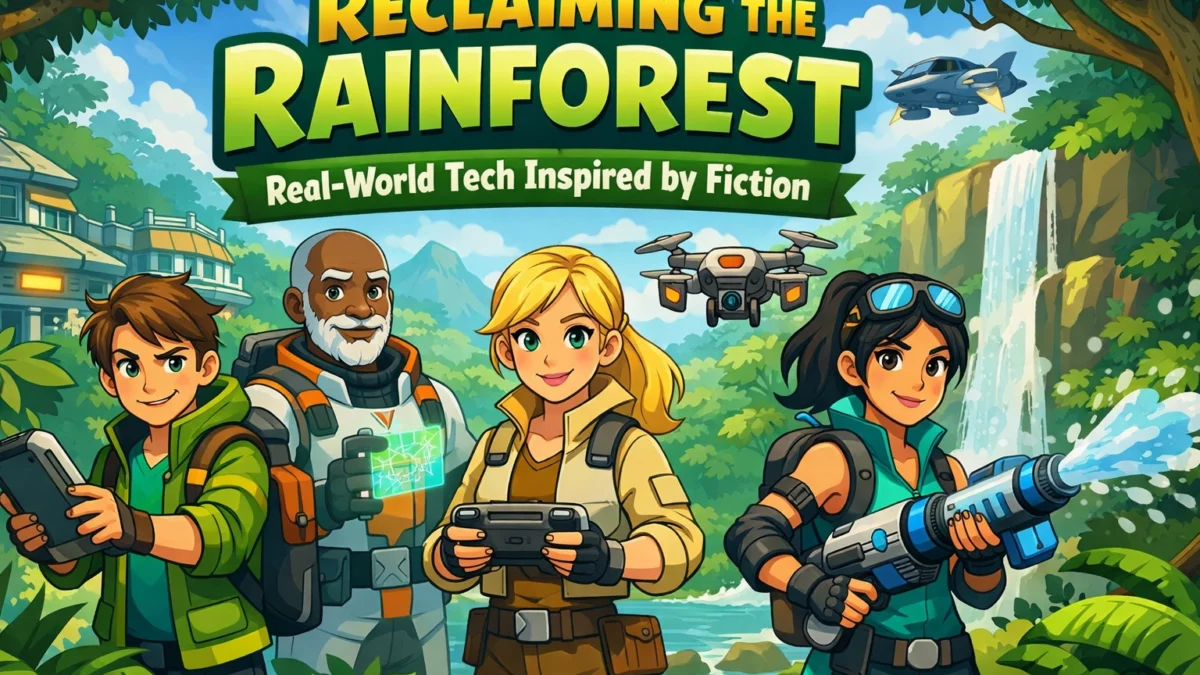
Meta Description: Discover how science fiction is becoming science fact in the fight to save our forests. From seed-planting drones to LiDAR mapping, explore the real-world tech inspired by the eco-adventures we love.
Hey there, fellow adventurers! Steven G. Samuels here.
Ever pick up a book and think, "Man, if only we had that gadget in real life, the world would be a much better place"? We’ve all been there. Whether it’s a device that cleans the ocean in a single pass or a fleet of robots that can replant a forest overnight, fiction has always been the playground where we test-drive our wildest dreams for the planet.
At The Rainsavers, we spend a lot of time dreaming up ways for our characters to save the world. But here’s the cool part: life is starting to imitate art. The tech we used to think was "too sci-fi" is actually hitting the ground (and the canopy) right now. We’re moving past the era of "doomsday" stories and entering the age of Eco-hope.
If you’ve been following our 6-book adventure series, you know that our team uses a mix of grit, ancient mysteries, and high-tech wizardry to protect the lungs of our planet. Today, let’s take a look at the real-life tech that sounds like it was ripped straight out of a Rainsavers mission.
The Sky is Falling… Seeds!
In many of our stories, we imagine heroes who can cover vast distances to restore balance to the environment. In the real world, we have something just as cool: Drone-based seed deployment.
Imagine a fleet of heavy-duty drones humming over a desolate, deforested patch of the Amazon. Instead of just taking photos, these drones are "firing" seed balls into the soil with the precision of a marksman. This isn't just a fun idea; it’s a reality being pioneered by companies like Flying Forests.
These drones use NASA-level tech: remote sensing and AI: to decide exactly where a seed has the best chance of survival. A small team of four drones can theoretically plant 40 million trees a year. That’s the kind of scale we usually only see in adventure novels. It reminds me a lot of how Jungle Dart, our teen protector, uses his deep knowledge of the forest to guide the team: except now, we’re using silicon and rotors to do it.

ALT: A fleet of specialized reforestation drones flying in formation over a clearing in a tropical forest, dispersing nutrient-rich seed pods.
Digital Ghosts: Seeing the Forest Through the Trees
One of the biggest challenges in conservation is actually knowing what’s happening deep inside the jungle. You can’t protect what you can’t see. In our books, Sunbyte, the hacker nurse, is always diving into data streams to find the hidden threats.
In the real world, scientists are using LiDAR (Light Detection and Ranging) to do exactly that. LiDAR uses laser pulses to create a 3D map of the forest that is so detailed you can see every individual branch and stem. It’s like giving the Earth a high-resolution CT scan.
This tech allows us to track forest recovery with "unprecedented precision." We’re no longer just guessing how much carbon a forest is storing; we can see it in 3D. This "digital twin" of the rainforest helps us fight back against illegal logging and understand how climate change is affecting tree growth in real-time. It’s the ultimate "hacker" tool for the environment.
The "Orangenius" of AI
We have a character named Alpha Orangenius: a literal genius orangutan who helps our team outsmart the villains. While we haven't found a genius ape in the wild just yet, we do have Artificial Intelligence that is acting as a force multiplier for conservation.
AI is currently being used to analyze hyperspectral satellite imagery to identify different species of trees from space. It can listen to the sounds of the rainforest through acoustic sensors and identify the "signature" of a chainsaw miles away, alerting rangers before the damage is done.
This blend of nature and machine is exactly why we believe mixing historical mysteries with sci-fi makes for such a compelling story. The villains might use tech to destroy, but our heroes (and real-world scientists) use it to reclaim.

ALT: A high-tech conservation monitoring station hidden in a lush jungle, featuring solar panels and AI-driven acoustic sensors mounted on a giant ancient tree.
Why Fiction Matters in the Fight
You might be wondering: "Steven, why are you talking about drones and lasers when you’re a book publisher?"
The answer is simple: Stories change the way we think about what’s possible.
For a long time, climate stories were just about the end of the world. They left people feeling stuck and anxious. But why eco-fiction will change the way you think is because it focuses on the action. When we write about team-based adventures, we’re showing that complex problems don't have "solo" solutions: they require a mix of skills, technologies, and perspectives.
Whether it’s the raw power of Primal or the digital expertise of Sunbyte, every member of the team matters. Real-world conservation is the same way. It’s not just about the person planting the tree; it’s about the coder who wrote the drone software, the investor who funded the carbon credits, and the reader who got inspired to care.
Bridging the Hero Gap
We’re currently seeing a massive shift in entertainment. People are moving away from the "lone wolf" superhero and toward team-based adventure series. Why? Because the challenges we face today: like reclaiming the rainforest: are too big for one person.
The tech we're seeing today, from Microsoft purchasing 1.8 million carbon removal credits to autonomous seeding fleets, is the result of thousands of people working together. It’s a real-life adventure story, and we all have a role to play.
If you’re feeling a bit of that "climate anxiety" we all talk about, I highly suggest looking into the tech being used for good. It’s hard to stay gloomy when you realize there are people out there literally engineering "Eco-hope."

ALT: A group of diverse young environmental scientists and engineers working together in a field lab at the edge of a vibrant rainforest.
Join the Adventure
At the end of the day, our books are about one thing: the belief that the world is worth saving and that we actually can do it. We use the rainforest as our backdrop because it’s the most vibrant, mysterious, and vital place on Earth. It’s the perfect setting for a modern environmental thriller.
But don't just read about the adventure: be part of it.
The real-world tech we've talked about today is just the beginning. As we continue to innovate, the line between the gadgets in our books and the tools in our hands will keep blurring. And that is a very good thing.
Ready to dive into the world of The Rainsavers?
If you want to see how our team uses high-tech gear and ancient wisdom to take on the bad guys, check out our full series. It's pulp adventure with a purpose, designed to entertain you while reminding you that the future isn't written yet: we're the ones holding the pen.
Click here to explore the world of The Rainsavers and start your adventure today!
Stay adventurous,
Steven G. Samuels
CEO, The Rainsavers
