Meta Description: Eco-anxiety got you down? Discover how The Rainsavers adventure series transforms climate dread into action-driven hope, no doom-scrolling required. Start reading today.

Look, it's February 2026, and if you're feeling that low-grade panic about the planet, welcome to the club. Eco-anxiety is real, it's exhausting, and honestly? Doom-scrolling through climate news at 2 AM isn't helping anyone.
But here's something weird that does help: adventure fiction.
Not just any beach read, though. We're talking about stories where heroes actually do something about environmental disasters. Stories where the Amazon rainforest gets a fighting chance. Stories where a ragtag team of specialists faces down corporate villains and ancient tech gone haywire, and wins.
Stories like The Rainsavers.
Why Your Brain Needs Action, Not Just Information
Let's get real for a second. You already know climate change is happening. You've read the reports. You've seen the headlines. You've felt that creeping sense of helplessness while standing in the recycling aisle wondering if your efforts even matter.
That's eco-anxiety in a nutshell: knowing something's wrong, feeling powerless to fix it, and carrying that weight around 24/7.
Here's the thing your brain desperately needs: proof that action leads to results. Not vague promises or distant policy changes, actual, visceral examples of people solving impossible problems through courage, teamwork, and refusing to quit.
That's where adventure fiction comes in.

How The Rainsavers Flips the Script on Climate Dread
The Rainsavers series doesn't sugarcoat the stakes. Book One drops you straight into the Amazon rainforest as it faces extinction-level threats. Ancient technology (powered by mysterious red mercury) has fallen into the wrong hands. Corporate greed is destroying ecosystems faster than anyone can stop it.
Sounds pretty bleak, right?
Except then you meet the team.
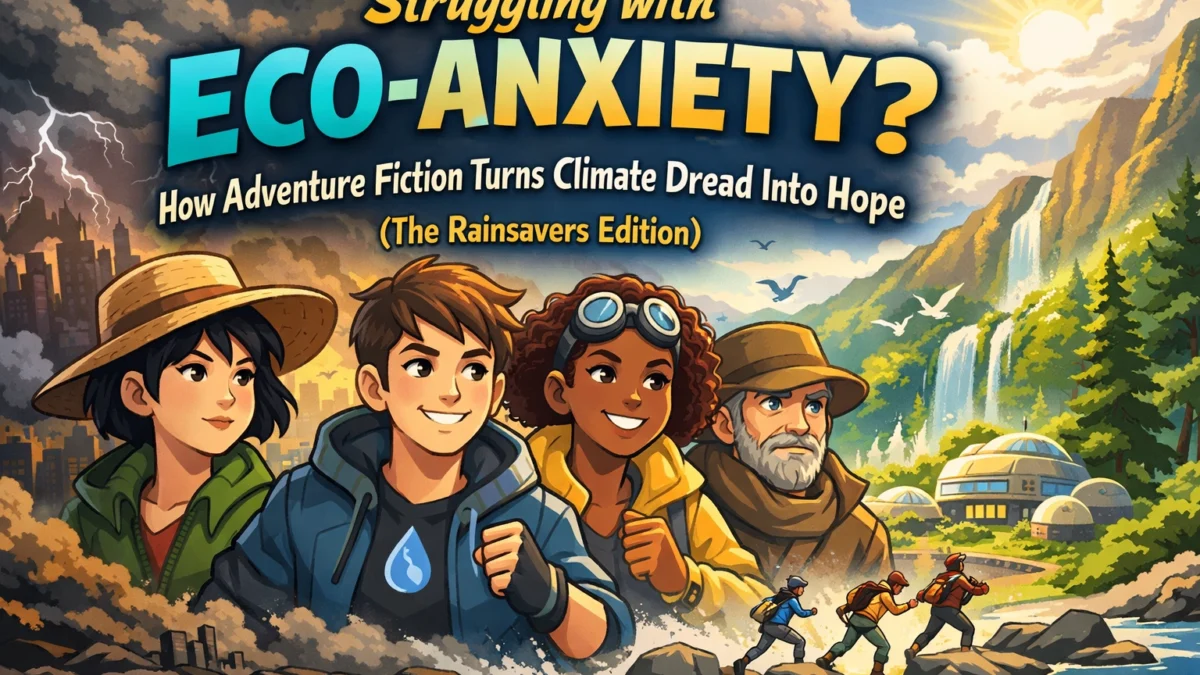
Primal, an environmental activist who won't back down when bulldozers show up. Mortalis, a mysterious figure with abilities nobody can quite explain. The Professor, brilliant, resourceful, always three steps ahead of the bad guys. And a growing crew of specialists who each bring something unique to the fight.
They don't have unlimited resources. They don't have government backing. What they do have is determination, strategy, and each other.
And over six books, they prove that a small group of committed people can genuinely change the world.
The Psychology of Hope Through Fictional Heroes
There's actual science behind why this works. When you read about characters taking effective action against overwhelming odds, your brain processes it differently than reading news articles. You're not just absorbing information, you're experiencing the emotional journey of going from "this is hopeless" to "we found a way."
The Rainsavers series takes you from the Amazon to Antarctica, from underwater facilities to literally the Moon. Each location presents impossible challenges. Each book shows the team adapting, innovating, and ultimately succeeding through a mix of high-tech solutions and good old-fashioned grit.
Your brain watches characters face eco-anxiety worse than yours (they're staring down actual extinction events) and then do something about it. That emotional experience rewires your own sense of possibility.

Why Team-Based Stories Hit Different
Solo superhero narratives are great, but eco-anxiety needs something different. It needs the reminder that you don't have to save the world alone. Nobody can.
The Rainsavers works because it's fundamentally about teamwork. The Professor can't solve red mercury technology without the field specialists. Primal's environmental knowledge is crucial in the Amazon but less useful on the Moon. Mortalis brings abilities nobody else has, but even those aren't enough without the others.
Sound familiar? That's because it mirrors actual environmental work. Climate solutions require botanists, engineers, activists, politicians, scientists, and regular people all pulling in the same direction.
Reading about a functional team tackling impossible odds reminds your anxious brain: "Oh right, I'm not supposed to fix this alone. I'm part of a bigger effort."
That shift from isolation to connection? That's where hope lives.
From the Amazon to the Moon: Why Scale Matters
One of the quietly brilliant things The Rainsavers does is escalate the scale across six books. You start in the Amazon, massive, yes, but grounded and tangible. By Book Six, the team is dealing with threats that span the entire planet and beyond.
This matters for eco-anxiety because it validates both local and global concerns. Your worry about the park down the street and your worry about Antarctic ice sheets are both legitimate. The series honors that by showing how small, focused actions build into global impact.
Plus, let's be honest: watching characters infiltrate a corporate facility to stop illegal deforestation in Book One hits different when you know they'll eventually be preventing lunar mining disasters in Book Six. The progression proves that solving "small" problems builds the skills and networks needed for bigger ones.

The Corporate Villain You Love to Hate
Every good adventure needs antagonists, and The Rainsavers delivers with villains that feel uncomfortably realistic. These aren't cartoon bad guys twirling mustaches. They're corporations prioritizing quarterly profits over long-term sustainability. They're executives who genuinely believe exploiting resources is "just business."
They're the frustrations you feel every day, given faces and names and schemes the heroes can actually thwart.
There's something deeply satisfying about watching Primal and the team dismantle corporate greed with a combination of clever planning and direct action. It scratches that itch your eco-anxiety creates: the desire to see accountability, to watch the bad guys actually lose for once.
Ancient Tech Meets Modern Threats
The red mercury technology running through the series is genius for another reason: it represents how historical choices create modern consequences. Ancient civilizations developed this power source without fully understanding the risks. Now contemporary villains are weaponizing it for profit, creating cascading environmental disasters.
Sound like any real-world scenarios? Fossil fuels? Industrial pollution? Deforestation?
The metaphor works because it's not heavy-handed. You get to enjoy pulse-pounding action sequences involving mysterious ancient tech while your brain quietly processes parallels to actual environmental challenges. The series never lectures: it just shows what happens when power falls into the wrong hands, and what's possible when the right people fight back.
Why 2026 Is the Perfect Time for This Series
Here we are in 2026, watching global environmental commitments either succeed or fail in real-time. The news cycle swings between breakthrough solutions and devastating setbacks. Eco-anxiety isn't going anywhere.
Which means you need coping mechanisms that actually work. Not toxic positivity. Not denial. Not paralysis.
The Rainsavers offers a third option: engagement through story. For the hours you're reading, you're not passively consuming doom. You're actively experiencing effective resistance, creative problem-solving, and environmental victories. Your nervous system gets a break from fight-or-flight and remembers what hope feels like.
Then you close the book, and that feeling lingers. Maybe you don't personally have red mercury tech or a secret base in Antarctica. But you remember that impossible problems do have solutions, that teams accomplish what individuals can't, and that giving up was never really an option.

Start With Book One, Trust the Journey
The beauty of a six-book series is watching how much ground it covers. Book One establishes the stakes, introduces the team, and delivers that first major victory that proves environmental protection isn't a lost cause. By Book Six, you've traveled the entire planet, seen the Rainsavers evolve, and experienced enough plot twists to fill a dozen movies.
But you've also experienced something more valuable: the sustained feeling that environmental action matters, that ordinary people can make extraordinary differences, and that hope is a choice worth making every single day.
Your eco-anxiety won't magically disappear. But it might transform into something more useful: motivation with direction, worry channeled into curiosity, dread replaced by determination.
Ready to Trade Doom-Scrolling for Adventure?
The Rainsavers isn't going to solve climate change. But it might just solve what doom-scrolling does to your mental health. It might remind you why environmental work matters. And it might give you enough hope to keep going when the news gets heavy.
Six books. One team. A whole planet worth saving.
Start reading Book One now at The Rainsavers and discover why adventure fiction might be the eco-anxiety antidote you didn't know you needed.
