Meta Description: Ever wonder how authors nail those authentic global settings? Here's how we researched real locations across six continents for The Rainsavers saga, from Amazon jungles to Arctic ice caps.

Writing a six-book epic that spans the globe isn't just about inventing cool places. It's about making readers feel the humidity of the Amazon, taste the salt spray in the Arctic, and smell the dust of ancient ruins, all from their couch.
But here's the thing: authenticity requires work. A lot of work.
The Google Earth Rabbit Hole Is Real
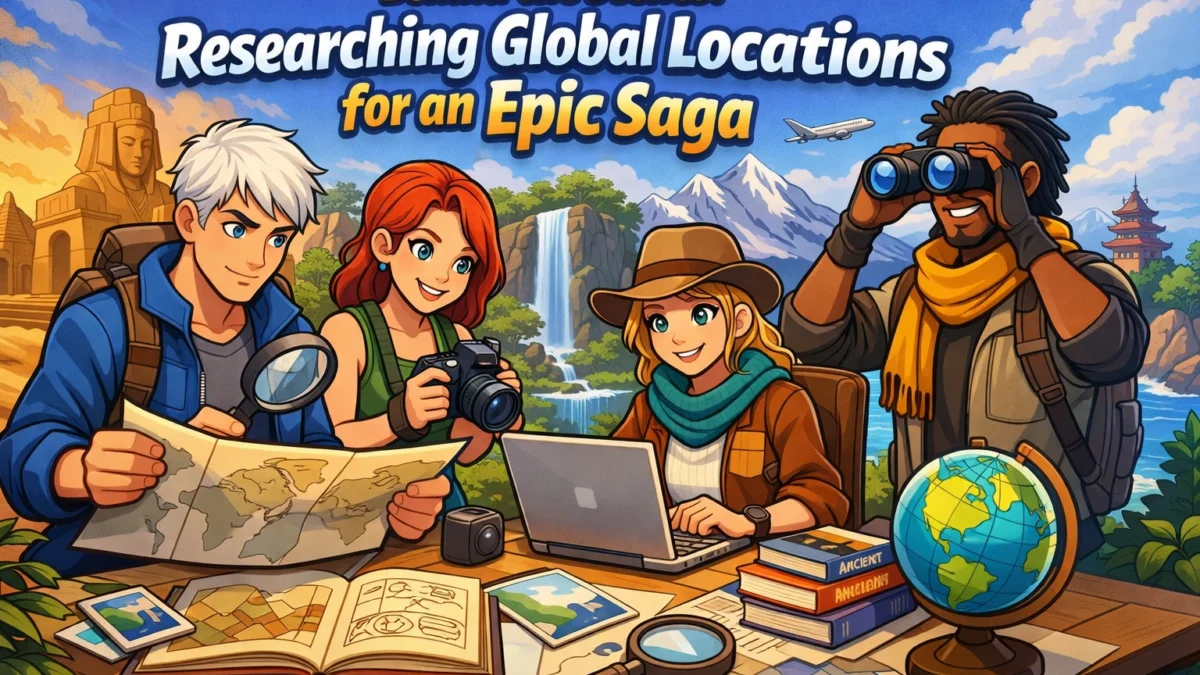
Let's start with the obvious confession: we spent an embarrassing amount of time on Google Earth in 2024 and 2025. Not just casual browsing, we're talking hours zooming into street-level views, measuring distances between landmarks, and checking what the terrain actually looks like from different angles.

For The Rainsavers series, each book needed distinct geographical settings that felt tangible. That meant verifying:
- Actual elevation changes (because characters can't casually jog up a mountain)
- Real vegetation types (palm trees don't grow in Iceland, surprisingly)
- Accurate travel times (between locations when your heroes are racing against time)
- Local weather patterns (rain exists differently everywhere, trust us on this)
The result? Locations that don't just sound real, they feel lived-in.
When Secondary Sources Aren't Enough
Research papers and travel blogs are great starting points, but they rarely capture the tiny details that make scenes pop. The smell of street food. The color of soil after rain. The specific way sunlight hits ancient stone at 4 PM.
That's where things get interesting (and expensive).
Some authors fly to every location they write about. We took a hybrid approach:
High-priority locations: On-site research, photos, voice notes capturing ambient sounds, conversations with locals who actually know the place beyond tourist brochures.
Secondary locations: Video calls with residents, deep-dive documentaries, and yes, more Google Earth sessions.
Mythological or restricted sites: Archaeological journals, historical texts, and creative interpolation based on similar verified locations.

The Arctic sequences in Book Three? Those required understanding ice shelf behavior, polar navigation challenges, and what hypothermia actually feels like at different stages. (One research trip involved sitting in a walk-in freezer for 20 minutes. Do not recommend.)
The Map Wall Strategy
Here's a weird confession: our office wall looked like a conspiracy theorist's dream for about 18 months.
Maps. Everywhere. Printouts with red string connecting locations. Sticky notes marking character movements. Highlighted routes across continents. Climate zone overlays. It was beautiful chaos.
Why? Because epic sagas aren't just about individual scenes, they're about geographical logic across thousands of pages. If your character is in Peru on Tuesday and somehow in Norway by Thursday without explanation, readers notice. They always notice.
The Rainsavers spans six books, multiple continents, and intricate character paths that occasionally converge. Keeping that spatially coherent required visual mapping that no spreadsheet could capture.
Cultural Consultants Save Your Bacon
Want to know the fastest way to lose reader trust? Write confidently about a place you've never understood beyond stereotypes.
We learned this the hard way during early drafts. What seemed like "exotic setting details" to us read as cringeworthy clichés to people who actually lived there.
Enter: cultural consultants.
For The Rainsavers, we worked with sensitivity readers and regional experts for major settings. These weren't just fact-checkers, they were collaborators who helped us understand:
- How locals actually navigate their environment (not how tourists do)
- Regional idioms and speech patterns that add authenticity to dialogue
- Cultural contexts that influence how characters might realistically respond to situations
- What details matter most versus what's filler

One consultant pointed out that our Amazon sequence had the right plants but wrong sounds, the jungle we described was too quiet for that specific region. That kind of granular feedback is gold.
When Research Becomes Procrastination
Let's be honest: research can become a convenient excuse to avoid writing.
"I can't write this scene until I know the exact species of bird that would be flying overhead."
No. Stop. Write the scene. Add [CHECK BIRD TYPE] and move on.
Research is essential, but perfectionism kills momentum. The trick is knowing when you have enough information to write authentically versus when you're just scared of the blank page.
For The Rainsavers, we developed a rule: if research takes longer than writing the actual scene, you've gone too deep. Get words on the page, mark questions, and circle back during revision.
Some of our best location details emerged during second drafts when we knew what the scene needed and could research specifically for that purpose.
Digital Tools That Actually Help
Beyond Google Earth (which remains the MVP), here are research tools that earned their keep:
Historical weather databases: For accurate seasonal conditions in past time periods
Academic journals: JSTOR became our best friend for archaeological and anthropological research
Local news archives: Understanding current issues and recent events that affect locations
Topographical mapping software: For understanding terrain elevation and water systems
Language forums: For catching idiom mistakes and regional vocabulary variations
The internet is an incredible research tool when you move past surface-level content. University databases, specialized forums, and academic Twitter (yes, really) provided insights no travel guide ever could.
The "But What If I'm Wrong?" Anxiety
Here's the secret every author experiences but few admit: you're going to get some details wrong.
Not because you're lazy, because capturing the full complexity of real places in fiction is impossible. You make choices. You simplify. You emphasize certain elements while downplaying others for narrative reasons.
The goal isn't perfect documentary accuracy. It's emotional authenticity.
Does your reader feel transported? Do the locations serve the story? Do the geographical details enhance rather than distract from character and plot?
If yes, you've succeeded.

For The Rainsavers, we prioritized locations feeling emotionally true over obsessive factual precision. Sometimes that meant acknowledging in author notes when we took creative liberties. Readers appreciate honesty.
Why Location Research Matters for Eco-Fiction
This isn't just about setting, it's thematic.
The Rainsavers deals with environmental challenges across the globe. The locations aren't just backdrops; they're characters themselves. Understanding how climate change affects the Arctic differently than the Amazon, how water scarcity manifests in various regions, how local ecosystems interconnect, that research fundamentally shaped the story.
You can't write convincing eco-fiction without understanding the actual ecology.
That meant diving into climate science, watershed systems, biodiversity hotspots, and environmental policy. It meant understanding not just how places look but how they function as living systems.
Did this slow down the writing? Absolutely.
Was it worth it? Check out The Rainsavers and decide for yourself.
The Payoff: When Readers Notice
The best research compliment isn't "wow, great research": it's when readers from those actual locations say "you got it right."
We've received messages from readers in four continents confirming that specific details resonated because they reflected genuine experience. That's the payoff. That's why you spend Tuesday afternoon trying to figure out exact sunrise times in Morocco during March.
Location research transforms generic adventure stories into immersive experiences. It's the difference between "they traveled somewhere exotic" and "I could smell that marketplace."
For a six-book saga, that authenticity compounds. By book three, readers trust your locations implicitly because you've earned it through accumulated details that ring true.
Your Turn
Ever wondered how your favorite book nailed a location you know personally? Or caught a glaring geographical error that yanked you out of the story?
The research process is messy, time-consuming, and occasionally involves sketchy Google searches that probably put you on a watchlist ("how to infiltrate abandoned Soviet facilities" for research purposes, we promise).
But it's also one of the most rewarding parts of writing epic fiction. Every location becomes a puzzle to solve, a new world to understand, a chance to transport readers somewhere they've never been: or show them somewhere familiar through fresh eyes.
Ready to see how global research translates into adventure fiction? Read Book One now and experience locations that span six continents, countless ecosystems, and one epic saga about ordinary people facing extraordinary environmental challenges.
Trust us: the geography is accurate enough to use as a very weird, very specific travel guide. (Though we don't recommend actually infiltrating those abandoned facilities.)
