
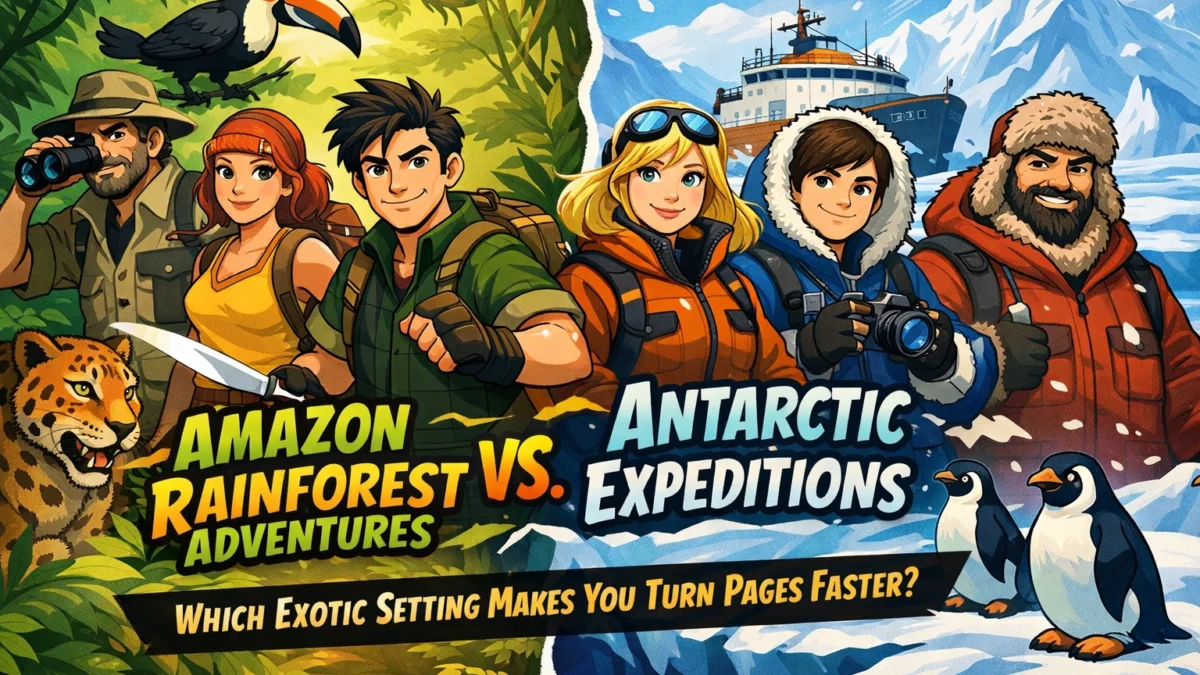
Meta Description: Jungle heat or Antarctic ice? Explore why setting matters in high-stakes adventure series.
Here's a question that keeps readers up at night: Would you rather sweat through a jungle thriller or freeze your way through a polar expedition?
Both settings promise exotic danger, high-stakes tension, and the kind of "what would I do?" moments that make you grip your Kindle a little tighter. But which one actually gets your heart racing faster?
Let's break it down, round by round.
Round 1: The Heat Factor (Literally)
Amazon Rainforest: You're drenched in humidity before page three. Mosquitoes the size of drones. Vines that might be hiding anacondas. Every step squelches. Your tactical gear sticks to your skin, and there's always, always, something rustling in the canopy above you.
The heat is oppressive, suffocating, alive. It's a character in itself.
Antarctic Expeditions: Cold so sharp it hurts to breathe. Frostbite warnings every chapter. Wind that can knock you flat. Whiteouts that erase the horizon. Your high-tech thermal gear is the only thing between you and hypothermia, and even that feels like a gamble.
The cold is merciless, isolating, deadly.
Winner? Tie. Both settings weaponize temperature in ways that keep readers on edge. The jungle makes you claustrophobic; Antarctica makes you feel utterly alone.

Round 2: The Danger Scale
Amazon Rainforest: Piranhas. Jaguars. Poison dart frogs. Plants that can literally kill you if you brush against them. And let's not forget human threats, drug cartels, illegal mining operations, rogue scientists doing Very Bad Things in hidden labs.
Nature wants to eat you. Humans want to stop you. Pick your poison.
Antarctic Expeditions: Crevasses that open without warning. Ice shelves that collapse. Storms that strand you for days. And if you're really unlucky? Ancient secrets buried under miles of ice, guarded by people who'd rather blow up a research station than let you leave.
Nature wants to bury you. Secrets want to stay hidden. Good luck.
Winner? Amazon, by a nose. The sheer variety of threats gives writers more toys to play with, and readers more reasons to yell "Don't go in there!" at fictional characters.
Round 3: The Mystery Element
Amazon Rainforest: Lost cities. Uncontacted tribes. Species science hasn't discovered yet. Legends of treasures, curses, and civilizations that vanished without a trace. Every shadow could hide an answer, or a bigger question.
The jungle keeps secrets like nowhere else on Earth.
Antarctic Expeditions: Frozen research bases with dark histories. Nazi expeditions rumored to have left behind more than just bunkers. Meteorites with strange properties. Ice cores revealing climate data that someone very powerful wants erased.
Antarctica doesn't just keep secrets. It preserves them perfectly for decades.
Winner? Antarctica. There's something uniquely terrifying about finding evidence, maps, documents, frozen bodies, that proves conspiracy theories might not be theories after all.

Round 4: The Team Dynamic
Amazon Rainforest: Your team is sweating, arguing about whether to trust the local guide, slapping at bugs, and rationing water. Tempers flare when supplies run low. Someone always forgets the bug spray. Someone else insists they "know a shortcut."
Spoiler: They don't.
Jungle missions breed chaos and banter in equal measure. The heat makes everyone a little unhinged, which is great for dialogue.
Antarctic Expeditions: Your team is huddled in a tent during a blizzard, sharing the last thermos of coffee, debating whether the comms failure is mechanical or sabotage. Trust is everything when you're hundreds of miles from rescue.
Polar missions force intimacy and paranoia. The cold strips away pretense. You see who people really are when survival depends on teamwork.
Winner? Antarctic expeditions. The forced closeness creates pressure-cooker tension that's hard to beat. When your team is your only lifeline, every argument feels life-or-death.
Round 5: The "Oh Crap" Moments
Amazon Rainforest: The bridge collapses. The river floods. The satellite phone dies. Alpha the orangutan steals your rations. (Yes, really.) You realize the "research station" you were heading toward is actually a front for something much worse.
Jungle chaos happens fast and loud.
Antarctic Expeditions: The ice cracks beneath your feet. The storm hits three days early. You find evidence that someone else is already here, and they're not friendly. The backup generator fails at the worst possible moment.
Antarctic disasters happen slow and silent, until they're catastrophic.
Winner? Tie again. Both settings deliver pulse-pounding "page-turner" moments, just in different flavors. Pick your adrenaline style: explosive jungle chaos or creeping polar dread.

So… Which Setting Wins?
Here's the twist: Why choose?
The best adventure series don't lock themselves into one location. They give you both, humid jungles and frozen wastelands, ancient mysteries and modern conspiracies, banter-filled chaos and tense survival scenarios.
That's exactly what The Rainsavers series does.
One book, you're sweating through the Amazon with a team that includes an actual orangutan field operative. (Yes, Alpha gets his own subplot. No, we're not explaining how that works: you'll have to read it.) The next, you're racing across Antarctic ice to stop a conspiracy involving Nazi moonbase tech and red mercury reactors.
Because why limit yourself to one exotic setting when you can have all of them?
What Really Makes You Turn Pages Faster
Here's the truth: Setting matters, but it's not everything.
What keeps readers up past midnight isn't just the location: it's how that location forces characters to adapt, improvise, and reveal who they really are under pressure.
It's the tactical field respirators failing in the jungle heat. The high-tech gear malfunctioning in subzero temps. The team arguments about packing lists that escalate into full-blown debates about trust and survival strategy.
It's the moments when your heroes realize the biggest threat isn't the environment: it's the people who want to control it.
And honestly? It's also the humor. The banter. The running gag about who forgot the extra batteries. The absurd "did that actually just happen?" moments that make you laugh out loud between white-knuckle action sequences.
Good adventure fiction balances stakes with personality. Danger with levity. Exotic locations with characters you'd actually want on your team.
The Verdict
If you're choosing between Amazon Rainforest adventures and Antarctic expeditions, ask yourself:
- Do I want humid, chaotic, high-biodiversity danger zones?
- Or cold, isolated, conspiracy-laden mystery missions?
- Do I want fast-paced jungle banter or tense polar survival drama?
Then realize you don't actually have to pick.
Modern eco-adventure series span continents, climates, and crisis levels. They take you from rainforest canopies to frozen research stations, from corporate boardrooms to hidden moonbases, from endangered species conservation to globe-spanning conspiracies.
They give you characters who argue about packing lists, trade sarcastic commentary under fire, and occasionally consult an orangutan about tactical decisions.
They make you care about both the planet and the people trying to save it: while delivering the kind of page-turning tension that makes you miss your subway stop.
Ready to see how we blend both? Start with Book One at rainsavers.com and discover why readers are binge-reading their way through six books of jungle heat, Antarctic ice, and everything in between.
Trust us( you'll want to pack for both climates.)
