
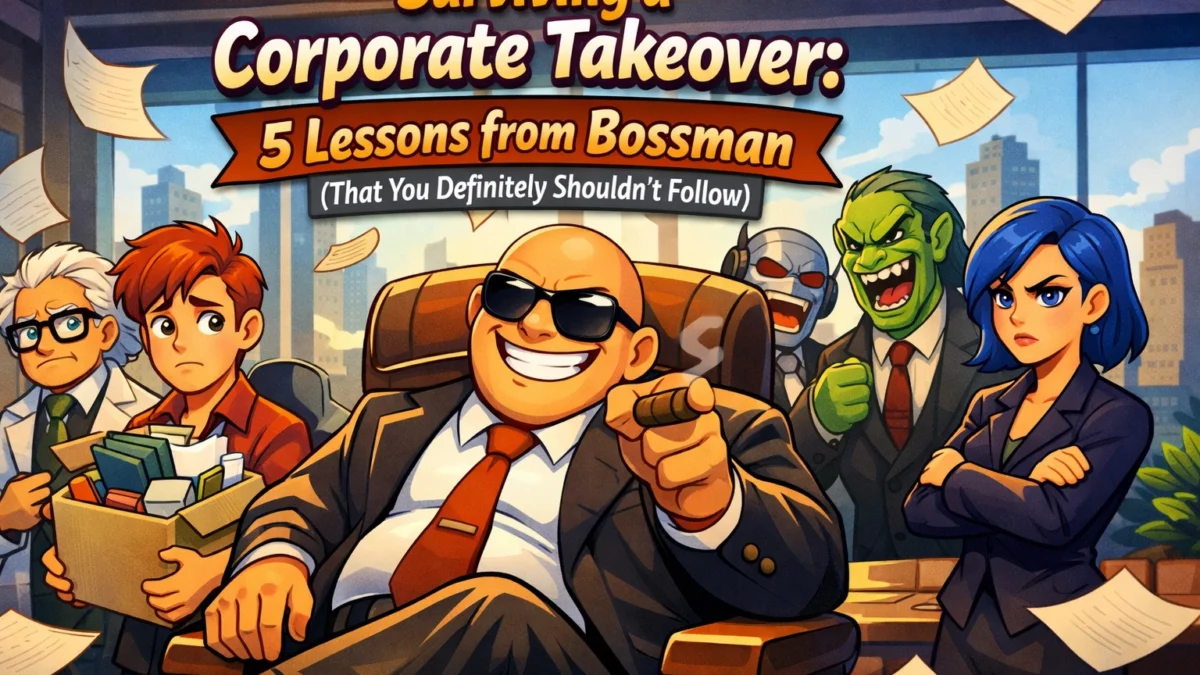
Disclaimer: The management of The Rainsavers would like to clarify that Bossman is a fictional villain whose business strategies violate approximately 47 international laws, basic human decency, and the Geneva Conventions. Please do not attempt any of these tactics at your actual job.
Look, we all know that guy in the boardroom. The one who treats quarterly earnings reports like they're battle plans for world domination. The one who considers "environmental impact assessment" a suggestion rather than a legal requirement. The one who definitely, 100%, without question, shouldn't be left alone with rainforest deeds and a helicopter full of mining equipment.
Meet Bossman, corporate raider, ecological disaster on legs, and the kind of villain who brings a PowerPoint presentation to an actual fight. If Gordon Gekko and a particularly aggressive hedge fund had a baby and raised it on protein powder and motivational speeches about "disrupting ecosystems," you'd get Bossman.
And today? We're diving into his playbook. Not because you should follow it (seriously, don't), but because understanding how corporate greed operates in fiction helps us recognize it in reality. Plus, watching Bossman crash and burn is extremely satisfying.
Lesson #1: Treat Everything Like a Hostile Takeover (Including Literal Forests)
Bossman's first rule of business? If it exists, you can acquire it. Trees? Acquisition targets. Biodiversity? Untapped assets. Indigenous land rights? Minor obstacles in the path of shareholder value.

In Bossman's world, the Amazon rainforest isn't an irreplaceable ecosystem that produces 20% of the world's oxygen, it's prime real estate with "development potential." His business model basically involves showing up with contracts, lawyers, and a complete disregard for the concept of "sacred ground" or "you literally can't breathe without this."
Why this is a terrible idea: Besides the whole "destroying the planet" thing? Turns out that when you threaten the rainforest, you make enemies of people who are very good at surviving in hostile environments. People like, oh, a team of eco-warriors who are excellent at both scientific research AND creative problem-solving involving vines, river currents, and occasionally well-timed wildlife interventions.
What happens in the books: Let's just say Bossman's expensive Italian leather shoes weren't designed for jungle pursuit scenes. Neither was his ego.
Lesson #2: Hire Mercenaries First, Ask Environmental Impact Questions Never
Bossman's HR strategy is simple: if your resume includes phrases like "tactical operations," "aggressive negotiation tactics," or "comfortable working with minimal ethical oversight," you're hired. Concerns about carbon footprints? That's what the legal department is for (note: his legal department is also mostly mercenaries).
His approach to staffing basically treats "corporate security" and "private military contractor" as interchangeable terms. Board meetings include phrases like "neutralize the opposition" and "establish a perimeter," which should probably raise some red flags but somehow don't.
Why this is a terrible idea: Mercenaries are expensive, unreliable, and tend to have surprisingly strong opinions about working conditions when they're being chased through the jungle by an orangutan with tactical awareness. Also, they're not great at the whole "maintaining corporate reputation" thing when their idea of conflict resolution involves firearms.
What happens in the books: Alpha the orangutan has entered the chat. And by "chat," we mean "series of increasingly hilarious encounters that prove opposable thumbs and problem-solving skills trump weaponry when you're fighting on someone else's territory."

Lesson #3: If the Law Gets in Your Way, Just Lawyer Harder
Bossman's legal strategy can be summed up as: "It's not illegal if you have enough lawyers to argue about the definition of 'illegal.'" Environmental regulations? There's a loophole for that. Indigenous land rights? His legal team has a 400-page document explaining why those don't apply when there's lithium underneath.
He treats international law like it's more of a gentle suggestion than actual law, which works great until it doesn't. His approach to compliance is basically "make it too expensive and complicated for anyone to fight back," which is a real strategy that real corporations use and yes, it's exactly as terrible as it sounds.
Why this is a terrible idea: Eventually, you run into people who can't be buried in paperwork. People who fight back with crowbars made of rebar, scientific knowledge, and a complete unwillingness to accept "market forces" as an excuse for ecological destruction. Also, judges tend to frown on the whole "crimes against nature" thing when it's documented thoroughly enough.
What happens in the books: Turns out that when your entire corporate strategy is built on legal gray areas, one well-placed whistleblower can collapse the whole house of cards. And when that whistleblower has friends who are really good at creative evidence gathering? You're going to have a bad time.
Lesson #4: Dismiss Every Warning as "Anti-Business Propaganda"
Scientists say your mining operation will contaminate water supplies for millions of people? Sounds like they're just jealous of your success. Environmental groups point out your project violates twelve different conservation treaties? Classic anti-capitalist fearmongering. The actual Indigenous people whose land you're destroying tell you to leave? Obviously, they don't understand economic development.

Bossman's approach to criticism is simple: everyone who opposes him is either uninformed, jealous, or secretly working for his competitors. It's never that he's actually doing something wrong, it's that everyone else doesn't understand his vision. His vision of quarterly profits, but still.
Why this is a terrible idea: Ignoring experts is how you end up surprised when the thing they said would happen… happens. Dismissing local knowledge means you miss crucial information about, say, seasonal flooding patterns or which areas contain aggressive wildlife. And treating every objection as illegitimate means you never develop the self-awareness to realize you're the villain in someone else's story.
What happens in the books: Everything the scientists and locals warned about happens. All of it. At once. While Bossman is in the middle of a press conference insisting everything is under control. It's like dramatic irony, but with more flooding and angry indigenous warriors.
Lesson #5: When All Else Fails, Double Down
This is Bossman's signature move. When Plan A fails, he doesn't retreat or reconsider: he throws more money at Plan A until it becomes Plan A+. When that fails, he adds more mercenaries and lawyers until it's Plan A++. At no point does it occur to him that maybe the fundamental strategy is flawed.
His approach to setbacks is basically "if brute force isn't working, you're not using enough of it," which works great in action movies where the villain eventually wins. Spoiler alert: that's not what happens in The Rainsavers.
Why this is a terrible idea: Escalation is expensive, attracts attention, and turns "unfortunate business dispute" into "international incident with multiple governments involved." Also, the heroes get more creative the more you push them, and creativity beats resources when you're fighting in their backyard.
What happens in the books: By the time Bossman realizes he's in over his head, he's already made enemies of every competent person within a 500-mile radius. The escalation doesn't lead to victory: it leads to increasingly spectacular failures that make for great reading but terrible business outcomes.

The Bottom Line (Unlike Bossman, We Actually Have One)
Here's the thing about Bossman: he's not a cartoon villain because he's exaggerated: he's terrifying because he's not. Strip away the adventure story elements, and his playbook is basically "aggressive corporate expansion with zero regard for consequences," which is… let's just say it has real-world parallels.
But what makes The Rainsavers so satisfying is watching that approach collide with people who refuse to be steamrolled. The series shows what happens when greed runs headfirst into determination, when corporate power meets actual resistance, and when the "inevitable march of progress" discovers that some things shouldn't be progressed all over.
Bossman's lessons aren't just about what not to do in business: they're about recognizing that treating everything as a resource to be exploited eventually backfires. Hard.
Ready to see Bossman's greed in action (and watch it blow up in his face)? Read Book One now and discover why corporate villainy is no match for a team that actually cares about what they're fighting for.
Because unlike Bossman's quarterly projections, this story has a satisfying ending.
P.S. – If your actual boss exhibits any of these traits, might we suggest updating your resume? And possibly contacting the appropriate regulatory authorities. Just saying.
