
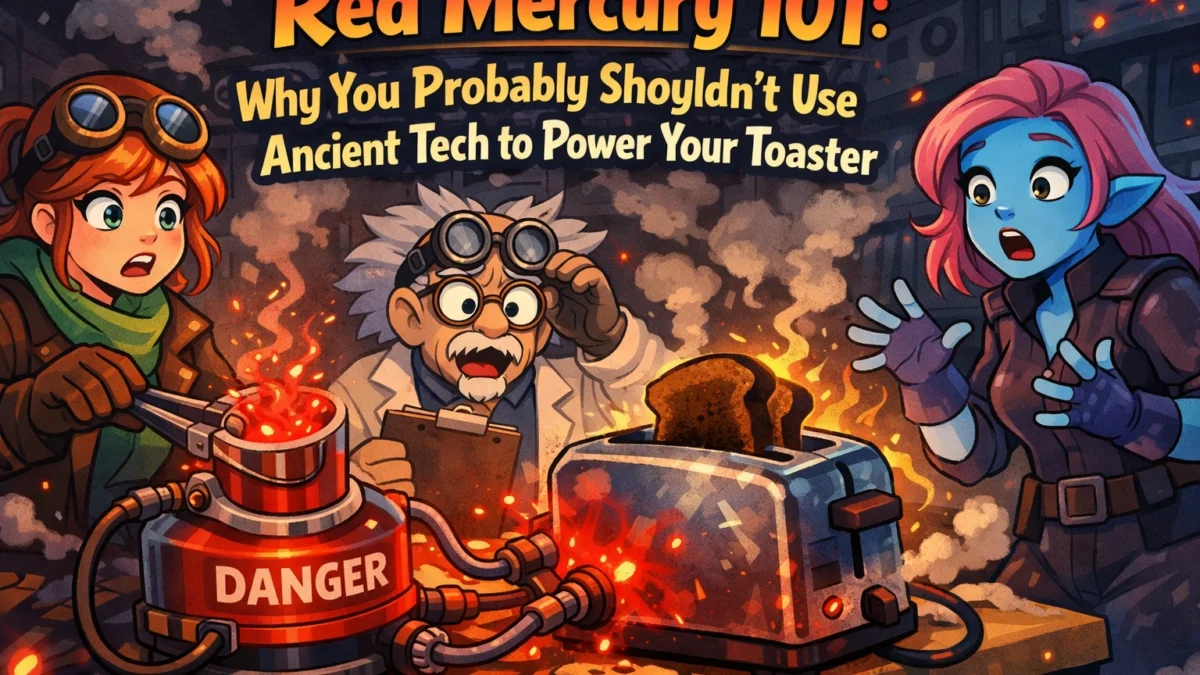
Look, we get it. Your electricity bill is through the roof in 2026, and you've been reading about some glowing red crystals that supposedly powered ancient civilizations. Maybe you're thinking, "Hey, if the Nazis tried to weaponize this stuff on a secret moonbase, surely I can use it for my kitchen appliances, right?"
Wrong.
So very, magnificently wrong.
Welcome to your crash course in Red Mercury, the most dangerous, misunderstood, and frankly annoying substance in the entire Rainsavers universe. Consider this your official warning label, user manual, and "please don't try this at home" disclaimer all rolled into one.
What Even IS Red Mercury?
In the real world, "red mercury" is a hoax, a scam perpetuated by con artists trying to sell colored water to gullible buyers. But in The Rainsavers series? Oh, it's very, very real. And that's the problem.
Red Mercury is an ancient energy source discovered by a pre-Nazi German expedition in Antarctica. Think of it as the world's worst battery: incredibly powerful, wildly unstable, and with a tendency to cause catastrophic failures at the most inconvenient times. It glows an ominous crimson red (hence the name, we're creative like that), emits radiation that makes Geiger counters have nervous breakdowns, and has been responsible for more "oops, I accidentally created a doomsday device" moments than we can count.
The technology was originally developed by an ancient civilization that apparently had really questionable safety standards. No OSHA regulations back then, clearly.

The "DO NOT TOUCH" List (Seriously, Don't)
Here are just a few reasons why Red Mercury should never, under any circumstances, power your household electronics:
1. It's Radioactive (Like, Really Radioactive)
Remember how we said it makes Geiger counters nervous? That wasn't a joke. Red Mercury emits a unique form of radiation that standard protective equipment wasn't designed to handle. Your lead apron from the dentist? Cute. Ineffective, but cute.
2. It Has Mood Swings
Red Mercury is temperamental. Temperature changes, electromagnetic interference, someone looking at it wrong, all of these can cause power fluctuations ranging from "mild annoyance" to "spontaneous fusion reaction." Your toast might come out perfectly golden one day and vaporized the next.
3. The Nazi Moonbase Problem
Here's the thing about technology developed by people who thought "secret moonbase powered by unstable ancient energy crystals" was a good idea: they weren't exactly thinking about consumer safety. The original Red Mercury reactors had a failure rate of approximately "yes." All of them. Every single one eventually failed, usually spectacularly.
4. It Attracts Unwanted Attention
The moment you power up anything with Red Mercury, you're basically sending up a flare to every villain, mercenary, and corporate espionage team within a thousand-mile radius. Leonard West's people have sensors for this stuff. Trust us, you don't want Leonard West's attention. He's still salty about the whole Antarctic incident.
A Brief History of Red Mercury Disasters
Let's take a quick tour through some notable Red Mercury mishaps from the series:
The Antarctic Expedition (1939): The Germans discovered the stuff and immediately decided to build a secret base. Spoiler alert: the base eventually exploded. Shocking, we know.
The Moonbase Initiative: Because putting unstable ancient technology on the moon where you can't easily run away seemed like the logical next step. Points for ambition, negative points for survival instinct.
Leonard West's "Controlled" Experiments: The word "controlled" is doing a lot of heavy lifting in that sentence. Let's just say there's a reason his facilities are always in remote locations far from population centers.

What It's ACTUALLY Good For (In Fiction, Mind You)
Okay, so Red Mercury is terrible for toasters. What IS it good for in The Rainsavers universe?
Power generation (when properly contained in facilities designed by people who didn't lose World War II)
Advanced propulsion systems (if you don't mind occasional reality-defying physics)
Extremely dangerous weapons (which is exactly why our heroes spend so much time trying to keep it out of the wrong hands)
Making the plot really exciting (this is actually its primary function)
The key difference between "useful Red Mercury application" and "catastrophic Red Mercury failure" is usually about seventeen layers of exotic containment shielding, a team of specialists who know what they're doing, and access to emergency shutdown protocols that may or may not work when you need them.
Notice how "kitchen appliances" didn't make that list?
The Leonard West Approach vs. The Rainsavers Approach
Here's where things get interesting. You've got two basic philosophies when it comes to Red Mercury:
The Leonard West Method: "Let's weaponize this unstable ancient technology for corporate profit! What could possibly go wrong?"
Spoiler: Everything. Everything can go wrong. Everything will go wrong.
The Rainsavers Method: "Maybe we should prevent this unstable ancient technology from falling into the wrong hands and causing global catastrophe?"
Significantly less profitable, but you get to sleep at night without worrying about inadvertently triggering an extinction-level event.

FAQ: Questions We Really Hope You're Not Actually Asking
Q: But what if I'm really careful with the Red Mercury?
A: No. The ancient civilization that created this stuff couldn't be careful enough with it. They're ancient now, as in, not around anymore. See the connection?
Q: Could I just use a tiny amount?
A: There's no such thing as a "tiny amount" of Red Mercury. It's like being "a little bit pregnant" or "slightly on fire." The moment you introduce it into a system, you're committed to the full experience, including the part where things explode.
Q: What if I have really good insurance?
A: Read your policy's fine print. We guarantee "damages caused by fictional ancient Nazi moonbase technology" is not covered.
Q: Where would I even get Red Mercury?
A: Stop. Just stop. We're not having this conversation.
The Actual Science (Well, Fiction-Science)
For those genuinely curious about how Red Mercury works in The Rainsavers universe without wanting to build their own reactor: the substance appears to tap into quantum-level energy fluctuations through a mechanism that makes actual physicists weep.
It's not fusion, not fission, and not any conventional energy generation method. The best description we have is "ancient civilization figured out something we're still trying to understand, and then wisely decided to bury it in Antarctica."
The containment systems required to safely harness Red Mercury are so complex that only a handful of facilities worldwide can maintain them. These aren't your standard "bought it off Amazon" containment units: they're billion-dollar installations with redundant safety systems, constant monitoring, and teams of specialists on standby 24/7.
Your toaster is not one of these facilities.
The Bottom Line
Red Mercury is fascinating, dangerous, and absolutely central to the mysteries and conflicts in The Rainsavers series. It's the MacGuffin that launches a thousand adventures, the technology that brings our heroes and villains into conflict, and the reason why we can't have nice, simple stories about normal things.
But should you use it to power your toaster?
Absolutely not.
Stick with electricity from your wall outlet. It's cheaper, safer, and significantly less likely to attract the attention of corporate mercenaries or trigger an international incident.
If you want to learn more about Red Mercury, the secret Antarctic bases, Leonard West's questionable decision-making, and how our team of unlikely heroes tries to prevent ancient technology from destroying the modern world, there's a much better option than attempting DIY energy experiments.
Unlock the secrets of Red Mercury in Book Three and discover why some ancient technologies should stay buried: preferably under several tons of ice, in an unmarked location, with no forwarding address.
Trust us, it's way more fun (and safer) to read about Red Mercury disasters than to create your own.
Now if you'll excuse us, we need to go investigate reports of someone trying to power their entire smart home system with a glowing red crystal. Some people just don't listen.
Ready to dive deeper into the mysteries of ancient technology, secret bases, and the team trying to save the world from both? Start your adventure with The Rainsavers and discover why some secrets are worth protecting: and why toasters should stick to regular electricity.
