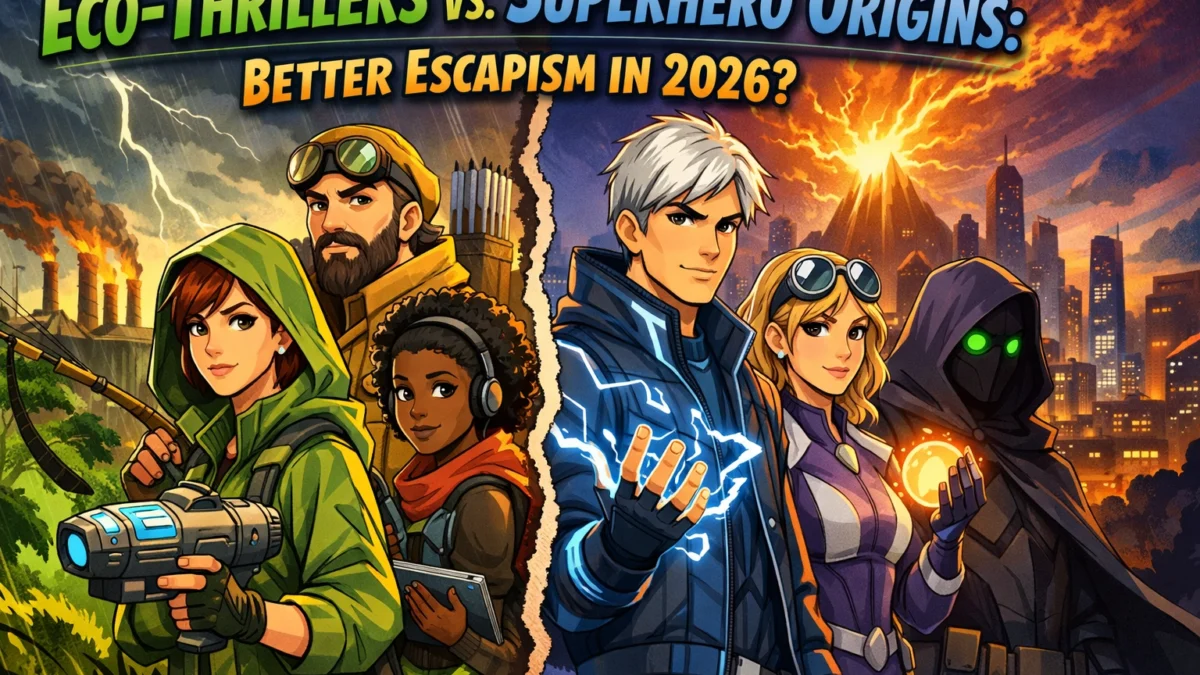
Meta Description: Superhero fatigue is real in 2026. But eco-thrillers? They're hitting different. Let's break down which genre actually gives you the escapism you're craving right now.
Look, I'm just going to say it: superhero origin stories in 2026 feel like watching someone assemble IKEA furniture for the two hundredth time. You know the steps. You know the Allen wrench is going to be slightly too small. You know someone's uncle is probably going to die to teach them about responsibility.
Meanwhile, eco-thrillers are out here asking: "What if the actual villain was corporate greed destroying ecosystems, and the heroes had to MacGyver their way through collapsing biomes with field science and sheer determination?"
Yeah. That hits different.
The Superhero Origin Problem (It's 2026, We're Tired)
Here's the thing about superhero origins: they're comfort food. Safe. Predictable. Guy gets powers, guy doubts himself, guy realizes with great power comes great CGI budget, guy saves the city from a purple beam shooting into the sky.
But in 2026? We're living in a world where the actual stakes feel real. Climate anxiety isn't abstract anymore. Resource wars aren't fictional. And watching another billionaire inventor create a super-suit to punch bad guys feels… kinda hollow when you scroll past news about actual ecosystem collapse on your lunch break.
Superhero escapism used to work because it was fantastical. Now it just feels escapist in the wrong way, like it's avoiding the problems we actually care about.

Eco-Thrillers Give You Stakes That Matter
Enter the eco-thriller. Not preachy. Not a documentary wearing a plot like a bad disguise. Just straight-up "the world is ending in a specific, scientifically-plausible way, and a small team of specialists has to stop it before Tuesday."
Take The Rainsavers, for example. Six books. Six different ecological disasters. Each one feels like it could be ripped from tomorrow's headlines, except it's wrapped in the kind of page-turning tension that makes you accidentally stay up until 3 AM on a work night.
The heroes? Not billionaires. Not aliens. Just people with PhDs in obscure sciences, field experience, and the kind of stubborn refusal to let the planet die on their watch that feels real. They don't get superpowers, they get respirators, tactical gear, and really good at thinking on their feet.
And somehow that's way more satisfying than watching someone discover they can fly.
Why "Grounded" Actually Works Better Now
There's this weird paradox happening in 2026: the more fantastical your hero powers are, the less we can connect with them. But give us a microbiologist who has to navigate a quarantine zone with limited supplies and a ticking clock? We're invested.
Eco-thrillers work because they're speculative without being impossible. They ask "what if?" in ways that feel like "what when?" The threats are tangible. The solutions require actual expertise, not just punching harder. The victories feel earned because they come from knowledge, strategy, and teamwork, not because someone's mutation finally kicked in at the right moment.
It's escapism that doesn't ask you to leave your brain at the door. It asks you to bring it along for the ride.

The Team Dynamic Hits Different
Another thing: superhero origins are obsessed with the lone wolf. Even in team movies, everyone gets their solo moment, their individual arc, their "I work alone" declaration before inevitably learning to trust others in act three.
Eco-thrillers? They skip that nonsense. The team has to work together from page one because the mycologist can't solve the problem without the climatologist's data, and neither of them survives without the field medic keeping them alive in hostile terrain.
The Rainsavers nails this. Every character brings specialized knowledge. Every character is essential. No one's the "chosen one", they're just the right people, in the right place, with the right skills, refusing to give up.
That feels way more inspiring than destiny or random mutation.
Villains You Can Actually Understand
Superhero origin villains tend to fall into two camps: mustache-twirling evil for evil's sake, or tragic mirrors of the hero who made one different choice. Cool. Fine. We've seen it.
Eco-thriller villains? They're corporations cutting corners. Politicians prioritizing profit over science. Systems of indifference that kill through inaction rather than malice. Sometimes the villain is just time, the clock running out before a cascade failure wipes out an entire biome.
These are villains we recognize. They're in our news feeds. They're in our actual lives. And watching heroes systematically dismantle them through competence and determination? That's cathartic in a way that punching a CGI monster just isn't anymore.

The 2026 Vibe Check
Let's be real: in 2026, we're all carrying some level of background anxiety about the state of the world. Climate, resources, ecosystems, the whole thing. It's there, humming in the background of our daily lives.
Superhero origins ask us to ignore all that and focus on whether the hero will master their powers in time. Eco-thrillers say "yeah, we're worried about that too, here's a story where people actually do something about it."
One feels like denial. The other feels like defiance.
Guess which one gives better escapism?
Why The Rainsavers Works So Well Right Now
Full disclosure: we're biased. But hear us out.
The Rainsavers series doesn't pretend climate threats aren't real. It doesn't dress up environmentalism in spandex and call it a day. It just gives you six books of high-stakes, expertly-plotted adventures where the heroes use actual science to solve actual (fictional, but plausible) problems.
Every book is standalone but part of a larger world. Every disaster is different, viral outbreaks, atmospheric collapse, ecosystem cascade failures. Every solution requires the team to adapt, improvise, and occasionally survive by the skin of their teeth.
It's the kind of escapism that makes you feel better about the world, not worse. The kind that says "yes, things are complicated, but competent people working together can actually make a difference."
And in 2026? That's the escapism we actually need.
The Verdict (Obviously Biased But Also Correct)
Superhero origins have their place. They're nostalgic. They're familiar. They're… fine.
But eco-thrillers are urgent. They're relevant. They're the kind of stories that make you turn pages frantically while simultaneously making you think about actual solutions to actual problems.
They're not asking you to believe in magic. They're asking you to believe in expertise, determination, and the idea that we're not doomed as long as people refuse to give up.
In 2026, that's the escapism that actually escapes forward instead of backward.
Ready for escapism that doesn't ask you to check your brain at the door? Read Book One now and see why eco-thrillers are the antidote to superhero fatigue we've all been craving.
