
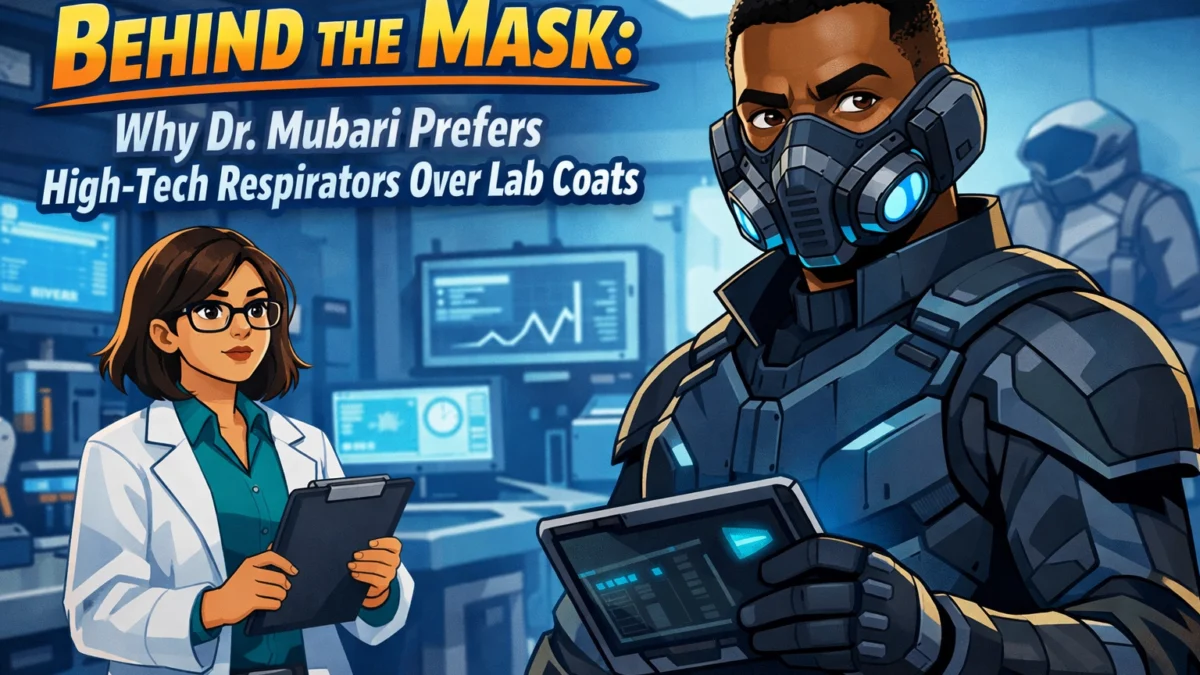

Meta Description: Why does our favorite scientist ditch the lab for the jungle? A look at Dr. Mubari's tactical field gear.
Look, we get it. When you think "scientist," you probably picture someone in a pristine white lab coat, safety goggles perched on their nose, pipetting mysterious liquids under fluorescent lights.
Dr. Mubari? Yeah, he burned that playbook on day one.
Instead, you'll find him knee-deep in the Amazon rainforest wearing a sleek tactical respirator that looks like it was designed by someone who binged too many spy thrillers, and we're absolutely here for it.
The Lab Coat Rebellion
Dr. Mubari didn't wake up one day and decide to cosplay as a field operative. His career trajectory makes perfect sense when you realize that the most dangerous research isn't happening in sterile laboratories anymore, it's happening where ancient ecosystems meet modern corporate greed.
"Show me a lab coat that can handle 98% humidity, venomous insects, and the occasional mercenary ambush," Mubari once quipped to the team. "I'll wait."

He has a point. Traditional lab gear was designed for controlled environments. Climate-controlled rooms. Bunsen burners. Maybe the occasional chemical spill that gets mopped up before lunch.
The Rainsavers operate in places where "controlled environment" means "we hope this tree branch doesn't collapse under Alpha's weight while we're collecting samples."
Why the High-Tech Respirator Isn't Just For Show
Mubari's signature field respirator isn't fashion (though it does look incredibly cool). It's survival equipment that doubles as a mobile research station. Here's what makes it essential:
Real-time Air Quality Analysis
The jungle isn't just humid, it's a cocktail of organic compounds, spores, pollen, and occasionally some truly sketchy chemical signatures from illegal mining operations. Mubari's respirator analyzes everything he breathes in real-time, flagging toxins before they become a problem.
Integrated Communications
Ever try coordinating a team spread across three square miles of dense rainforest? Yeah, walkie-talkies don't cut it when you're also trying to avoid inhaling something that'll make you hallucinate for three days. The respirator's built-in comms keep him connected to the team while filtering out the bad stuff.
Modular Filtration System
This is where it gets genuinely brilliant. Mubari can swap filter cartridges based on the threat level. Biological hazards? Check. Chemical agents? Check. That weird fungus they discovered in Book Three that Leonard West tried to weaponize? Double check.
Because Science Doesn't Stop for Comfort
Lab coats are great when you're standing still. They're less great when you're:
- Climbing through vine-tangled canopy layers
- Sprinting away from illegally armed timber poachers
- Crouching in muddy riverbanks collecting water samples
- Explaining to Alpha why eating fermented fruit was a bad tactical decision
Mubari needed gear that could keep up with his brain: and his increasingly chaotic fieldwork.

The First Time He Ditched the Lab Coat (A Cautionary Tale)
According to team legend, Mubari showed up to his first Amazon expedition in traditional lab attire. Pressed white coat. Sensible slacks. Even brought his favorite safety goggles.
He lasted approximately four hours.
The coat snagged on every branch, vine, and curious spider. The humidity turned it into a soggy disaster. And when the team had to ford a river unexpectedly? Let's just say wet lab coats have the aerodynamic properties of a parachute made of concrete.
"I looked like a drowned scientist cosplaying as a ghost," Mubari later admitted. "Not my finest moment."
The respirator idea came shortly after, when he realized he needed gear designed for where the science actually happens: not where institutional committees think science should happen.
Field Science vs. Lab Science: The Great Debate
Here's the thing nobody tells you about modern environmental research: the most critical discoveries don't happen in controlled settings anymore. They happen in the messy, unpredictable, occasionally dangerous places where ecosystems are collapsing in real-time.
Mubari could absolutely run simulations and models from a comfortable university lab. He'd probably publish more papers. Get invited to more conferences. Never have to worry about whether his equipment will survive the next monsoon.
But he'd also miss the ground truth.

The respirator represents a philosophy: Real science happens in real places, under real conditions, with real stakes.
Lab coats are for people who can afford the luxury of distance. Mubari and The Rainsavers don't have that luxury. When Leonard West is planning to extract resources that could destabilize entire ecosystems, you can't wait for peer review. You need answers now, and you need them on-site.
What's Actually Inside That Thing?
The technical specs are classified (Steven's rules, not ours), but we can tell you this much:
- Micro-spectrometry sensors that can identify chemical compounds in parts per billion
- Encrypted communication arrays that keep corporate spies from listening in
- Emergency oxygen reserves for when things go from "concerning" to "evacuate immediately"
- Temperature regulation because heatstroke is not a good look on anyone
- UV sterilization protocols that activate between uses
It's basically if a PhD thesis and a special ops mission had a baby, and that baby was really, really good at keeping you alive in hostile environments.
The Unexpected Benefits
Mubari didn't anticipate all the side effects of abandoning traditional scientist aesthetics:
Villains take him more seriously.
Nothing says "I'm not playing around" like showing up to a confrontation in tactical field gear. Leonard West's mercenaries learned quickly that the guy in the respirator wasn't going to be intimidated by threats or bribery.
The team respects his commitment.
When you're willing to gear up like everyone else instead of hiding behind academic credentials, it builds trust. Mubari isn't the "scientist observer": he's an active team member who happens to have multiple PhDs.
It's become iconic.
Let's be honest: the respirator look is cool. It's visually distinctive, thematically appropriate, and instantly recognizable. If The Rainsavers ever get action figures (fingers crossed), that respirator is 100% making the final design.
The Lab Coat's Revenge (Sort Of)
Mubari does keep one pristine lab coat in his quarters. He wears it exactly once per year: during the team's annual "Remember When We Were Normal Professionals" dinner, where everyone dresses in their pre-adventure career attire.
It's reportedly hilarious.
"I put it on and immediately feel like I should be lecturing undergraduates about the Krebs cycle," Mubari says. "Which is fine, but it's not going to help us stop illegal red mercury extraction operations or prevent corporate eco-terrorism."
Fair point.

What This Means for Modern Adventure Fiction
Here's why Dr. Mubari's gear choices matter beyond just looking awesome in jungle settings:
It represents the evolution of hero archetypes. Scientists in fiction are finally getting to be proactive, capable field operatives instead of background exposition machines. Mubari doesn't just explain the problem: he's out there solving it alongside the rest of the team.
It acknowledges real-world complexity. Environmental threats in 2026 aren't simple. They require expertise, technology, bravery, and the willingness to get your hands (and respirator) dirty. The Rainsavers reflect that reality.
It's just more fun. Let's not overthink it: high-tech field gear in exotic locations makes for better storytelling than fluorescent-lit laboratory scenes. Both have their place, but readers want adventure, and adventure requires the right equipment.
Meet the Team Who Makes It All Possible
Dr. Mubari's tactical approach to field science is just one piece of what makes The Rainsavers such a compelling series. From Alpha the orangutan's surprising tactical instincts to the team's ongoing battles against corporate villainy, there's a reason readers keep coming back for more.
Curious about the rest of the crew and their gear choices? Want to see how Mubari's respirator holds up against Leonard West's latest scheme?
Meet the team at rainsavers.com and discover why sometimes the best scientists are the ones who aren't afraid to leave the lab behind.
The Rainsavers: Where environmental science meets high-stakes adventure, and nobody's wearing lab coats anymore.
