
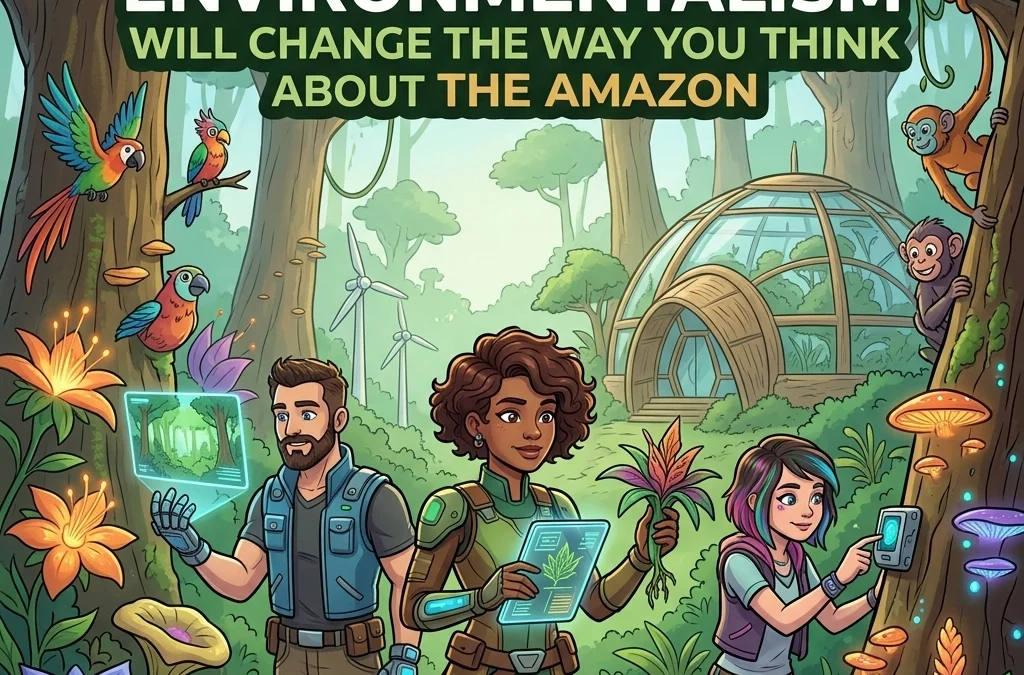
Meta Description: Discover why science fiction environmentalism is the secret to understanding the Amazon in 2026. Dive into The Rainsavers' world of Red Mercury, ancient tech, and eco-adventure!
Hey there, Rainsavers fans! Steven G. Samuels here.
It’s April 19, 2026, and I’ve been thinking a lot about the "Lungs of the Earth." You know the place, the Amazon Rainforest. For decades, we’ve been told the same story: it’s disappearing, it’s fragile, and we need to save it. And while that’s all 100% true, sometimes the way we talk about environmentalism feels a bit… well, dry.
That’s where science fiction environmentalism (or "Eco-Sci-Fi" as some of the team calls it) comes in. It’s not just about facts and figures; it’s about imagination. It’s about taking the very real threats our planet faces and turning them into an epic adventure that makes you want to get up and do something.
At The Rainsavers, we don’t just write books; we build worlds where the environment is the most important character. And today, I want to talk about why this genre is the key to changing how we look at the Amazon.
It’s Not Just a Forest; It’s a Living Machine
When most people think of the Amazon, they think of a vast, green expanse. But in the world of The Rainsavers, and in the realm of high-concept sci-fi, we see it as a complex, biological machine.
Think about it: the Amazon regulates the world's oxygen, influences weather patterns as far away as Texas, and holds secrets we haven’t even begun to unlock. Sci-fi environmentalism pushes us to ask: What if the forest was conscious? What if it was protecting something hidden beneath the canopy?
In our series, we explore the idea that the Amazon isn't just a victim of modern greed: it’s a fortress. When you start seeing nature as a powerful, active force rather than a passive victim, your whole perspective shifts. You stop pitying the planet and start respecting its power.

Alt text: A futuristic drone flying over a dense, glowing Amazonian canopy, showcasing a blend of nature and high-tech monitoring.
The "Red Mercury" Factor
One of the coolest parts of writing for The Rainsavers is playing with "what if" technology. Specifically, Red Mercury.
In 2026, we’re all looking for the next big energy breakthrough. In our fiction, Red Mercury represents that bridge between ancient mysteries and futuristic potential. When you place a high-tech MacGuffin like that in the heart of the Amazon, the stakes go through the roof.
It’s not just about "saving trees" anymore. It’s about protecting a source of power that could either save humanity or end it. This kind of storytelling makes the environmental message feel urgent. It’s not a distant problem for future generations; it’s a mission happening right now.
If you want to dive deeper into the tech that drives our stories, check out our Episodes page.
Character Spotlight: Seeing the Jungle through Primal’s Eyes
To really change your mind about the Amazon, you have to see it through the eyes of someone who lives it. Take Primal, one of our core team members.
While Leonard West might look at the Amazon and see a tactical challenge or a puzzle to be solved, Primal sees a legacy. For him, every vine and river is part of a history that stretches back long before modern technology existed.
Science fiction allows us to blend these perspectives. We get to see the Amazon as both a prehistoric wonder and a sci-fi battlefield. This duality is what makes the setting so vibrant. It’s not just "the woods": it’s the front line of the battle for Earth's soul.
You can meet the whole crew, including Mortalis and the rest of the gang, over at our characters page.

Alt text: A character profile sketch of Primal standing in a lush jungle environment, holding a piece of ancient technology.
Why Team-Based Adventures Beat Solo Heroes
We’ve talked about this before on the blog (check out Why Team-Based Adventure Series are Taking Over), but it’s worth repeating.
Environmentalism is a team sport. No one person can save the Amazon. Science fiction environmentalism reflects this by focusing on teams. The Rainsavers aren't a bunch of invincible super-people. They’re a group with different skills, different backgrounds, and: most importantly: different flaws.
When they go into the Amazon, they have to rely on each other. This mirrors the real world. Saving our planet’s most vital ecosystems requires global cooperation. By reading about a team working together to stop modern threats and uncover ancient mysteries, we’re subconsciously learning how to tackle our own real-world challenges.
Ancient Tech vs. Modern Threats
One of my favorite themes to explore is the clash between the old and the new. The Amazon is home to countless legends of lost cities and advanced ancient civilizations.
In The Rainsavers, we take those legends and give them a sci-fi twist. What if those ancient civilizations had technology that was actually better for the planet than what we have today? What if their "magic" was just a form of sustainable science we’ve forgotten?
This framing changes the Amazon from a "primitive" place to a "pioneer" place. It suggests that the answers to our future might be buried in our past. It’s a recurring theme in our books, and you can read more about it in our post on Ancient Tech vs. Modern Threats.

Alt text: A glowing ancient stone pillar hidden behind thick tropical leaves, pulsating with blue energy.
Making "Eco-Anxiety" disappear
Let’s be real: 2026 has been a bit of a rollercoaster. It’s easy to feel overwhelmed by news about the climate. That’s why we write these stories.
Science fiction environmentalism gives us a way to process our fears through action and adventure. Instead of feeling helpless, you get to ride along with characters who are actually doing something about it. It’s about empowerment.
We’ve heard from so many readers that The Rainsavers has helped them deal with their own climate anxiety. By turning the "Amazon problem" into a "save the world adventure," it becomes something we can wrap our heads around. If you’re feeling the weight of the world, take a break and jump into an adventure. You might find it changes the way you think about your own backyard!
For more on how fiction helps with real-world stress, check out our guide: Struggling with Climate Anxiety? Try an Adventure Series.
A Quick 2026 Adventure Tip
If you’re planning on doing some real-world exploring this year (maybe not to the heart of a Red Mercury site, but somewhere green!), remember Leonard West’s #1 rule: "Pack for the climate you want, but prepare for the one you’re in."
In 2026, weather patterns are more unpredictable than ever. Always carry a manual compass: tech is great until the canopy gets too thick or a solar flare hits!
Join the Mission
The Amazon is waiting, and so are the mysteries of the Red Mercury. Whether you’re a long-time fan or just discovering the world of sci-fi environmentalism, we’re glad to have you on the team.
The stories we tell today shape the world we build tomorrow. Let’s make it a world worth saving.
Ready to start your adventure?
Grab your copy of the latest Rainsavers adventure at the Shop!
Stay curious, stay brave, and keep saving those raindrops.
: Steven G. Samuels
CEO, The Rainsavers
Want to stay updated on all things Rainsavers? Follow our journey and check out our latest media updates at rainsavers.com.
