
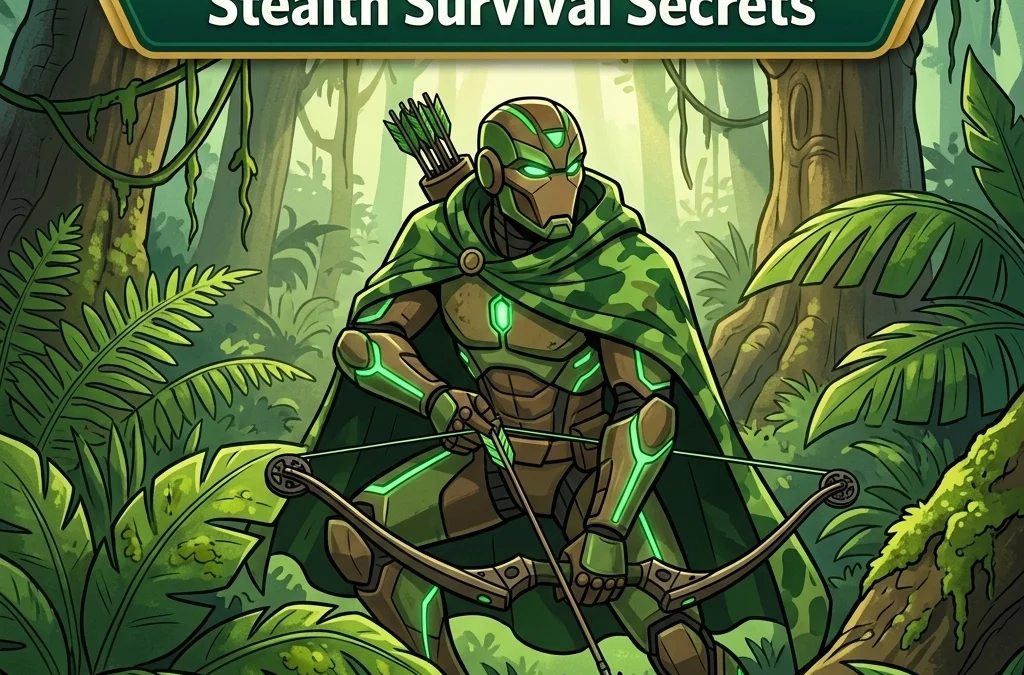
Meta Description: Master the art of the unseen with Jungle Dart’s ultimate guide to jungle stealth. From breaking your silhouette to the philosophy of the "Ghost Walk," learn how The Rainsavers survive the world's harshest environments without leaving a footprint.
Listen close, because I’m only going to say this once: and I’ll probably be gone by the time you finish the sentence.
In the world of The Rainsavers, being loud is a death sentence. Whether we’re tracking eco-terrorists through the Amazon or recovering ancient tech from a vine-choked ruin, our greatest weapon isn't a gadget or a gun. It’s the ability to disappear in plain sight. They call me Jungle Dart for a reason. I’m small, I’m fast, and if I’ve done my job right, you won’t even know I was in the room until the humidity drops and the objective is secured.
Being "Invisibly Green" isn't just about wearing camo fatigues you bought at a surplus store. It’s a mindset. It’s about understanding that the jungle isn't an obstacle: it’s an extension of your own body. If you’re struggling to stay under the radar in your own adventures (literary or otherwise), here are the field-tested stealth secrets that keep us alive.
1. Break the Silhouette (The Human Shape is a Snitch)
The human brain is hardwired to recognize two things instantly: faces and the human "T-shape" (head and shoulders). If you’re standing upright against a backdrop of vertical trees, you stick out like a neon sign in a library.
To become truly invisible, you have to break that outline. In the field, I use "scrim": strips of burlap or local foliage: attached to my gear. The goal isn't to look like a bush; it's to look like nothing. When the light hits a jagged, uneven edge, the eye passes over it. When it hits a straight shoulder line? Busted.

Pro-Tip from the Field: If you find yourself without gear, use the environment. Lean into the curves of the trees. Don’t stand next to a trunk; become part of its shadow. I once spent four hours tucked into the root system of a Ceiba tree while a security patrol literally ate lunch three feet away. They didn’t see me because I didn’t look like a person: I looked like a particularly lumpy piece of moss.
2. Mud: Nature’s High-Def Camouflage
Forget those fancy face paint sticks. They’re oily, they smell like chemicals, and they sweat off in twenty minutes. If you want to disappear, you need to get dirty.
Real jungle stealth requires local materials. Mud doesn't just mask your skin tone; it masks your thermal signature and your scent. In some of our more intense missions, especially when we’re dealing with high-tech sensors, a thick layer of cool river mud can be the difference between a successful extraction and a very uncomfortable interrogation.
The "Oops" Moment: Leonard West once tried to use a specific type of blue clay he found near a riverbank in the Congo. He thought it looked "tactical." Turns out, that specific clay is a favorite rubbing post for forest elephants. We spent the next three miles being chased by a very confused matriarch who thought Leonard was a long-lost relative. Lesson learned: Know your mud.
3. The Sound of Silence (The Ghost Walk)
The jungle is never actually quiet. It’s a literal wall of sound: insects buzzing, birds screaming, leaves rustling. The trick to stealth isn't being silent; it’s being rhythmic.
Nature has a beat. An unnatural sound: like a heavy boot snapping a dry twig: is a sharp spike in that rhythm. Every creature in the canopy stops to listen. That silence is what gets you caught.
To master the "Ghost Walk," you have to change how you move:
- The Toe-Heal Roll: Instead of stomping down, place your outer mid-foot down first, feel for twigs, and then roll your weight onto it.
- The Pause: For every three steps, stop for ten seconds. Listen. If the insects stop chirping, you’re moving too fast.
- Syncing with the Wind: Wait for a gust of wind to rustle the canopy before you make a big move. The noise of the leaves will mask your movement.

If you want to see how we put these moves into practice during our high-stakes missions, check out our episodes for some real-time action.
4. Scent: The Predator’s Secret Weapon
We spend a lot of time worrying about what people see and hear, but we forget what they smell. Humans smell like laundry detergent, deodorant, and processed snacks. To a jungle predator: or a trained scout: that’s a beacon.
When we’re deep in "Invisibly Green" territory, we ditch the soap. We rub crushed wild ginger or pine needles (depending on the biome) on our clothes. It sounds gross, but blending into the local olfactory landscape is crucial.
And for the love of the planet, don't eat a protein bar with an artificial "Mountain Berry" scent right before a covert approach. I’ve tracked enemies for miles just by following the smell of their cheap chewing gum.
5. Technology vs. The Green
At The Rainsavers, we often go up against villains who have more tech than sense. They use drones, thermal imaging, and motion sensors. You might think nature is at a disadvantage, but nature has had millions of years to perfect the art of the "hidden."
We use a mix of ancient techniques and eco-friendly tech to stay ahead. For example, some of our specialized suits use biomimicry to shift patterns slightly based on the surrounding light levels. But even the best tech fails. Batteries die. Circuits fry in the humidity. That’s why we always fall back on the basics.
As I always tell the team: "The jungle is a living thing. If you treat it like an enemy, it will expose you. If you treat it like an ally, it will hide you."

If you’re interested in how we balance these ancient mysteries with modern threats, you should dive into our deep dive on Ancient Technology vs. Modern Threats. It explains exactly why our enemies keep losing, despite their billion-dollar budgets.
6. The "Invisibly Green" Philosophy
Surviving without being seen isn't just about hiding from enemies. It’s about respect. A true Rainsaver leaves the environment exactly as they found it. No broken branches, no disturbed nests, no trash.
This philosophy is at the heart of everything we do. We’re environmental heroes because we believe the planet is worth saving, and you can’t save something if you’re stomping all over it. Whether we're featured in TV commercials or sneaking through the pages of our latest book, the goal is always the same: Maximum impact on the mission, zero impact on the Earth.
Are You Ready to Join the Hunt?
Stealth is a skill that takes years to master, but you can start today. Start by observing. Go sit in a park or a backyard. Try to sit so still that a bird lands within five feet of you. If you can do that, you’ve taken your first step into my world.
If you’re struggling with the weight of the world: what some call climate anxiety: sometimes the best cure is to lose yourself in an adventure where the good guys actually have a plan. We’re out there, in the green, making sure there’s still a world left to hide in.
Think you have what it takes to be as stealthy as a member of our team? Or maybe you just want to read about us failing miserably before we get it right?
Head over to our shop to grab the series, or if you’ve got a burning question about how to handle a jaguar encounter (hint: don’t try to pet it), you can contact the author directly.
And don't forget to check out our Down the Rabbit Hole Contest to see if you can find the hidden secrets we’ve tucked away across our site.
Stay hidden. Stay green.
: Jungle Dart
For more eco-adventure tips and updates from the front lines of the environmental war, visit The Rainsavers.
