
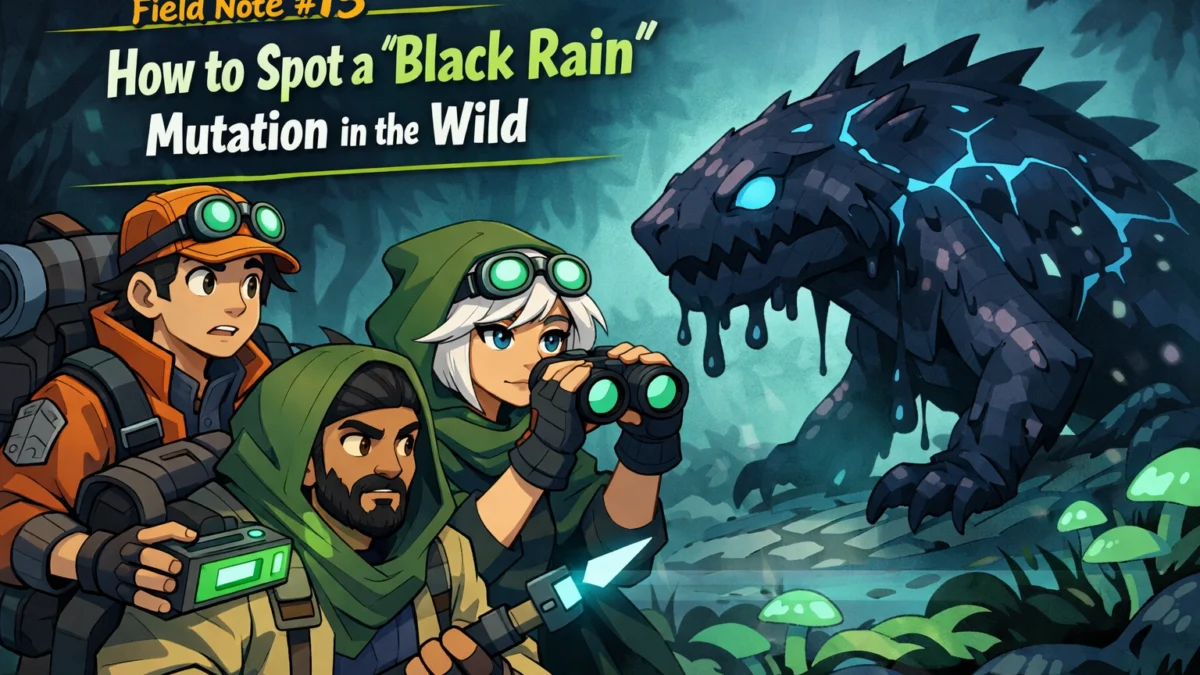
Meta Description: Dive into the eerie world of Book Two with Field Note #15. Learn how to identify "Black Rain" mutations using tactical scanners and German WWII-era research clues. Stay safe out there, Rainsaver!
ALT Text: A close-up tactical view of a hand-held scanner detecting a glowing, neon-veined plant in a dark, misty jungle environment.
Hey Rainsavers, Steven here.
Or, well, it’s Steven’s notes being transcribed by Penny while Steven tries to explain to a park ranger why he’s carrying a localized weather-mapping array in a duffel bag. (Update: The ranger is not amused, and Steven is currently "offering a very detailed educational seminar" on atmospheric density. We might be here a while.)
Anyway, back to business. If you’ve been following our journey at The Rainsavers, you know that things got… weird in Book Two. We aren’t just dealing with regular old climate change anymore. We’re dealing with the Schwarzer Regen, the Black Rain.
This isn't your garden-variety drizzle. This is a legacy of a Sonderprojekt (special project) gone wrong, a bit of WWII-era science that decided to wake up eighty years later and start rewriting the DNA of the Amazon. If you’re out in the field, whether that’s a deep-jungle trek or just reading along from your couch, you need to know what you’re looking at.
Here is your official (mostly approved) field guide to spotting a mutation before it spots you.
1. The "Wunder-Wuchs" (Wonder-Growth) Factor
The first sign that the Black Rain has touched an area isn’t usually a giant monster. It’s the plants. We call it Wunder-Wuchs. In the original German research notes we recovered from that rusted bunker (you know the one, with the terrifyingly heavy door), the scientists noted that flora exposed to the Nebel (mist) didn't just grow; they accelerated.
Look for ferns that have the structural integrity of steel cables. If you see a lily that’s the size of a Volkswagen and smells like ozone and old pennies, don’t sniff it. That’s a Giftspritze (poison sprayer).
Pro-Tip: If the plant seems to be pulsing in time with your own heartbeat? That’s not a "connection with nature," that’s a predatory bio-rhythm. Back away slowly.

ALT Text: A mutated tropical flower with glowing purple veins and jagged, metallic-looking leaves.
2. Identifying the "Irrlicht" Glow
You’ve seen the bioluminescence in those nature documentaries, right? Pretty, glowing plankton, happy little jellyfish. Yeah, this isn’t that.
The "Black Rain" mutation creates an Irrlicht effect, an eerie, sickly green or violet glow that doesn't flicker. It’s steady. It’s the result of the Abart (anomaly) processing heavy metals pulled directly from the soil.
When you’re using your hand-held scanner, and please tell me you calibrated yours this morning, watch the spectral analysis. If the magnesium levels are off the charts in a living organism, you’ve found a mutation.
Oops Moment: Steven once tried to follow an Irrlicht thinking it was a rare firefly. It turned out to be the lure of a Schatten-Kröte (Shadow Toad). He lost a very good boot that day. We don't talk about the boot.
3. Tactical Scanner Calibration (The "Don't Die" Settings)
Your scanner is your best friend. Without it, you’re just a person in a very damp forest waiting to become fertilizer. To properly spot a mutation, you need to set your scanner to the "Gamma-Echo" frequency.
The Black Rain leaves a residual isotopic signature. In Book Two, we discovered that the original German researchers used a device called a Geiger-Zähler-Plus. Our modern tech is better, but the principles are the same.
Look for these readings on your display:
- Carbon-14 Discontinuity: If the scanner can't decide if the tree is 2 years old or 2,000 years old, it’s mutated.
- Acoustic Anomalies: Mutations often emit a low-frequency hum (around 19Hz). It’s just below the human hearing threshold, but it makes you feel like someone is standing right behind you. If you get the "chills," check the scanner.

ALT Text: A digital readout of a tactical scanner showing high radiation levels and a 3D wireframe of a distorted canine-like creature.
4. Behavioral Shifts in the "Nachtjäger"
Animals are the hardest to spot because they’re fast. But the Nachtjäger (Night Hunters) have specific tells.
In the wild, a jaguar will avoid you. A Black Rain jaguar will watch you. It won't growl. It won't hiss. It will just… wait. The mutation strips away the natural fear of humans and replaces it with a cold, calculated curiosity.
We’ve noticed that mutated fauna often exhibit Spiegel-Verhalten (mirroring behavior). If you stop, they stop. If you tilt your head, they tilt theirs. It’s not cute. It’s the mutation trying to figure out if you’re a threat or a snack. (Hint: In the Black Rain’s eyes, we’re all snacks).
5. The Architecture of the "Bunker-Reste"
Sometimes you spot the mutation by looking at what’s around it. The Schwarzer Regen was developed in secret Forschungsstellen (research stations) during the 1940s. These locations are often the "Ground Zero" for the heaviest mutations.
If you find concrete structures with "Eagle and Globe" insignias: usually hidden under thick, oily vines: you are in a high-risk zone. The soil here is saturated with the original chemical formula.
Wait, what was that noise?
(Penny’s note: Steven just dropped his scanner. He’s fine. The scanner is… mostly fine. He’s now trying to tape it back together with duct tape. Very professional.)

ALT Text: An overgrown, moss-covered concrete entrance to an underground bunker with rusted iron doors.
6. Summary: The Rainsaver Checklist
Before you head out into the "Down the Rabbit Hole" contest zones or just continue reading the series, keep this checklist in your tactical pocket:
- Check the Color: Is it "Nuclear Sunset" orange or "Ghost Ship" violet? It’s a mutation.
- Check the Sound: Is there a hum that makes your teeth ache? It’s a mutation.
- Check the History: Are there rusted German gears nearby? You’re definitely in a mutation zone.
- Check Your Gut: Does the forest feel like it’s holding its breath? Run.
We aren't superheroes. We don't have capes, and we certainly don't have invulnerability. We’re just people with scanners, a bit of history, and a lot of nerve. That’s what being a Rainsaver is all about: facing the mysteries of the past to save the future.
If you want to see how Steven and the team handled their first encounter with a Wächter (Guardian) mutation, you’ll have to check out the latest chapters. Trust me, it involves a lot more running and a lot less "cool tactical standing around."

ALT Text: Steven G. Samuels looking stressed while holding a duct-taped scanner in a dark forest.
Why Does This Matter?
The "Black Rain" isn't just a plot point. It’s a warning. In our world, the changes happen slower, but they’re just as real. At The Rainsavers, we believe that adventure stories can be a lens to look at our own planet. Plus, who doesn't love a good mystery involving secret bunkers and glowing jungle wolves?
If you’re ready to dive deeper into the science (and the madness) of Book Two, head over to our site. We’ve got character bios, maps of the Schwarzer Regen impact zones, and enough lore to keep you busy until the next solar eclipse.
Don't forget to enter our latest challenge:
Think you can spot a mutation? We’re running the Down the Rabbit Hole Contest where you can submit your own "Field Notes" for a chance to be featured in our upcoming releases!
Stay safe, keep your scanner charged, and for heaven's sake, don't eat the glowing berries.
: Steven (and Penny)
Join the Adventure
Want to see the Black Rain in action?
Get your copies of the books, grab some gear, and join the ranks of the world's most caffeinated eco-adventurers. The planet isn't going to save itself, and those mutations aren't going to document themselves!
Check out more from the blog:
