
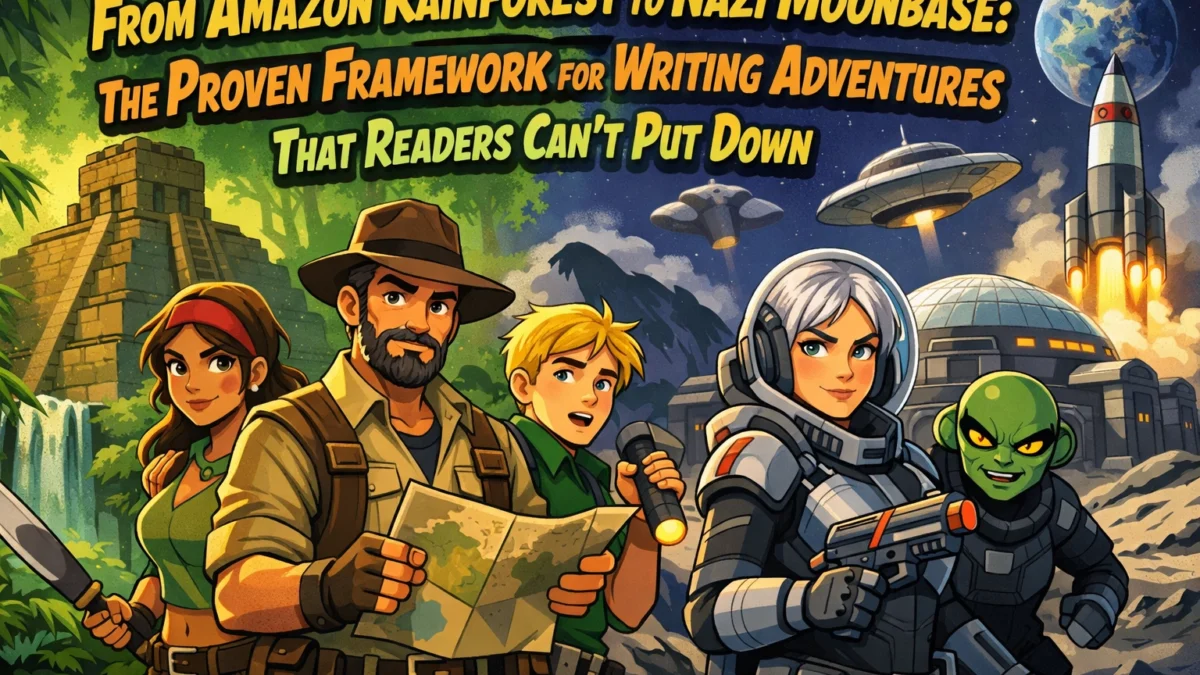
Meta Description: Learn the proven framework for scaling adventures from jungle expeditions to moonbase showdowns, while keeping eco-themes front and center. See how The Rainsavers nails it across six books.
Let's be honest: taking readers from a humid rainforest mission to a literal Nazi moonbase sounds like a ridiculous creative flex. But in 2026, that's exactly what makes a multi-book adventure series work. The trick? A scalable framework that keeps the eco-themes grounded even when your heroes are breathing recycled oxygen on the lunar surface.
Here's how to pull it off without losing your readers, or your mind.
Start Small, Think Massive
Your first book doesn't need to save the galaxy. It needs to save something real. In The Rainsavers, the team starts in the Amazon, boots on the ground, sweat on their backs, fighting illegal loggers and corporate greed. The stakes? A rainforest. The vibe? Tactical, immediate, and deeply personal.
This is your foundation. Readers need to care about why your heroes fight before you send them to Antarctica or outer space. If they don't feel the stakes in Book One, they won't stick around for Book Six when things get weird.
The Formula:
- Book 1: Local threat, tangible villain, eco-crisis readers can visualize
- Books 2-3: Expand the geography (new continent, underwater base, ancient ruins)
- Books 4-6: Scale the weirdness (space, time travel, secret moon Nazis, whatever fits your universe)

Keep the Mission Clear, Even When the Setting Gets Wild
Here's where most writers crash and burn: they change the location but forget to change the lens. Your heroes might be on the moon, but if they're still thinking about oxygen recycling, water conservation, and resource scarcity, guess what? You're still writing eco-fiction.
The Rainsavers crew faces this exact challenge. Whether they're in the Sahara, Egypt, or literally space, the core conflict stays consistent: powerful people hoarding resources, environmental destruction as a weapon, and a small team fighting back with tech, grit, and field respirators that look cooler than they have any right to.
Pro Tip: Your setting should amplify the eco-theme, not replace it. A moonbase isn't just a sci-fi backdrop, it's a closed ecosystem where one bad decision can kill everyone. That's eco-horror gold.
Escalate the Danger, Not Just the Spectacle
Bigger doesn't always mean better. A firefight on the moon sounds epic, but if your readers don't feel the stakes, it's just noise.
The proven framework for escalation:
- Physical danger , Early books focus on survival (jungle traps, wildlife, armed mercenaries)
- Global stakes , Mid-series threats affect entire ecosystems or populations
- Existential risk , Final books introduce threats that could reshape humanity's future
Notice what doesn't change? The team still has to care. Your villain can threaten the world, but if your hero's best friend is also in danger, readers will feel it twice as hard.
In The Rainsavers universe, the antagonist Bossman scales from "corrupt CEO destroying rainforests" to "guy with a literal moonbase plotting something unhinged." But the heroes' motivation stays grounded: stop him before more people and ecosystems get crushed under his greed.
Build a Team That Balances Skills and Chaos
Solo heroes are dead in 2026. Readers want teams, characters who bicker, complement each other's skills, and occasionally save each other's lives in ways that make you go "okay, that was clever."
Your adventure framework needs:
- The strategist (plans the mission, keeps everyone focused)
- The tech genius (solves problems with gadgets and hacking)
- The wildcard (takes risks, creates chaos, somehow pulls off miracles)
- The heart (reminds everyone why they're fighting in the first place)

Mix these archetypes, give them real flaws, and watch the magic happen. The Rainsavers team works because they're not superheroes: they're skilled, exhausted, occasionally terrified people doing their best with experimental respirators and salvaged tech.
Use Setting as a Character
Your moonbase isn't just a backdrop. It's a threat. It has rules, dangers, and quirks that shape how your heroes operate.
Think about how each location changes the game:
- Amazon rainforest: Humidity, diseases, limited visibility, guerrilla tactics
- Antarctic research station: Isolation, cold that kills in minutes, no escape routes
- Ancient Egyptian ruins: Traps, curses(?), historical mysteries that tie into modern threats
- Nazi moonbase: Limited oxygen, low gravity combat, zero room for error
Each setting should force your heroes to adapt. New gear, new strategies, new ways to screw up. That's what keeps readers hooked: not just where the team goes, but how they survive it.
Tie Everything Back to the Core Theme
This is the secret sauce. No matter how wild your adventure gets, every book needs to circle back to why your heroes started fighting.
For The Rainsavers, it's always about protecting ecosystems and stopping corporations from weaponizing nature. Book One? Illegal logging. Book Six? A moonbase powered by stolen resources and genocidal ambitions. Different scale, same villain mindset.
Readers will forgive a lot of weirdness if you keep the thematic core consistent. Your eco-vigilantes can fight Nazis on the moon: as long as the fight still means something for the planet.
Quick Checklist:
- Does this mission connect to the original eco-threat?
- Are the stakes personal and global?
- Can readers see how this villain's plan hurts real ecosystems?
- Do your heroes' skills and values stay consistent?
If you answered yes to all four, you're golden.
The Payoff: Readers Who Can't Stop at Book One
When you nail this framework, something magical happens: readers binge. They finish Book One and immediately grab Book Two because they need to know what happens in the Sahara. Then Antarctica. Then Egypt. Then space.
Why? Because you've built a world that scales without breaking. Your heroes stay grounded, your themes stay consistent, and your settings keep upping the ante in ways that feel earned, not random.
The Rainsavers pulls this off across six books by treating every location as a new chapter in the same fight: not a random detour. The team grows, the tech evolves, and the threats get more absurd, but the mission never changes: stop Bossman, protect the planet, survive another day.

Ready to See It in Action?
If you're wondering how a series goes from jungle ops to moonbase showdowns without losing its soul, there's only one way to find out. See how we blend both in The Rainsavers series: where eco-fiction meets tactical espionage meets "wait, did they really just fight Nazis on the moon?"
Spoiler: they did. And it works.
See how we blend both and grab Book One now.
