
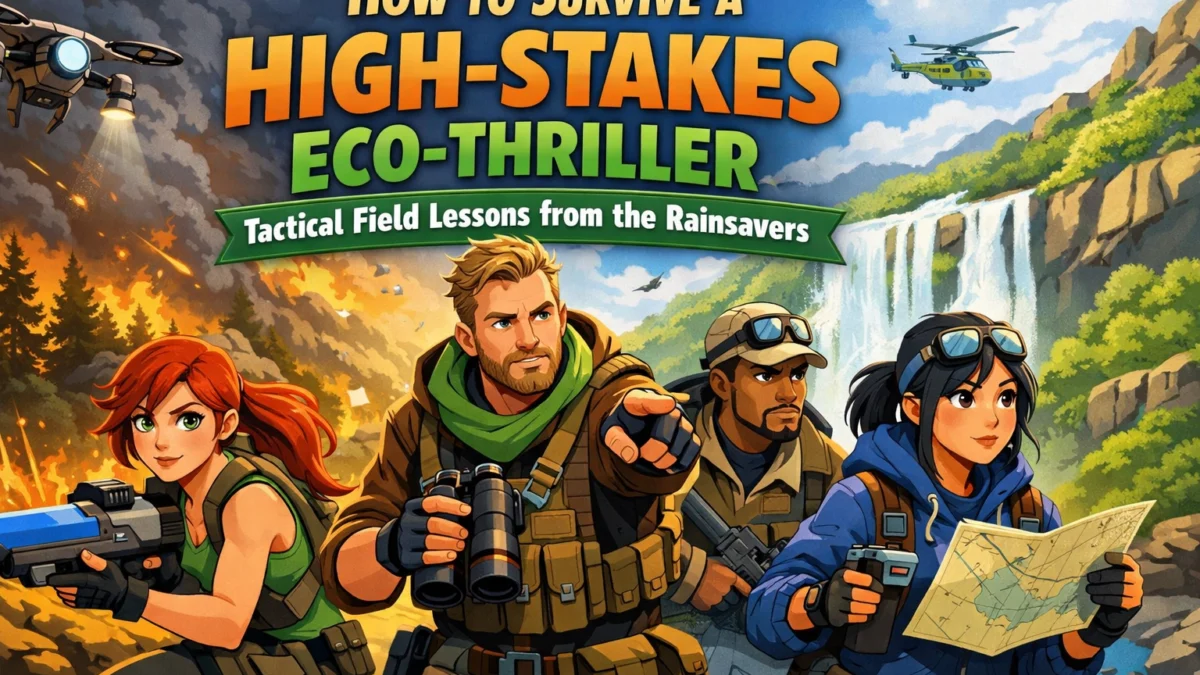
Meta Description: Get the tactical edge. Learn the field survival secrets of the Rainsavers as they navigate high-stakes eco-thrillers in 2026. Teamwork, tech, and eco-hope included.
ALT text: A rugged tactical backpack equipped with high-tech glowing sensors and a professional-grade field respirator resting on a damp jungle floor.
Look, we’ve all been there. You’re deep in the Amazon, the humidity is at 100%, your boots are squelching with every step, and you realize: quite suddenly: that the corporate mercenaries chasing you have much better satellite coverage than you do.
It’s 2026. The world is a different place. The stakes for our planet have never been higher, and neither has the tension in our favorite fiction. At The Rainsavers, we don't just write stories; we build survival blueprints. If you’re going to survive a high-stakes eco-thriller, you need more than just a sense of justice and a cool haircut. You need a tactical mindset.
I’m Steven G. Samuels, CEO of The Rainsavers, and I’ve spent enough time in the world of Book One to know that solo heroics are a great way to get yourself lost in the canopy. Today, we’re breaking down the field lessons that keep our team alive. Grab your gear; we’re going in.
Lesson 1: The Gear is Your Lifeline (And It’s Not a Cape)
In 2026, the "superhero" look is out. Capes get caught in vines, and spandex is a one-way ticket to heatstroke. The Rainsavers rely on "Rainsaver Standard Issue": gear designed for the intersection of high-tech environmental monitoring and tactical survival.
The centerpiece of any Rainsaver’s kit is the Advanced Tactical Field Pack. This isn’t your middle school backpack. We’re talking integrated bio-sensors that track local air quality, soil toxicity, and even the "stress levels" of the surrounding flora. Why? Because the jungle talks if you know how to listen. If the trees are reacting to a chemical spike two miles upriver, you want to know before you start drinking the water.

ALT text: A close-up of a high-tech sensor array glowing blue against the dark greens of a dense rainforest canopy.
Pro-Tip: Always carry a field respirator. In an eco-thriller, the villain isn't just a guy with a gun; it’s often a localized climate disaster or a bio-engineered toxin. If you can’t breathe, you can’t save the world.
Lesson 2: Forget Solo Valor: Teamwork or Bust
We see it all the time in old-school stories: one guy takes on an entire army. In a real-world eco-crisis? That guy gets a cramp and disappears. The Rainsavers operate on a team-based model because diversity of skill is the only way to tackle complex environmental threats.
We’ve actually talked about this before: why team-based adventure series are taking over. When you’re facing ancient mysteries mixed with modern corporate greed, you need a hacker, a biologist, a navigator, and someone who knows how to fix a drone with duct tape and hope.
In Book One, our team doesn't win because they’re the strongest; they win because they communicate. If you’re trying to survive your own high-stakes adventure, find your squad. If you think you can do it alone, you’ve already lost.
Lesson 3: Environmental Awareness (The "Eco" in Thriller)
To survive a thriller at The Rainsavers, you have to treat the environment as a character, not a background. The mud, the rain, and the heat are players in the game.
In 2026, the terrain is changing. We’re seeing a shift in how readers perceive these settings. It’s no longer just a "scary forest." It’s a fragile ecosystem under attack. Survival means understanding how to use the terrain without destroying it. We call this "Low-Impact Tactical Maneuvering."

ALT text: A tactical map displayed on a transparent tablet, showing heat signatures and water flow patterns in a tropical region.
Whether it's ancient technology vs modern threats or navigating a flood zone, the key is data. A Rainsaver doesn't just run through the woods; they analyze the topography. They know which way the wind is blowing (literally and politically).
Lesson 4: Field Notes & "Oops" Moments
Look, tactical survival sounds cool, but it’s messy. Real messy. If you want to know what it’s actually like in the field, you have to look at the moments that didn't go according to plan.
Field Note #42: The "Rock" Incident
Character: Jax (Tactical Specialist)
Note: Do not, under any circumstances, attempt to use a moss-covered boulder as a tripod for a long-range sensor without checking if said boulder is actually a very grumpy, very large turtle. Sensor destroyed. Turtle fine. Jax’s dignity? Non-existent.
Field Note #109: The Humidity Factor
Character: Maya (Tech Analyst)
Note: Note to self: "Water-resistant" does not mean "Submerged-in-a-tropical-storm-for-three-days-resistant." Next time, bring more rice. Or a better case.
These "oops" moments are what make the Rainsavers human. We aren't invulnerable icons; we’re people trying our best in a world that’s literally catching fire. We believe that eco-fiction will change the way you think precisely because it’s grounded in these very human mistakes.

ALT text: A humorous sketch of a Rainsaver character trying to dry out a high-tech gadget over a small, controlled campfire.
Lesson 5: Combatting Climate Anxiety with Action
Survival isn't just physical; it's mental. In 2026, climate anxiety is a real threat to the mission. If the team loses hope, the mission fails. This is why we focus on "Eco-Hope."
It’s easy to look at the state of the world and want to give up. But the Rainsavers are built on the idea that every small win counts. Whether you’re struggling with climate anxiety or just looking for a way to engage with the world’s problems through fiction, the lesson is the same: Action is the antidote to despair.
When we’re in the field, we don't focus on the global catastrophe. We focus on the next fifty yards. We focus on the person to our left and our right. We focus on the data in front of us.

ALT text: Two members of the Rainsaver team looking out over a sunrise in a lush, recovered valley, their gear reflecting the morning light.
The Ultimate Survival Checklist
If you find yourself dropped into a Rainsavers episode tomorrow, here is your quick-start guide:
- Check Your Seal: Is your field respirator airtight? Check it again.
- Sync Your Comm-Link: If you can’t hear your team, you’re just a target.
- Calibrate the Sensors: Nature is your early-warning system. Don't ignore the bio-spikes.
- Hydrate or Die: If you haven’t drunk a liter of filtered water in the last two hours, you’re already behind.
- Keep the Hope: The mission is larger than you. If you go down, make sure the data gets out.
Why We Tell These Stories
At The Rainsavers, we believe that the thrill of the hunt and the rush of the adventure are even better when the stakes are real. We aren't fighting alien invasions; we’re fighting for the ground beneath our feet. We’re moving away from the "superhero" tropes of the past and into a future where modern eco-heroes are saving both fiction and the planet.
Survival in a high-stakes eco-thriller isn't about having the biggest explosion. It’s about having the best team, the right gear, and the resilience to keep moving forward when the storm hits.
Are You Ready to Join the Team?
The mission is just beginning. Book One is your field manual, and the world of 2026 is our playground. If you’re tired of the same old solo-hero stories and want something that feels like it could happen in your own backyard (if your backyard was a high-stakes tactical zone), then you’re in the right place.
Dive into the adventure now. Explore the world of The Rainsavers and see if you have what it takes to survive the field.
