
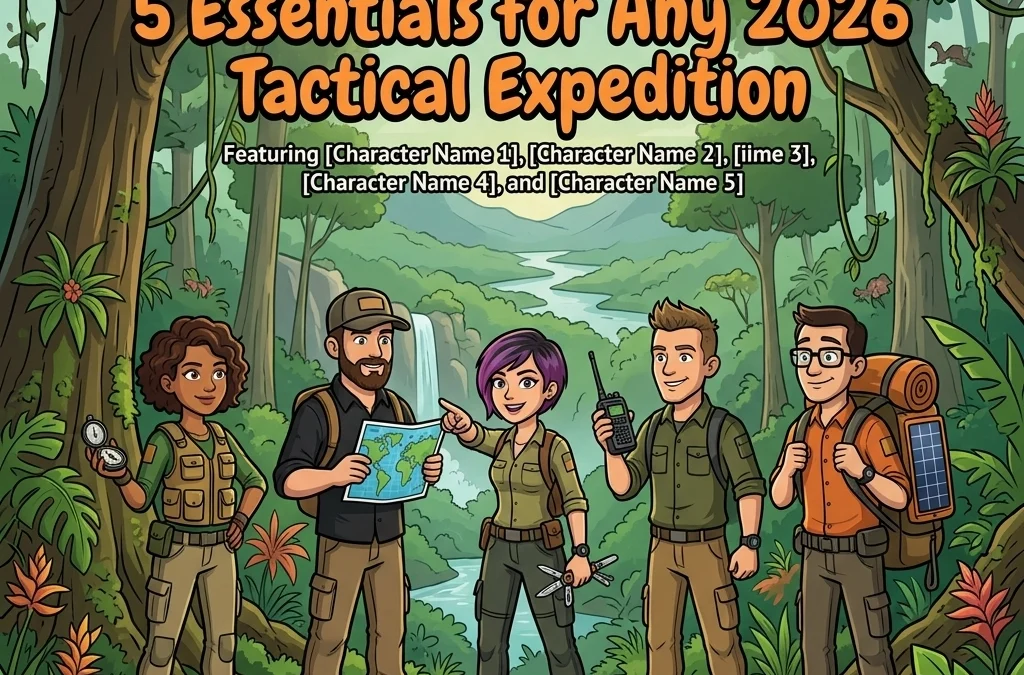
Meta Description: Heading into the Amazon in 2026? Whether you’re a seasoned field agent or a first-time eco-adventurer, these 5 tactical essentials will keep you breathing, moving, and connected. Check out the gear that makes The Rainsavers' expeditions possible.
Hey there, fellow adventurers! Steven G. Samuels here. If you’ve been following our journey at The Rainsavers, you know that we don’t just write about the jungle: we live it. Or at least, our characters do, and we spend a lot of time researching exactly what it takes to keep them alive in the most unforgiving environments on the planet.
As we move deeper into 2026, the Amazon isn't just the "lungs of the planet" anymore; it’s a high-tech frontier where nature and shifting climates are constantly rewriting the rules of survival. If you’re planning a tactical expedition: or just dreaming of one while reading our latest book: you need more than just a sharp knife and a "can-do" attitude. You need a kit that can handle the humidity, the bio-hazards, and the unpredictable tech-anomalies of the modern world.
Here are the five essentials that every member of my team packs before we even think about stepping off the transport.
1. The Aegis-7 Respirator (Climate-Control Grade)
In 2026, the Amazon air is… thick. And I’m not just talking about the 99% humidity that makes you feel like you’re breathing through a wet sponge. Between the increased fungal spore counts and the localized "micro-pollutants" we're seeing in certain sectors, your lungs need a bodyguard.
The Aegis-7 isn’t your grandfather’s gas mask. It’s a low-profile, high-flow respirator designed specifically for high-exertion tactical movements.
Why it’s essential:
- Active Dehumidification: It actually strips the moisture out of the air before it hits your windpipe, preventing that "drowning on dry land" feeling.
- Bio-Shielding: It filters out 99.9% of airborne pathogens, which is a lifesaver when you’re trekking through decaying organic matter that hasn't been disturbed in centuries.
- Voice Integration: Let’s be honest, trying to shout over a tropical downpour while wearing a mask is a losing battle. The Aegis-7 has a built-in comm-link that keeps your voice crystal clear for the rest of the team.

2. The Handheld Multi-Spectral Scanner
Gone are the days when a simple magnetic compass was enough to get you home. In the deep canopy, GPS is spotty at best, and the geological anomalies we’ve been tracking (the kind that drive the plots of our stories!) can play havoc with traditional electronics.
A handheld multi-spectral scanner is the "Swiss Army Knife" of 2026 navigation. It doesn’t just tell you where North is; it tells you what’s under the mud.
What to look for:
- Lidar Mapping: This allows you to "see" through the dense foliage to find solid ground or hidden structures (like those ancient German bunkers we’re always hearing about).
- Chemical Analysis: Is that water safe to filter? Is that weird blue frog going to give you a heart attack if you touch it? The scanner gives you real-time feedback on the chemistry of your environment.
- Thermal Overlays: Essential for spotting predators (or rival expedition teams) before they spot you.
3. Kinetic-Tread Jungle Boots (Self-Draining)
Foot rot is the silent killer of any Amazon expedition. If your feet stay wet for three days straight, you’re not just miserable: you’re a liability. In 2026, we’ve finally perfected the balance between tactical protection and extreme drainage.

Our preferred specialized jungle boots feature a kinetic-tread system. Every time you take a step, the pressure of your heel acts as a pump, forcing water out through one-way valves in the sole.
Pro-Expedition Tip: Never skimp on the socks. Even with self-draining boots, you need copper-infused liners to fight off the jungle funk. We’ve seen tough-as-nails field agents reduced to tears because they wore basic cotton socks. Don't be that person.
4. Bio-Luminescent Signaling & Lighting
Flashlights are great, but batteries are heavy and light-pollution can be a problem if you’re trying to stay low-profile. For 2026, we’ve moved toward bio-luminescent signaling.
These are small, "crick-and-glow" style sticks, but instead of harsh chemicals, they use synthetic proteins that mimic the glowing fungi found in the deep Amazon. They provide a soft, ambient glow that doesn't ruin your night vision and won't attract every moth within five miles.
Tactical uses:
- Trail Marking: Drop a low-glow marker every fifty yards so your team can find their way back to the extraction point.
- Emergency Signaling: Many of these sticks have a "flash" mode that creates a strobe effect visible from the air, even through the canopy.
- Silent Comms: Use different colors (Blue for "all clear," Amber for "hold position") to communicate with your team without making a sound.

5. Multi-Phase Water Purification (The "Life-Straw" 2.0)
Water is everywhere in the Amazon, but you can’t drink a drop of it without some serious processing. In 2026, we’re dealing with more than just bacteria; we’re looking at micro-plastics and heavy metal runoff from upstream mining operations.
A multi-phase purifier is non-negotiable. You want something that uses a combination of mechanical filtration, UV-C sterilization, and activated carbon.
Field Notes:
In our latest adventure series, the team often has to rely on "found water" in the ruins of ancient civilizations. In the real world, you should always carry at least two liters of "clean" water on your person, but your purifier is your insurance policy for when things go sideways.

Why the Kit Matters in 2026
You might be wondering why we’re so obsessed with gear at The Rainsavers. It’s simple: the line between "adventure" and "disaster" is usually drawn by the tools you have in your pack.
When we’re writing about eco-heroes saving the planet, we want the tech to feel real. We want you to feel the weight of the Aegis-7 on your face and hear the hum of the multi-spectral scanner. In 2026, survival is a tech-game as much as it is a physical one. The Amazon is changing, and our gear has to change with it.
What Stays Home?
Just as important as what you bring is what you leave behind.
- Heavy Steel Plates: Unless you’re expecting a full-scale firefight, the weight will kill you faster than a bullet. Go for liquid-armor or high-density polymers.
- Standard GPS Handsets: Without a local signal booster, they’re just expensive paperweights in the deep bush.
- Cotton Anything: Seriously, if it’s cotton, it’s a sponge for mold.
Ready to Join the Expedition?
Tactical expeditions aren't just about the gear; they're about the mindset. They're about knowing that when the rain starts pouring and the scanner starts pinging, you have exactly what you need to see the mission through.
We spend all day dreaming up these scenarios so that when you read our books, you’re right there in the mud with us. If you’re ready to see how this gear looks in action: and maybe uncover a few ancient mysteries along the way: keep your eyes on our field reports.
Stay safe out there, and remember: the jungle always has the home-field advantage. Be prepared!
: Steven G. Samuels, CEO of The Rainsavers
