Meta Description: Meet Bossman, The Rainsavers' slickest corporate villain. He's turning the Amazon rainforest into profit, one buzzword at a time. Here are 5 terms that prove he's very good at being bad.
Look, every great villain needs a brand.
In 2026, you can't just show up with a scary mask and expect people to take you seriously. You need a mission statement. A LinkedIn profile. Maybe a TED Talk about disruption. And if you're Bossman, the ruthlessly charming antagonist from The Rainsavers series, you need a vocabulary that makes destroying the Amazon rainforest sound like a quarterly growth initiative.
That's right. We're talking corporate villainy at its finest.
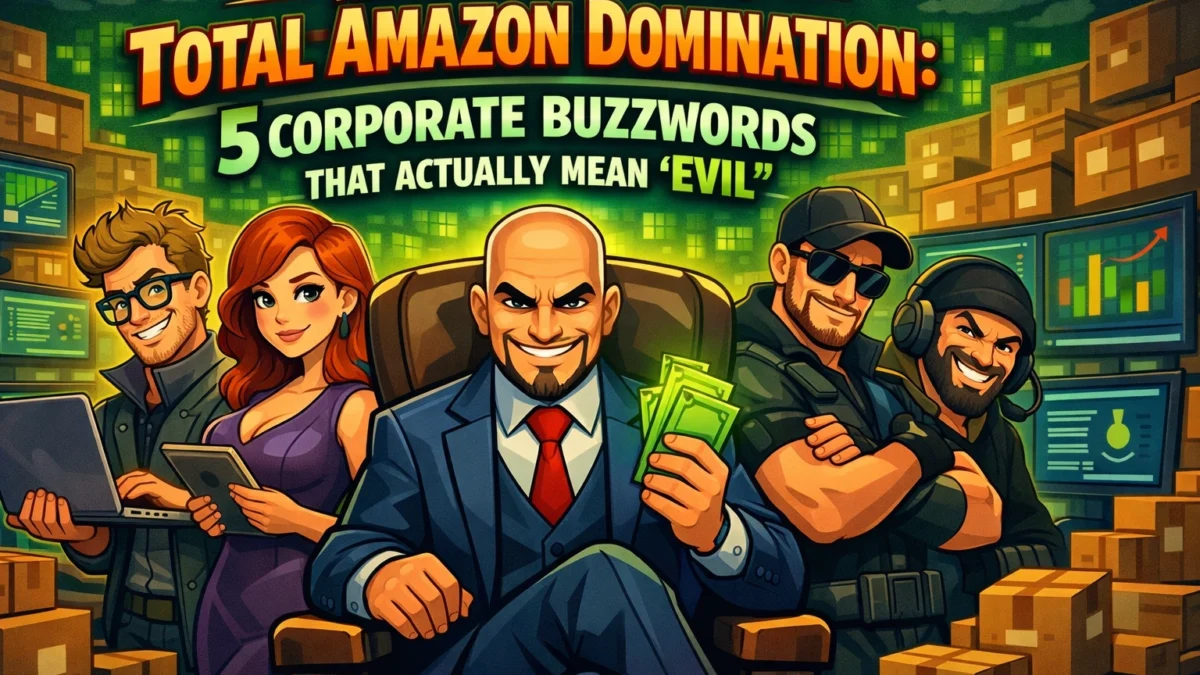
While Dr. Mubari and the Rainsavers crew are out there trying to save endangered species and stop ecological collapse, Bossman is in a climate-controlled boardroom, sipping single-origin coffee, and saying things like "streamline resource acquisition" when he really means "cut down all the trees."
So let's decode the playbook. Here are 5 corporate buzzwords Bossman loves, and what they actually mean when a fictional supervillain uses them.
1. "Maximize Stakeholder Value"
Translation: "I'm going to extract every last resource from this rainforest and leave nothing behind but a tax write-off."
Bossman loves this one. It sounds so responsible, doesn't it? Like he's looking out for investors, employees, maybe even local communities.
Nope.
In practice, "maximizing stakeholder value" means turning a biodiversity hotspot into a quarterly earnings report. It means paving over jaguar habitats to install distribution centers. It means hiring mercenaries with tactical respirators to intimidate anyone who asks inconvenient questions about, you know, extinction.
The beauty of this phrase is its flexibility. Stakeholders could mean shareholders. Or board members. Or that one nephew who keeps asking when the yacht upgrade is coming. It definitely doesn't mean the 400 species of birds currently losing their nesting grounds.
Oops moment: In Book Two, Bossman accidentally uses this phrase during a live-streamed shareholder meeting while literally standing in front of a burning forest. The optics were… not great. But his PR team spun it as "aggressive carbon offset strategy." (It didn't work.)

2. "Streamline Operations"
Translation: "Fire the people who care, automate the process, ignore the consequences."
Streamlining sounds efficient, doesn't it? Who doesn't want a leaner, meaner operation?
But when Bossman says it, what he really means is: "Let's remove every step in the supply chain that involves a human conscience."
Environmental impact assessments? Streamlined (a.k.a. skipped).
Community consultations? Streamlined (a.k.a. bribed or intimidated).
Ethical sourcing? Streamlined (a.k.a. what's that?).
In The Rainsavers, Bossman's entire empire runs on the principle of removing "inefficiencies", which is corporate-speak for "anything that slows down profit." This includes things like labor rights, safety protocols, and oh yeah, the continued existence of the Amazon rainforest.
The genius of "streamline" is that it sounds proactive. Progressive, even. Like you're trimming fat. Not, you know, dismantling an entire ecosystem.
3. "Leverage Synergies"
Translation: "I'm going to combine all my evil plans into one mega-evil plan."
If you've ever sat through a corporate merger meeting, you've heard this one. "Synergies" are supposed to happen when two companies join forces and become more powerful together.
For Bossman, synergies mean coordinating strip mining, illegal logging, and black-market biotech research into a single vertically integrated catastrophe. Why ruin the rainforest in three separate ways when you could ruin it all at once and call it innovation?
In Book Three, Bossman literally pitches a "Synergy Summit" to his investors, where he unveils plans to combine deforestation tech with genetic experimentation. (Spoiler: Dr. Mubari crashes the summit wearing a stolen lab coat and a lot of righteous anger.)
Oops moment: Bossman's internal memo about "leveraging bio-synergies with indigenous displacement protocols" gets leaked to the press. Turns out, saying the quiet part out loud is bad for your ESG score.

4. "Achieve Operational Excellence"
Translation: "I will squeeze every ounce of productivity out of this operation, ethics be damned."
Operational excellence is the holy grail of corporate culture. It means everything runs like a well-oiled machine. No waste. No delays. No questions.
For Bossman, it means his teams work 18-hour shifts in sweltering jungle heat, pressured to hit quotas that make "make rate" look generous. It means if you're not hitting your KPIs (Key Performance Indicators), you're out, or worse, you're reassigned to "field testing" in areas with suspiciously high jaguar activity.
The Rainsavers series doesn't shy away from showing what "excellence" looks like when a villain is in charge. Spoiler: it involves a lot of respirators, very few bathroom breaks, and a company culture best described as "aggressively toxic."
Oops moment: One of Bossman's middle managers quits and immediately writes a tell-all titled Surviving Excellence: My Year in Bossman's Jungle Sweatshop. It becomes a bestseller. Bossman tries to sue for defamation but can't prove any of it was false. Because it wasn't.
5. "Disrupt the Market"
Translation: "I'm going to break all the rules, destroy all the competition, and call it innovation."
Ah, disruption. The darling buzzword of every startup founder and venture capitalist since 2015.
Disruption is supposed to be a good thing: shaking up outdated industries, bringing fresh ideas, democratizing access. You know, Silicon Valley stuff.
But when Bossman says he's disrupting the market, what he means is: "I'm going to ignore every environmental regulation, undercut every ethical competitor, and make so much money so fast that by the time anyone notices, I'll be untouchable."
In The Rainsavers, Bossman's "disruptive" approach involves cutting costs by bypassing safety standards, exploiting legal loopholes, and occasionally just… bribing government officials. It's disruption in the same way a wrecking ball is "disruptive" to a building.
The scariest part? People cheer for it. Investors love disruption. The media loves disruption. Until, of course, the Rainsavers show up and disrupt Bossman's disruption. (Meta, right?)

Why Bossman Is 2026's Perfect Villain
Here's the thing about Bossman: he's not a cartoonish bad guy. He doesn't cackle in a lair or monologue about world domination. He does spreadsheets. He takes investor calls. He talks about "sustainable growth" while literally bulldozing the Amazon.
He's the villain we recognize in 2026: because he sounds like every corporate press release we've ever rolled our eyes at.
And that's what makes The Rainsavers such a wild, necessary read. It takes the corporate doublespeak we're exhausted by and turns it into the actual language of villainy. It's eco-fiction that doesn't preach: it entertains. And it gives us heroes (like Dr. Mubari) who fight back with science, grit, and the occasional high-tech respirator.
If you've ever wanted to see a villain get taken down not with superpowers, but with receipts: this series is for you.
Ready to Watch Bossman Get What's Coming?
You've decoded the buzzwords. You've seen the playbook. Now it's time to see what happens when corporate villainy meets a team that's done playing nice.
Read Book One now and meet Bossman in his natural habitat: a glass-walled office overlooking the world's most endangered rainforest, wondering why his "streamlining initiative" is being interrupted by a very angry scientist in tactical gear.
Spoiler: it only gets better from there.
