Look, we get it. You've seen the headlines. You've scrolled through the doom. You've probably stress-eaten an entire bag of chips while reading about melting ice caps at 2 AM. (No judgment. We've been there.)
But here's the thing about 2026: the year isn't asking you to curl up into a ball of existential dread. It's asking you to do something, even if that something starts with cracking open a book about heroes who actually fight back.
Welcome to the unofficial survival guide for your brain. Let's talk about why adventure fiction might just be the best thing you can do for your eco-anxiety right now.
The Problem: Your Brain on Doom
First, let's acknowledge the elephant in the room. (Not a literal elephant. Though elephants are cool. We should protect them.)
Eco-anxiety is real. Psychologists have been tracking it for years, and in 2026, it's basically a shared experience. That low-level hum of worry about wildfires, rising seas, biodiversity loss, and whether your grandkids will ever see a coral reef? Yeah. That's not weakness. That's your brain doing exactly what it's supposed to do when it perceives ongoing threats.
The problem? Your brain wasn't designed for constant, slow-moving, planetary-scale disasters. It's built for "there's a lion, RUN" situations. So when the threat is everywhere and nowhere, your nervous system just… loops. Worry. Scroll. Worry more. Repeat.

Here's where it gets interesting: research shows that action is one of the best antidotes to anxiety. But when the problem feels too big, action feels impossible.
Enter: adventure fiction.
Why Adventure Stories Hit Different in 2026
Adventure stories have always been about one thing: ordinary people (or extraordinary people in ordinary circumstances) facing impossible odds and doing something anyway.
That's not escapism. That's a rehearsal.
When you read about a team of eco-heroes navigating a crisis, your brain gets to practice hope. It gets to imagine solutions. It gets to feel what it's like to be part of something bigger than yourself, without the crushing weight of real-world consequences.
And in 2026? We need that more than ever.
The Science of Story-Based Hope
Psychologists call it "narrative transportation." When you're deeply absorbed in a story, your brain processes the events almost like they're happening to you. Your heart rate changes. Your emotions shift. You feel the tension, the triumph, the relief.
Translation: Reading about heroes who save rainforests can literally make your brain feel like you helped save a rainforest.
Is it the same as actual activism? No. But it's also not nothing. It's a reset button for your nervous system, and sometimes, that's exactly what you need before you can take real-world action.
The Rainsavers Approach: Action Over Angst
This is where we get a little biased. (We're allowed. It's our blog.)
The Rainsavers was built on a simple idea: what if eco-fiction felt like a blockbuster action movie instead of a guilt trip?
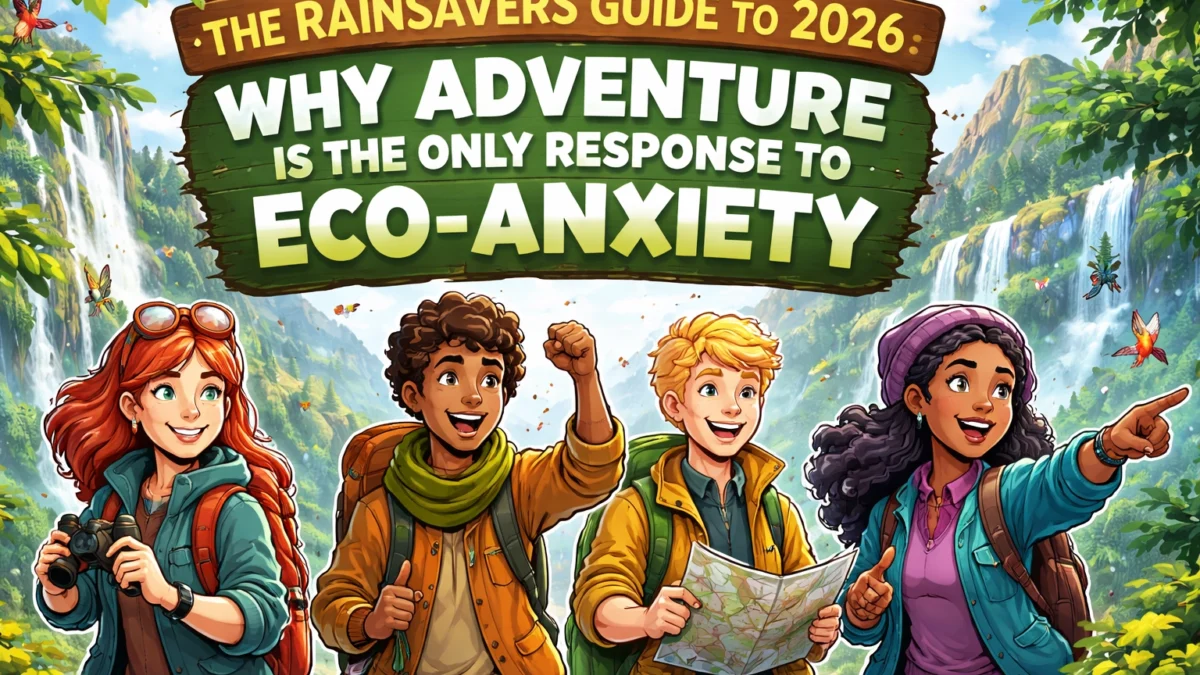
No lectures. No finger-wagging. Just a team of specialists, scientists, soldiers, tech geniuses, and yes, one very smart orangutan, taking on environmental threats with the same intensity you'd expect from any great adventure saga.

The result? Stories that let you feel the urgency of real-world issues without the paralysis. You get:
- High-stakes missions (because saving the Amazon should feel as thrilling as any heist film)
- Flawed, relatable heroes (who mess up, argue, and occasionally make terrible jokes under pressure)
- Real science woven into fiction (so you learn something without realizing you're learning)
- Hope that doesn't feel naive (because the wins are hard-earned)
It's adventure fiction with a purpose. And honestly? It's a lot more fun than doomscrolling.
A Quick Field Guide: How to Use Adventure Fiction for Eco-Anxiety
Okay, let's get practical. Here's your 2026 survival protocol:
Step 1: Recognize the Loop
When you notice yourself spiraling, refreshing news tabs, catastrophizing, feeling helpless, pause. That's your cue to interrupt the pattern.
Step 2: Choose Your Adventure
Pick up something with forward momentum. Action. Problem-solving. Characters who do things instead of just suffering. (May we suggest starting here?)
Step 3: Let Your Brain Rehearse
Give yourself permission to feel the hope. Let the story take you somewhere. Your nervous system doesn't know the difference between fictional triumph and real triumph, it just knows it feels better.
Step 4: Ride the Momentum
Here's the secret: that hopeful energy doesn't disappear when you close the book. Use it. Channel it into small actions, a donation, a conversation, a local cleanup. Whatever feels manageable.
Step 5: Repeat as Needed
This isn't a one-time fix. It's a practice. Think of adventure fiction as part of your mental health toolkit, right alongside walks outside and calling your friends.

But Wait, Isn't This Just Escapism?
Great question. Let's address it directly.
Yes, adventure fiction is a form of escape. But escape isn't inherently bad. Sometimes you need to leave a burning building before you can figure out how to put out the fire.
The difference between healthy escapism and avoidance is what happens next. If you read a book and then go back to feeling helpless, that's one thing. But if you read a book and come out the other side feeling like change is possible? That's not escape. That's fuel.
The Rainsavers characters aren't perfect. They don't have all the answers. But they show up anyway. And sometimes, that's the only lesson you need.
Why 2026 Is the Year for Eco-Adventure
Look around. The cultural moment is shifting.
People are tired of doom. They're tired of being told the planet is dying while also being told there's nothing they can do. They want stories that match the urgency they feel: but also offer a way forward.
That's why eco-adventure fiction is having a moment. It's not about pretending everything is fine. It's about imagining what it looks like when people fight back.
And in 2026, that imagination matters more than ever.
Your Mission, Should You Choose to Accept It
Here's the deal: eco-anxiety isn't going anywhere. The problems are real. The stakes are high.
But you don't have to face it with dread. You can face it with adventure.
You can pick up a story that makes you feel something other than helpless. You can let your brain practice hope. You can remember what it feels like to root for the good guys; and then carry that energy into your actual life.
It's not naive. It's necessary.
Ready to trade dread for adventure? Start the mission at The Rainsavers.
Because the planet doesn't need more people paralyzed by fear. It needs people who still believe in the fight.
