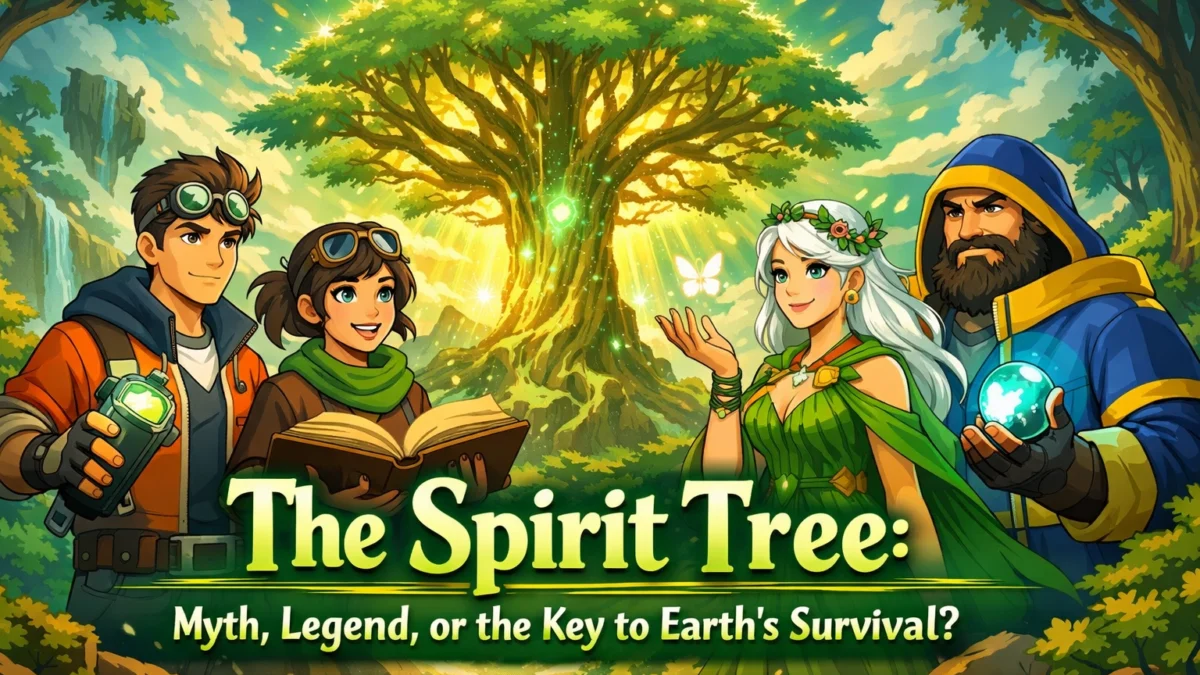
Look, we need to talk about the elephant in the room. Or should I say, the tree in the room.
If you've been following The Rainsavers series, you know that the Spirit Tree isn't just some pretty piece of set decoration or a convenient plot device. It's the whole enchilada, the beating heart of the story, the mystery that keeps fans up at night theorizing on Reddit, and quite possibly the most important character that never speaks a single word.
But here's where it gets wild: What if this fictional creation taps into something way older and more universal than we initially thought? What if the Spirit Tree is just the latest incarnation of a concept that's been haunting human consciousness since we first started painting on cave walls?
Buckle up, friends. We're going deep.
The Ancient Roots (Pun Absolutely Intended)
Here's something that'll blow your mind: Nearly every major culture throughout history has had its own version of a sacred tree. We're talking Vikings with their Yggdrasil, the Celts with their oak groves, the Maya with the Tzite tree, and the list goes on.

These weren't just random trees that ancient peoples decided were cool. They represented something fundamental, a connection between earth and sky, between the material world and the spiritual realm, between humanity and the cosmos itself. The Norse believed Yggdrasil literally held the nine realms of existence together. If that tree fell, game over for the universe.
Sound familiar? Because if you've read The Rainsavers, you know the Spirit Tree functions on a similarly epic scale. It's not just a tree, it's a network, a consciousness, a living library of Earth's entire ecological memory.
So What Makes the Spirit Tree Different?
Here's where The Rainsavers flips the script. While ancient myths used sacred trees as metaphors for cosmic order or spiritual enlightenment, the Spirit Tree operates on a refreshingly modern wavelength: environmental survival.
In 2026, we're not exactly living in a world where we can afford purely symbolic gestures anymore. Climate change isn't a distant threat, it's the weather report. Species aren't "endangered", they're gone. And suddenly, the idea of a tree that holds the key to planetary survival doesn't feel like fantasy. It feels like wishful thinking masquerading as fiction.
The Spirit Tree in The Rainsavers universe serves as a biological network, think of it as nature's internet, except it predates silicon by billions of years. It connects ecosystems, communicates across species barriers, and holds the accumulated knowledge of every living thing that's ever drawn breath on this planet.

And here's the kicker: modern science is actually discovering that real forests work kind of like this. The "wood wide web", yes, that's the actual scientific term: shows us that trees communicate through underground fungal networks, sharing nutrients and even warning each other about threats. Mother trees nurture saplings, and forests function as interconnected communities rather than individual organisms competing for resources.
The Spirit Tree just takes this concept and cranks it to eleven.
The Mystery Element: What Does It Actually Want?
One of the most compelling aspects of the Spirit Tree in The Rainsavers is that it remains fundamentally mysterious. Even as readers, we're never entirely sure of its motivations. Is it benevolent? Is it neutral? Does it even understand human concepts of good and evil?
The ancient Celts believed that certain trees housed protective spirits, while others could be downright dangerous. Oak trees connected to the Well of Wisdom could grant knowledge to heroes: but at what cost? The Spirit Tree operates in a similar moral gray zone. It offers solutions to environmental catastrophes, but the price might be higher than humanity wants to pay.

This ambiguity is refreshing in an age of simple narratives. The Spirit Tree isn't going to hold your hand and explain everything. It's not interested in being understood in human terms. It operates on timescales we can barely comprehend: thinking in centuries while we're stuck worrying about quarterly earnings.
The 2026 Question: Fiction or Warning?
Let's get real for a second. It's February 2026, and we're living through a time when fiction and reality are having a complicated relationship. We've got AI writing poetry, billionaires building rockets, and weather patterns that would've seemed apocalyptic just a decade ago.
So when The Rainsavers presents us with the Spirit Tree: a living entity that could theoretically save Earth if we could just figure out how to properly communicate with it: are we reading fantasy or a thought experiment?
Maybe the genius of the Spirit Tree concept is that it doesn't matter. Whether it exists in our world or not, the questions it raises are painfully relevant:
- What if nature has wisdom we're too arrogant or distracted to access?
- What if the solution to our environmental crisis requires us to fundamentally change how we relate to the living world?
- What if saving the planet means accepting that we're not the main characters?
These aren't comfortable questions. They require us to step outside our human-centric bubble and consider that maybe: just maybe: we've been getting it wrong this whole time.
Why This Matters Beyond the Page
Look, I could spend another thousand words geeking out about the specific lore details, the prophetic passages in Book Three, or the fan theories about what happens if the Spirit Tree actually dies. But here's what really matters:
The Spirit Tree works as a narrative device because it taps into something we collectively understand on an almost cellular level. Trees have always been symbols of life, growth, connection, and endurance. They're literally the lungs of our planet. They've been standing witness to human history since before we invented writing.

The Rainsavers just asks: What if they've been trying to tell us something this whole time?
In traditional mythology, heroes would seek out sacred trees for wisdom or power. In The Rainsavers, the twist is that the tree has been seeking us: waiting for humanity to evolve enough to actually listen. It's not about conquering nature or extracting resources. It's about partnership, communication, and recognizing that we're part of a much larger system than we've been willing to acknowledge.
The Invitation
Here's the thing about the Spirit Tree: whether it's myth, legend, or a blueprint for survival, it challenges us to think differently. It asks us to consider that the answers to our biggest problems might not come from the latest tech startup or government initiative. They might come from understanding systems that have been operating successfully for millions of years.
And honestly? In 2026, we could use all the help we can get.
So whether you're a longtime reader dissecting every clue in The Rainsavers series, or someone just discovering this universe for the first time, the Spirit Tree invites you into a mystery that's bigger than any one book. It's a portal into questions about survival, connection, and what it means to be alive on this planet right now.
Want to explore more about The Rainsavers universe and dive deeper into the Spirit Tree mystery? Head over to rainsavers.com and join readers worldwide who are discovering that sometimes the best fantasy is the kind that makes reality a little more magical.
After all, the tree is waiting. And unlike us, it's got all the time in the world.
