
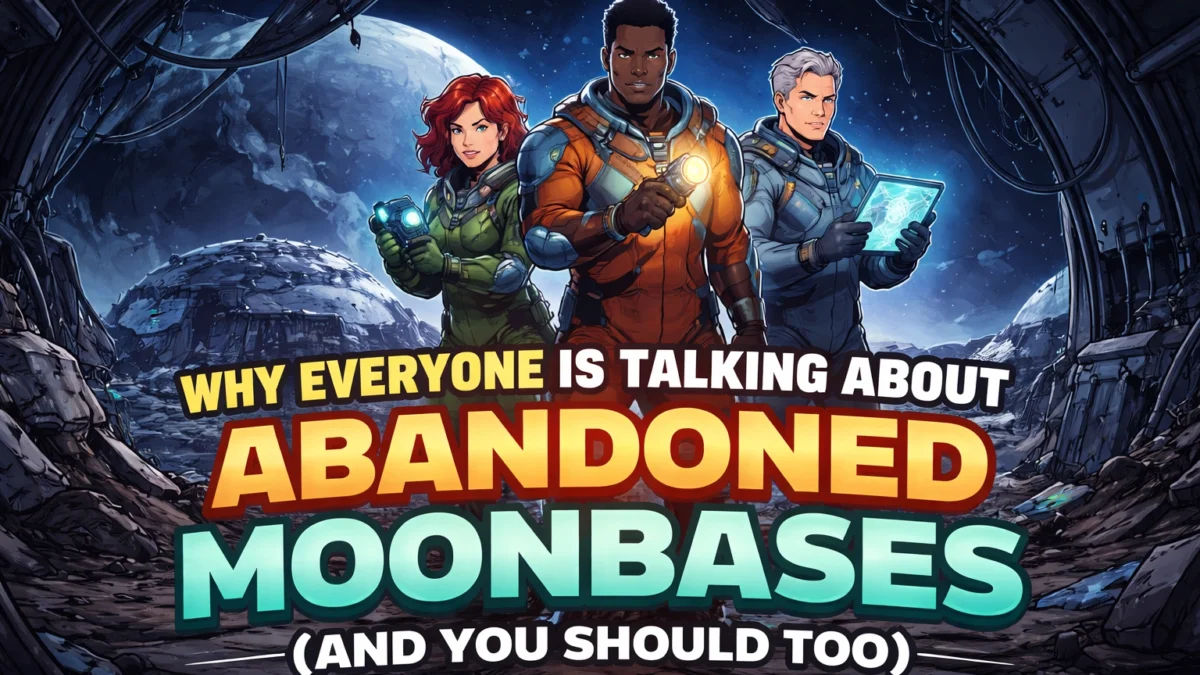
Okay, real talk: if you've scrolled through any bookish corner of the internet lately, you've probably noticed something weird happening.
Everyone is suddenly obsessed with abandoned moonbases.
And honestly? They should be. You should be too. Here's why this dusty, crater-scarred trope is having its main character moment in 2026, and why it's the perfect backdrop for adventure fiction that actually makes you think.
The Moon Is Having a Renaissance (And Fiction Got There First)
Let's set the scene. It's 2026. Real-world space agencies are talking about lunar gateways. Private companies are sketching out habitat modules. The moon isn't just a distant rock anymore, it's starting to feel possible.
And fiction writers? They've been camping out on the lunar surface for decades, waiting for the rest of us to catch up.
But here's the twist that's making abandoned moonbases especially juicy right now: it's not just about going to the moon. It's about what we left behind.
Think about it. An active, shiny moonbase is cool and all. But a derelict one? With flickering emergency lights, half-buried airlocks, and decades-old secrets sealed behind blast doors?
That's where the real story lives.

Why Abandoned Beats Active (Every Single Time)
Active bases are about hope, progress, humanity reaching for the stars. That's great for documentaries.
But abandoned bases? They're about questions.
- Who was here?
- Why did they leave?
- What were they hiding?
- And most importantly: what's still here?
Abandoned moonbases give authors the best of both worlds. You get the high-tech, isolated, oxygen-is-running-out tension of space fiction. But you also get the creeping dread of exploration horror, the "we shouldn't be opening this door" energy that makes pages turn themselves.
It's basically a haunted house… on the moon… with no air outside.
Yeah. It hits different.
The Real History That Makes This Trope Unhinged (In a Good Way)
Here's where things get spicy.
Abandoned moonbase fiction isn't just pulling from imagination. Some of the wildest plot devices are rooted in actual historical weirdness:
Nazi lunar conspiracy theories: Yes, this is a real rabbit hole. Post-WWII rumors about secret German technology programs spiraled into decades of speculation about hidden bases, including lunar ones. Is it real? Almost certainly not. Is it incredible fuel for thriller fiction? Absolutely.
Cold War-era moon plans: Both the US and Soviet Union had classified programs exploring military uses for the moon. Some of those documents are still partially redacted. When real history has redaction bars, fiction writers start salivating.
Abandoned real-world bases on Earth: From Antarctic research stations to military bunkers, we have plenty of examples of what happens when humans build something remote, use it, and then… leave. The decay. The artifacts left behind. The mystery of what the last person saw before they locked the door.
Authors take all of this and ask: what if that happened on the moon?

The Isolation Factor (AKA Why Your Brain Loves This Setting)
There's a psychological reason abandoned moonbases hit so hard.
The moon is 250,000 miles away. If something goes wrong, no one is coming to help. Not quickly, anyway.
Now add "abandoned" to that equation. You're not just isolated, you're isolated in a place that someone else already failed at. The life support might be sketchy. The maps might be wrong. And whatever made the last crew leave? It might still be a problem.
This setting cranks the survival stakes to maximum while also delivering that archaeological thrill of uncovering the past. It's Indiana Jones meets Alien meets your worst "forgot to study for the exam" nightmare.
Readers can't look away. And honestly, neither can we.
How The Rainsavers Takes This Trope and Runs With It
Okay, we're a little biased here. But when we were developing The Rainsavers series, we knew we had to send the team somewhere that would test everything they thought they knew.
The Amazon? Done it. Ancient temple networks? Check. Underground bunkers with questionable ventilation? You bet.
But the moon?
Book Four: Shadow of the Moon drops the team into exactly the scenario we've been describing. A derelict lunar installation. Decades-old secrets. Equipment that may or may not still work. And a mission that goes sideways approximately five minutes after touchdown.
We leaned hard into the creepy-cool atmosphere: crater-scarred exteriors, airlocks that groan when they cycle, data logs that raise more questions than they answer. The team's high-tech field respirators (which, let's be honest, already look like something out of a sci-fi movie) finally get to operate in an actual airless environment.
It's different from the jungle. It's different from the temples. And it forced us to think about what happens when eco-heroes have to survive in a place where there's no ecosystem at all.

5 Reasons Abandoned Moonbases Are Peak Fiction Fuel
Let's break it down, listicle-style:
1. Built-in mystery. Who built it? Why was it abandoned? What's in the locked section? The setting does half the plot work for you.
2. Survival tension on steroids. Every breath costs resources. Every broken seal is a potential death sentence. Stakes don't get higher.
3. Visual goldmine. Dust-covered consoles. Earth rising through a cracked viewport. Bootprints preserved for decades. This stuff practically illustrates itself.
4. Perfect villain playground. Secret programs, rogue factions, corporate cover-ups: abandoned bases are made for shadowy antagonists with agendas.
5. Nostalgia meets anxiety. There's something deeply unsettling about finding evidence of people who were just like us in a place that's now silent. It's a memento mori with better lighting design.
The 2026 Question: What Are We Really Afraid Of?
Here's the thing about fiction trends: they usually reflect what's happening in the real world.
In 2026, we're watching space programs accelerate. We're seeing private companies make promises about lunar colonies. We're asking big questions about resources, territory, and who gets to claim what's out there.
Abandoned moonbase fiction taps into a quiet anxiety: what if we go, and then we fail?
What if we build something incredible and then have to walk away from it? What if the next generation finds our abandoned outposts and wonders what went wrong?
These stories let us explore that fear safely. We get to send fictional characters into the ruins, let them piece together what happened, and (hopefully) find a way forward.
It's cathartic. It's thrilling. And it's a reminder that the most interesting part of space exploration might not be the arrival: it's the archaeology of what came before.
Ready to See What's Up There?
If you've made it this far, you're clearly our kind of reader.
Abandoned moonbases. Ancient secrets. A team that's in way over their heads but absolutely refuses to quit.
Ready for lift-off? Follow the team to the lunar surface in Book Four: Shadow of the Moon.
Trust us: the view is worth the trip. Even if the air recyclers are making some very concerning noises.
Want more deep dives into the weird history and wilder fiction behind The Rainsavers? Check out our blog for character spotlights, behind-the-scenes breakdowns, and the occasional conspiracy theory we couldn't resist researching.
