
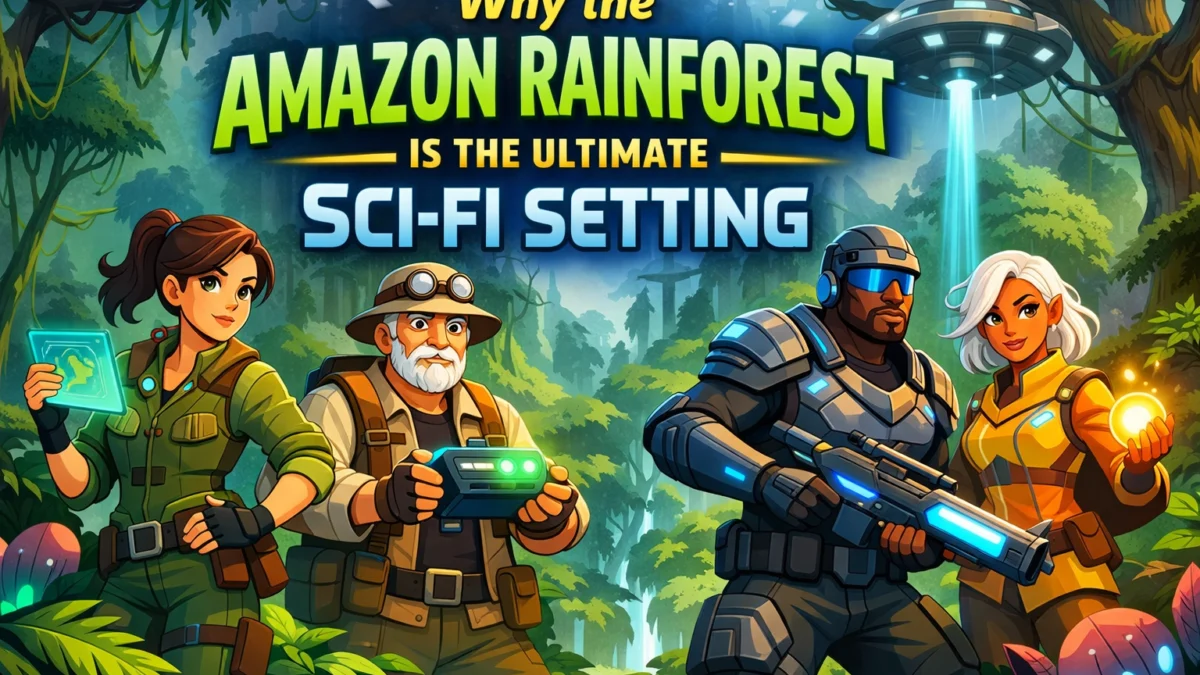
Meta Description: Forget alien planets, the Amazon Rainforest has everything sci-fi needs: killer biodiversity, bioluminescent weirdness, and tech-breaking heat. Here's why it's 2026's ultimate adventure setting.

Look, we get it. When you think "sci-fi setting," your brain probably jumps to Mars colonies, distant galaxies, or some neon-soaked cyberpunk cityscape. But here's the thing: while everyone's busy inventing fictional alien worlds, the Amazon Rainforest has been sitting here on Earth being actually weird this whole time.
And in 2026, as we're watching real-world environmental stakes get higher and ecological mysteries deepen, the Amazon isn't just a great sci-fi setting, it might be the ultimate one.
The Alien World Already on Our Planet
Imagine pitching a sci-fi planet to a studio: "It's covered in species we've never catalogued, features glowing organisms that light up the night, and has terrain so hostile that modern technology struggles to function properly."
Cool concept, right? Except that's just… the Amazon. No CGI required.

The rainforest houses some of the most biodiverse ecological communities anywhere on the planet. We're talking thousands of species in a single hectare, many of which science hasn't even properly documented yet. When your real-world setting comes pre-loaded with mystery and discovery, you're already halfway to a compelling sci-fi story.
And here's where it gets wild: the Amazon has actual bioluminescent features. Fungi that glow in the dark. Insects that light up like tiny biological LEDs. The kind of stuff that made Avatar's forests feel magical? It's already happening in the Amazon, no special effects needed.
Built-In Narrative Tension (Nature Doesn't Need a Script)
Most sci-fi settings require writers to invent dangers. "Oh no, the alien predators!" "Watch out for that toxic atmosphere!" But the Amazon? It comes with built-in peril that needs zero explanation.
Dense canopy that blocks out sunlight? Check. Creatures that can kill you seventeen different ways? Check. Terrain so challenging that even getting from Point A to Point B becomes an adventure? Big check.

This is exactly why we set The Rainsavers series here at The Rainsavers. When your teenage heroes are trying to save an ancient ecosystem while racing against modern threats, the environment itself becomes a character. The rainforest doesn't just provide a backdrop, it actively participates in the story.
Tech That Actually Stops Working
Here's a screenwriter's dream scenario: your high-tech villains show up with all their fancy thermal imaging and satellite tracking, and then… the Amazon just breaks it.
The region's extreme heat and humidity wreak havoc on advanced technology. Thermal vision systems? Nearly useless when everything is hot. GPS signals? Good luck under that canopy. Communications equipment? Prepare for frustration.
This creates natural conflict without feeling contrived. Your characters can't just tech their way out of problems. They have to adapt, improvise, and actually engage with the environment. It's organic storytelling gold.
The "Lost World" Effect Never Gets Old
Arthur Conan Doyle figured this out back in 1912 with The Lost World, isolated pockets of the Amazon make perfect settings for "what if?" scenarios. Those tepuis (flat-topped mountains) create ecosystems that evolved separately for millions of years. Prehistoric characteristics. Species found nowhere else on Earth.
In 2026, as genetic engineering and climate science advance, these isolated mountain islands become even more compelling as sci-fi elements. What could be hidden there? What might have survived? What could humans have altered or discovered?

The beauty is that readers already want to believe there's something mysterious in the Amazon. The setting does half your worldbuilding work for you.
Environmental Stakes That Actually Matter
Here's what makes the Amazon especially relevant right now: the environmental stakes are real, urgent, and universally understood.
When your story involves protecting the rainforest, readers don't need three chapters of exposition to understand why it matters. Everyone in 2026 knows what's at stake. The Amazon affects global climate, houses irreplaceable biodiversity, and represents humanity's relationship with nature itself.
This lets writers dive straight into adventure while carrying genuine thematic weight. You get to tell an exciting story about teenagers racing against time and tap into real-world concerns about environmental collapse, without being preachy or losing the fun factor.
Visual Spectacle Without the Visual Effects Budget
Even if you're writing books (like us), the visual possibilities of the Amazon are incredible. But if your story ever makes the jump to screen? You're looking at a filmmaker's paradise.
The rainforest provides:
- Stunning natural lighting through canopy gaps
- Endless visual variety (rivers, mountains, caves, trees)
- Natural color palettes that range from emerald greens to sunset explosions
- Fog, rain, and weather effects that create instant atmosphere
Unlike invented sci-fi worlds that require massive VFX budgets, the Amazon gives you visual spectacle for the cost of… going there. (Okay, that's still expensive, but way cheaper than rendering an alien planet.)

Why The Rainsavers Lives Here
When we created our six-book eco-adventure series, setting it in the Amazon wasn't just aesthetic, it was essential. Our teenage heroes needed a setting that could match their mission: protecting something precious against modern threats with ancient roots.
The rainforest gave us:
- Mystery: Hidden temples, undiscovered species, forgotten knowledge
- Danger: Natural hazards that make every mission genuinely risky
- Beauty: A setting worth fighting for that readers can visualize
- Relevance: Stakes that connect to real-world concerns
- Scope: Room for six books of discoveries without repeating ourselves
The Amazon doesn't just host our story, it is our story.
The Future is Already Here (It's Just Really Humid)
Most science fiction asks "what if?" about the future. But the Amazon asks "what if?" about right now.
What if there are species we haven't discovered that could revolutionize medicine? What if ancient civilizations left behind knowledge we're only beginning to decode? What if the key to understanding Earth's future lies in protecting its most biodiverse region?
These aren't hypotheticals. They're actual scientific questions being explored in 2026. Your sci-fi story set in the Amazon isn't some far-future fantasy, it's speculative fiction about the present, which somehow makes it even more compelling.
Your Adventure Awaits (Mosquito Repellent Not Included)
So yeah, space is cool. Cyberpunk cities are neat. Dystopian wastelands have their place.
But if you want a sci-fi setting that's visually stunning, narratively rich, environmentally relevant, and literally alien while also being real? The Amazon Rainforest is sitting right here on Earth, waiting to host your next favorite story.
And if you're curious what that looks like in action, with teenage heroes, ancient mysteries, and very real modern threats, well, we might know a series about that.
Read Book One now and discover why the ultimate sci-fi adventure doesn't need to leave the planet.
