
Hey there, adventure seekers! Steven G. Samuels here, CEO of The Rainsavers.
It’s Friday, March 13, 2026. Some people consider this a spooky day, but here at The Rainsavers, we think it’s the perfect time to go "Down the Rabbit Hole." While the rest of the world is busy arguing over the latest AI updates or looking toward lunar colonies, we’ve been keeping our eyes fixed on the most mysterious place on Earth: the Amazon Rainforest.
Most people think the Amazon is just trees, jaguars, and a whole lot of rain. But if you’ve been following our books or keeping up with the latest LiDAR satellite scans, you know there’s a lot more hiding under that canopy than just monkeys. We’re talking about high-tech research labs, ancient geometric structures, and things that look like they were ripped straight out of a sci-fi thriller.
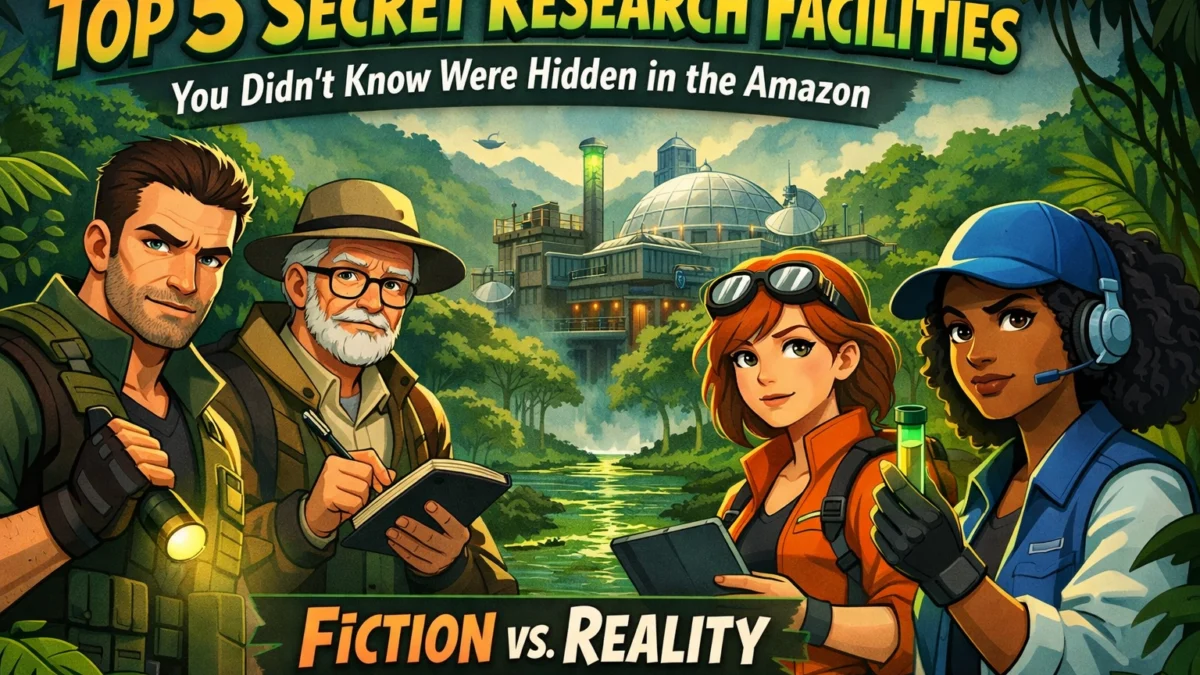
Let’s dive into the top 5 secret research facilities: some are very real, and some are the brainchild of our wild imaginations here at The Rainsavers.
1. The Canopy Collective Hub (Fiction)
In the world of The Rainsavers, the heroes don't live in a shiny skyscraper in New York. They live in the Canopy Collective Hub.
The Fiction:
Imagine a facility that is literally woven into the trees. We’re talking bio-engineered vines that act as fiber-optic cables and solar leaves that power high-end laboratory equipment. This isn't just a "treehouse"; it’s a multi-level research station that uses ancient technology to maintain a zero-carbon footprint while tracking illegal logging operations in real-time. It’s the ultimate base for a team of eco-heroes who realize that team-based adventures are way more effective than going solo.
The Reality:
While we don't have bio-engineered internet-vines (yet), scientists in 2026 are using "tree-talk" sensors to monitor forest health. These sensors are small, hidden devices that detect chemical changes in trees to predict droughts. We took that real science and dialed it up to eleven for the books!

2. The Amazon Tall Tower Observatory (ATTO) (Reality)
Believe it or not, there is a giant needle sticking out of the jungle that looks like a villain’s lair, but it’s actually saving the world.
The Reality:
The ATTO is very real. Standing at 325 meters (about 1,066 feet), it’s taller than the Eiffel Tower. It was built to study the interaction between the forest and the atmosphere. Because it’s so far from human civilization, it gathers the purest air samples on the planet. Scientists here are basically the real-life version of our characters, fighting to understand how the "lungs of the planet" are breathing in this changing climate.
The Fiction Connection:
In our series, we often ask: what if these towers weren't just observing? What if they were being used by a shadow corporation to manipulate weather patterns? It’s that blend of ancient mysteries vs. modern threats that makes the Amazon such a fertile ground for high-stakes storytelling.
3. The Subterranean Seed Vault of Xingu (Fiction)
Deep beneath the basin, where the humidity can melt your boots, lies a facility that doesn't exist on any map.
The Fiction:
In The Rainsavers Book 3, the team discovers a secret facility built into an ancient sinkhole. This isn't just a lab; it’s a genetic library. It contains the DNA of every plant species in the Amazon, some of which haven't been seen by humans for thousands of years. The facility uses geothermal energy from the earth’s core to keep the samples at a perfect 40 degrees Fahrenheit. The catch? It’s guarded by a localized AI that doesn't like intruders.
The Reality:
While we have the Svalbard Global Seed Vault in the Arctic, rumors have persisted for years about "lost" botanical treasures in the Amazon. Recently, LiDAR scans have revealed massive, interconnected geometric earthworks in the Xingu region. Scientists are still trying to figure out what they were for: storage? Rituals? Or perhaps something we haven't even dreamed of yet.

4. The LiDAR "Ghost Cities" (Reality)
For decades, we thought the Amazon was a "counterfeit paradise" where large civilizations couldn't survive. 2026 has proven us wrong.
The Reality:
Using Light Detection and Ranging (LiDAR), archaeologists have "stripped away" the trees on their digital maps to find sprawling urban centers. These aren't just ruins; they are sophisticated networks of roads, canals, and plazas. These discoveries have completely changed our understanding of human history in South America. They prove that the Amazon was once home to millions of people living in highly organized "garden cities."
The Fiction Connection:
In our stories, these aren't just empty ruins. We imagine that some of these "Ghost Cities" still have functioning technology hidden in their foundations. If you’ve ever wondered why rainforest adventures change the way you think about superhero origins, it’s because the setting itself is a character. The mystery of who lived there: and what they left behind: is the engine that drives our plots.
5. Project "Verde-Zero" (Fiction)
Every great adventure needs a formidable obstacle, and Project Verde-Zero is the ultimate "bad guy" facility.
The Fiction:
Hidden behind a literal waterfall, this corporate-funded research site is dedicated to "optimizing" the rainforest. Their goal? To replace natural trees with synthetic versions that produce twice as much oxygen but are owned by a patent-holding conglomerate. It’s the ultimate battle of ancient technology vs. modern threats. The facility is sleek, chrome, and completely out of place in the lush green of the jungle.
The Reality:
Actually, there are secret mining and research camps that pop up in the Amazon constantly. Often illegal, these "pop-up" facilities use satellite jamming technology to hide from government surveillance. They are the real-world inspiration for the villains our heroes face. Dealing with climate anxiety through fiction is a lot easier when you have a team of heroes who can actually kick some corporate butt!

Why Does This Matter in 2026?
You might be asking, "Steven, why are you obsessed with secret labs in the middle of a jungle?"
It’s simple. We live in an era where the line between what is "real" and what is "possible" is blurring every day. At The Rainsavers, we believe that eco-fiction will change the way you think about adventure stories. By mixing the hard science of the ATTO tower with the wild "what-ifs" of our 6-book series, we create a world that feels urgent, exciting, and: most importantly: worth saving.
Whether it’s a real-life scientist climbing 300 meters into the sky to catch a breath of air or a fictional hero sliding down a zip-line to stop a genetic heist, the Amazon remains the ultimate stage for the greatest stories of our time.
Ready to Go Deeper?
If you're tired of the same old capes and tights, maybe it’s time to see how modern eco-heroes are saving both fiction and the planet. Our world is changing, and our stories need to change with it.
If you’re feeling brave, we have a little something special for you. We’ve hidden some "intel" throughout our site about the next big mission. Are you ready to see what's actually going on in those restricted zones?
Stay curious, stay green, and maybe keep an extra eye on those LiDAR maps. You never know what we might find next.
: Steven G. Samuels
CEO, The Rainsavers