
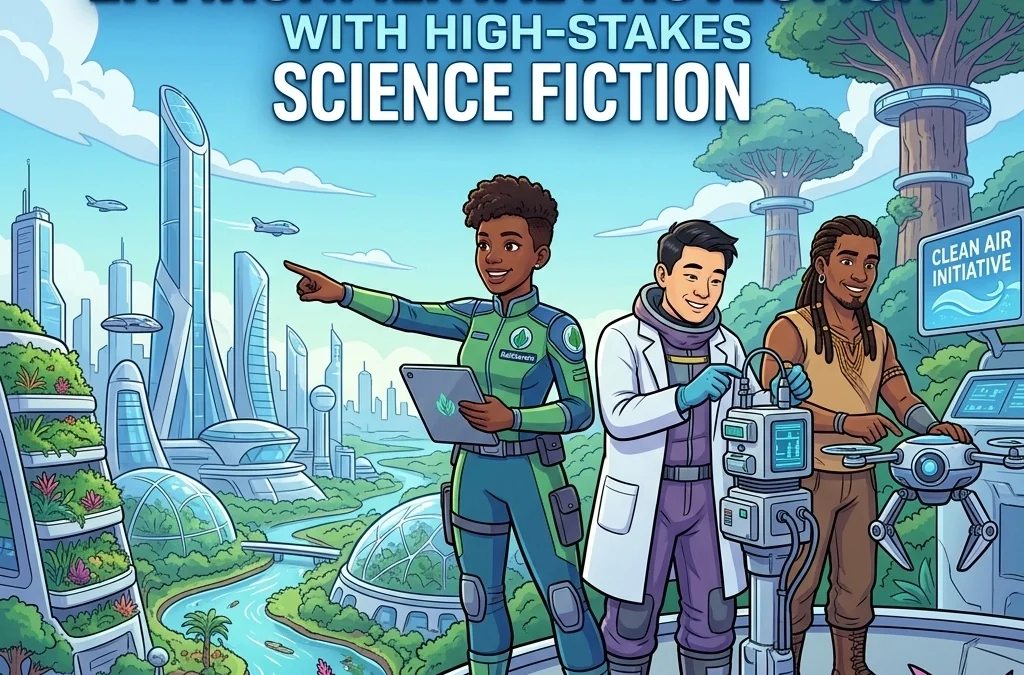
Meta Description: Discover how to blend environmental protection with high-stakes science fiction. Learn how The Rainsavers integrates red mercury, eco-justice, and intense character drama into a 2026 adventure.
Happy Wednesday, everyone! It’s April 1st, 2026, and while the rest of the internet is busy with holograms and prank AI bots, we’re here to talk about something a bit more substantial.
At The Rainsavers, we get asked all the time: “How do you make saving the planet feel like an edge-of-your-seat sci-fi thriller?”
Usually, when people hear "environmental fiction," they think of a dry lecture or a sad documentary. But in 2026, we know better. Environmentalism isn’t just about recycling bins; it’s about survival, high-tech espionage, and the literal soul of the planet. If you’re looking to weave ecological protection into your high-stakes sci-fi, you’ve come to the right place.
Here is how we do it at The Rainsavers, and how you can think about these "green" stories in a whole new way.
1. Conflict is the Lifeblood (Skip the PSA)
The biggest mistake you can make in eco-fiction is being too "preachy." Nobody wants to be told what to do; they want to see characters struggle with impossible choices.
As we've learned from the ultimate guide to climate fiction, the best stories present conflicting viewpoints. In The Rainsavers, environmental protection isn't just a "good vs. evil" checkbox. It’s a geopolitical chess match.
Imagine a world where terraforming or restoring an ecosystem is a source of active conflict. One faction might want to leave the rainforest untouched to preserve ancient secrets, while another wants to "optimize" it with tech for human survival. When you have two characters who both think they are "saving the world" but have diametrically opposed methods, you have a high-stakes thriller.

Alt Text: A high-tech laboratory in the middle of a dense, glowing jungle where scientists argue over a holographic map.
2. Red Mercury and High-Stakes Tech
In science fiction, the "science" part needs to be cool. We use elements like Red Mercury to bridge the gap between environmentalism and hard sci-fi.
Red Mercury isn't just a battery; it’s a catalyst that can either heal the atmosphere or become the ultimate weapon. When you introduce a resource that everyone wants, a resource that is tied directly to the health of the planet, the environmental stakes instantly become high-stakes.
We often explore how ancient technology vs. modern threats creates unstoppable villains. If a villain finds a way to use the Earth’s natural energy for a corporate takeover, the environment isn't just the "setting", it's the hostage.
3. Characters with Skin in the Game
You can’t have a high-stakes adventure without a team you care about. In 2026, the era of the solo "invincible" hero is fading. We’re seeing a massive shift toward team-based adventure series.
Take our powerhouse, Primal. He isn't just a guy who hits things. His very existence is tied to the environment and the scientific accidents that shaped him. You can read more about how a crash turned Tom Swift into Primal to see how character origins can be rooted in ecological disasters.
Then you have Alpha Orangenius, a genius orangutan. This isn't just for "fun", it represents a bridge between humanity and the natural world. When Alpha uses his intellect to save the team, it reinforces the idea that nature is an ally, not just a resource. Check out how Alpha Orangenius can save the team for a taste of that dynamic.

Alt Text: Primal standing in a protective stance over a rare species of flora while holding a high-tech scanner.
4. Resource Conflicts as Central Drama
Research shows that the most effective sci-fi explores how countries or private actors leverage advantages to gain access to water or air. In our series, we focus on the social and ecological impact of these resources.
If you’re writing or reading eco-sci-fi, ask yourself:
- Who controls the water?
- Who has the Red Mercury?
- What happens to the local community when a "green" corporation moves in?
By addressing these as mutually constitutive problems, the story becomes about social justice as much as it is about trees and plants. It’s about whose survival matters.
5. Field Notes: Making the Jungle a Character
One of the best tips for integrating environmental protection is to treat the environment like a character. It shouldn't just be a static background.
Penny’s Field Notes (April 2026): Oops! We once tried to write a scene where the heroes just walked through the jungle without noticing the vines. Steven (our CEO) reminded us that in The Rainsavers, the jungle is alive! If the team doesn't respect the ecosystem, the ecosystem fights back. Lesson learned: always watch out for the carnivorous flora when you're trying to save the world.
When the land has "reactions" to what the characters do, the stakes feel much higher. If a villain’s weapon causes a localized drought, show the immediate impact on the characters' health and morale.

Alt Text: A group of explorers navigating a futuristic rainforest where the plants emit a soft, bioluminescent blue light.
6. Dealing with the "Eco-Anxiety" Factor
Let’s be real: thinking about the planet can be stressful. Many readers avoid environmental stories because they don't want to feel sad.
Our strategy? Action.
We tackle climate anxiety by giving our characters the tools to actually do something. It’s not a tragedy; it’s a mission. Whether it’s facing off against Mortalis or stopping a Red Mercury leak, the focus is always on the solution and the thrill of the chase.
7. The Corporate Logic vs. The Logic of Care
In our world, the villains usually represent "Corporate Logic": seeing nature as private property to be exploited. Our heroes represent "Care Logic": a deep, affective relationship with the world that activates political and physical action.
This duality provides:
- Moral Clarity: You know why the heroes are fighting.
- Antagonistic Forces: Corporate villains have deep pockets and high tech, making them formidable foes.
If you want to see how this plays out, check out ancient mysteries vs. modern threats to see how we build our bad guys.

Alt Text: A sleek, corporate skyscraper made of glass and steel towering over a shrinking, vibrant green forest.
Summary: The Secret Sauce
Integrating environmental protection into sci-fi isn't about removing the fun; it’s about adding layers. By using:
- Multiple Perspectives (not everyone agrees on the solution).
- High-Tech McGuffins (like Red Mercury).
- Compelling Heroes (like Primal and Alpha).
- Tangible Consequences (the jungle reacts!).
You create a story that is both relevant for 2026 and incredibly fun to read.
If you're ready to dive into a world where the stakes are as high as the canopy and the tech is as deep as the ocean, it’s time to join the mission.
Ready for your next adventure?
Explore the world of The Rainsavers today. From rainforest mysteries to high-tech showdowns, the planet needs a hero: and a team.
