
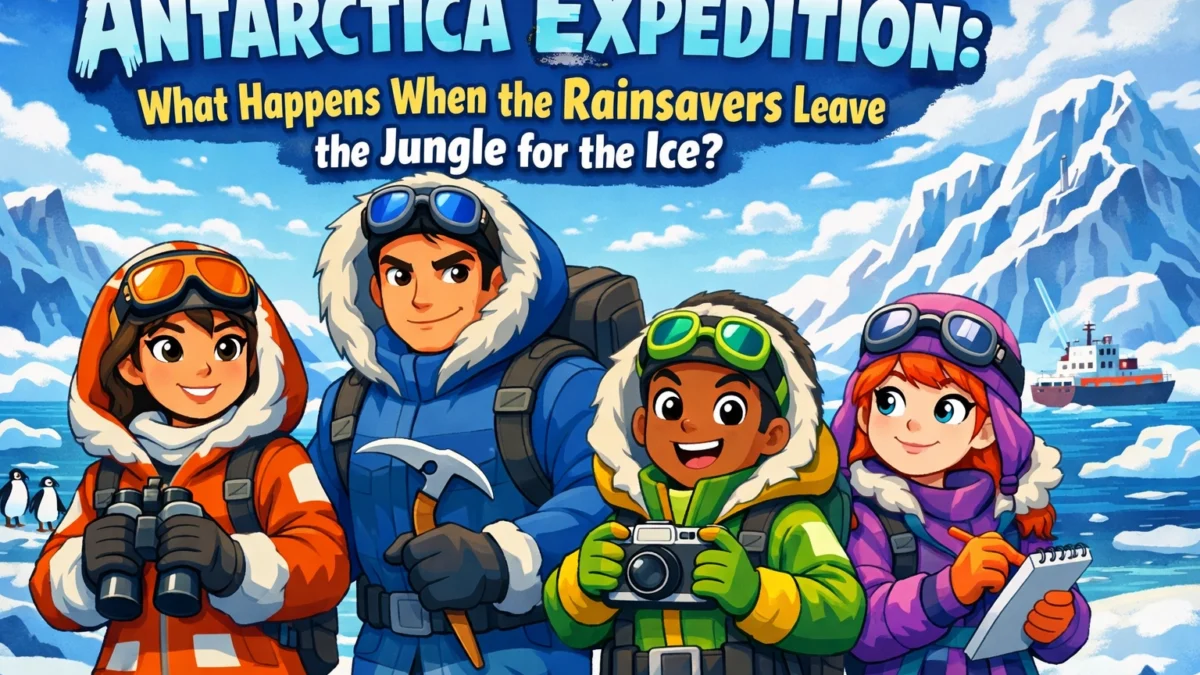
Welcome to March 2026. If you’ve been following the journey of The Rainsavers, you know we’re usually hacking through the dense, humid vines of the Amazon or dodging tropical storms in the South Pacific. But things just got a whole lot chillier. We’ve officially traded the mosquito nets for thermal plating and the machetes for ice picks.
The transition from the jungle to the Antarctic ice sheet isn't just a change of scenery; it’s a complete system shock. When you’re used to +45 degrees and 90% humidity, landing in a place where your breath freezes before it leaves your mouth is… an experience.
So, what happens when the world’s premier eco-adventure team leaves the heat behind? Let’s dive into the frost.
From Humidity to Hypothermia: The Great Pivot
Transitioning climates is one of the hardest things an expedition team can do. We’ve spent years perfecting our "jungle legs," learning how to move through mud and dense foliage. But Antarctica? Antarctica is a different beast entirely.
Research shows that moving from a humid region like the Amazon to the dry, soul-crushing cold of the South Pole creates massive physiological stress. Your body doesn’t just "get used to it." You have to fight for every calorie and every degree of body heat. In the jungle, the enemy is the heat and the damp. In the ice, the enemy is the air itself.
Our team leaders have noticed that cold stress doesn't just make you shiver: it makes you impatient. When your core temperature drops, your decision-making starts to fray. You take risks you wouldn't normally take. That’s why we’ve had to overhaul our entire operational protocol for this mission.

The Gear: 2026 Tech vs. The Elements
You can't go into the ice wearing cotton and a smile. For the Antarctica Expedition, we’ve upgraded to the highest-spec tactical gear available in 2026. We’re talking about high-tech, multi-layered systems designed to handle "alternating activity levels."
One of the biggest challenges in Antarctica is that one minute you’re stationary (freezing), and the next you’re hauling 100 pounds of gear across a crevasse (sweating). If that sweat freezes against your skin, it’s game over.
Our new tactical kits include:
- Thermal-Regulating Exoshells: Lightweight but tougher than steel, these suits vent heat during high exertion and trap it during rest.
- Sub-Zero Drones: Most drones fall out of the sky when the lithium batteries hit -30. Ours are equipped with internal heating coils and specialized rotors to handle the thin, freezing air.
- Heated Hydration Systems: Because there is nothing worse than being thirsty and realizing your water bottle is a solid block of ice.
This isn't just about survival; it's about being effective eco-heroes. If you’re interested in how this gear stacks up against the threats we face, check out our latest episodes to see the tech in action.
Oops Moments: Field Notes from the Frost
It wouldn’t be a Rainsavers mission without a few "oops" moments. Even with the best training, the ice has a way of humbling you.
Take "The Great Drone Incident of Tuesday," for example. Our lead tech specialist (you can meet the whole crew on our characters page) tried to launch a scout drone without pre-heating the sensors. The drone took off, spiraled once, and then decided it would rather be a penguin, nose-diving straight into a snowbank. We spent three hours digging it out while a group of actual penguins watched us with what I can only describe as "judgmental silence."
Then there was the "Flash-Frozen Protein Shake." One of the team members left their breakfast shake outside the pressurized tent for exactly four minutes. They didn't get a drink; they got a chocolate-flavored brick that we eventually had to use as a doorstop.
These moments keep us grounded. When you're dealing with ancient mysteries vs. modern threats, you have to be able to laugh at yourself: otherwise, the isolation will get to you.

The Psychological Battle: The "Big White"
Antarctica is often called "The Big White." There are no trees, no birds (except the judgmental penguins), and no smell of rain on hot dirt. It’s sensory deprivation at its finest.
This is where the team-based adventure shines. A solo hero would lose their mind out here in a week. But The Rainsavers rely on each other. When one person starts to feel the "ice blues," the rest of the team pulls them back. We’ve found that team-based eco-adventures are dominating 2026 fiction precisely because readers realize that nobody saves the world alone: especially not at -50 degrees.
Why are we even here?
You might be wondering: Why leave the jungle at all?
The answer lies in the ice cores. Antarctica is a time capsule. It holds the history of our planet’s climate, and unfortunately, it also holds secrets that certain "modern threats" would love to get their hands on. We’re here to ensure that the balance of the planet isn't tipped by those who see the melting ice as an opportunity for profit rather than a warning sign.
This mission is a core part of our 6-book adventure series. We’re exploring the intersection of ancient technology and modern environmental threats. What we find beneath the ice might just change the way the world thinks about renewable energy: or it might unleash something we aren't prepared for.

Tactical Tips for Your Own (Mental) Expedition
While you might not be heading to the South Pole today, many of us deal with our own "climates of stress." Here’s how the Rainsavers stay frosty (in a good way):
- Check Your Gear: Whether it’s your physical health or your mental toolkit, make sure you have what you need before you enter the storm.
- Rely on the Squad: Don't be a solo superhero. Reach out to your team.
- Stay Hydrated: Even when it's cold. Especially when it's cold.
- Keep the Humor: If a drone crashes, laugh. Then fix it.
Join the Adventure
The Antarctica Expedition is just the beginning of our 2026 roadmap. We’re pushing the boundaries of what eco-fiction can be, moving away from "doom and gloom" and toward high-octane, high-tech adventure.
If you’re tired of the same old hero tropes and want something that feels relevant to the world we live in today, you’ve come to the right place. From our TV commercials to our latest movies, we are building a universe where the environment is the ultimate stakes.

Want to get involved?
- Check out our Shop for gear that (mostly) won't freeze.
- Enter the Down the Rabbit Hole Contest.
- Tell us what you think in our latest Poll.
The ice is calling, and The Rainsavers are answering. Stay warm out there, readers. We’ll see you at the next base camp.
For more updates on our journey and to see why eco-fiction is changing the way we think about stories, keep your eyes on the Rainsavers Blog.
Stay tactical. Stay green. Stay Rainsavers.
