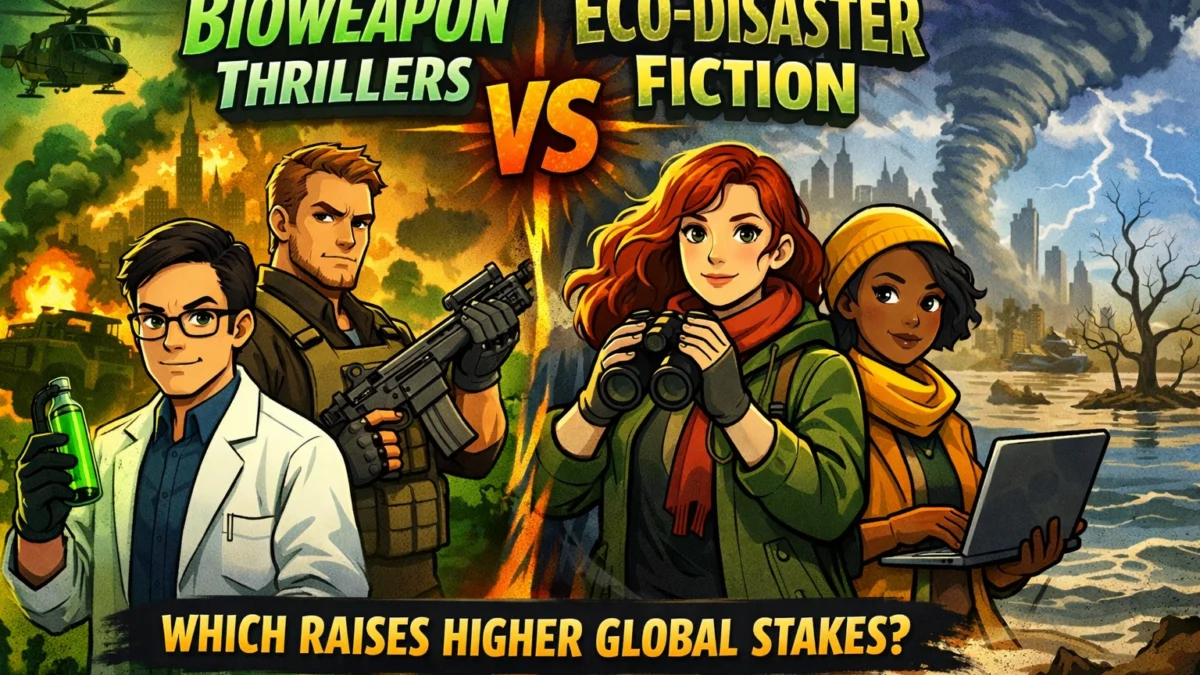
Let's be real, in 2026, we're living in the era of existential dread. Climate reports drop like horror movie trailers, and every other headline feels ripped from a dystopian novel. So when you're picking up a thriller, which plot hits harder: a bioweapon that could wipe humanity off the map in days, or an environmental collapse that grinds civilization down over decades?
Spoiler alert: the answer is both. And the smartest villains know it.
The Bioweapon Appeal: Instant Catastrophe
Bioweapon thrillers deliver pure, concentrated terror. One vial. One mutation. One brilliant madman in a lab coat, and suddenly we're talking about a pathogen that spreads faster than misinformation on social media.
The stakes? Immediate extinction-level events. Characters racing against a ticking clock. Quarantine zones. Mass panic. It's visceral, it's urgent, and it taps into our primal fear of invisible threats we can't punch or shoot our way out of.
In fiction, bioweapons work because they're fast. You don't need three books to build tension when a genetically engineered virus can depopulate a continent in Chapter 4. The urgency is baked in. Every page turn feels like borrowed time.

Eco-Disaster Fiction: The Slow-Motion Apocalypse
Now flip the script. Environmental catastrophes don't need to be weaponized, they're already happening. Deforestation, ocean acidification, collapsing ecosystems. These threats don't announce themselves with dramatic lab explosions. They creep up on you like a rising tide, and by the time you notice, your city's underwater.
Eco-disaster fiction hits differently because it's plausible. We're not asking "what if?" anymore, we're asking "how soon?" It's the difference between a jump scare and existential dread that keeps you awake at 3 AM scrolling through climate data.
The stakes here are global and generational. It's not just about surviving next week; it's about whether there's a livable planet left for anyone's grandkids. That's heavy stuff for a Thursday night read, but it resonates because we're living adjacent to it right now.
Why Not Both? Meet Bossman (Burner)
Here's where The Rainsavers gets diabolically clever. Why choose between two existential nightmares when you can weaponize both?
Enter Bossman, also known as Burner, a villain who makes other bad guys look like amateur hour. This guy isn't just threatening humanity with a bioweapon or orchestrating environmental collapse. He's leveraging both as part of the same twisted game plan.
Think about it: rainforests burning at unprecedented rates? That's not just ecological devastation, that's destroying biodiversity, eliminating potential medical discoveries, and destabilizing global climate systems all at once. Now add a genetically engineered pathogen into that chaos, and you've got a villain who's playing 4D chess while everyone else is still figuring out checkers.

Bossman understands something that makes him genuinely terrifying: modern catastrophes don't operate in isolation. Environmental collapse creates perfect conditions for disease spread. Destabilized ecosystems mean animal-to-human pathogen jumps become more frequent. Resource scarcity breeds conflict, which breeds more chaos.
He's not just a mad scientist or an eco-terrorist. He's both. And that combination raises the stakes beyond anything a single-threat villain could achieve.
The Science of Scary: Which Feels More Real?
In 2026, both threats feel uncomfortably close to home. We lived through a pandemic. We've watched wildfire seasons extend into year-round emergencies. The question isn't whether these scenarios are realistic, it's which one keeps you up at night.
Bioweapons have that immediate "oh god, we're all going to die" factor. They're tangible villains you can point at, contain (maybe), and defeat (hopefully). There's a clear enemy, which paradoxically makes them feel more manageable in fiction.
Environmental catastrophes? Those are systemic, diffuse, and maddeningly complex. You can't arrest climate change or quarantine a collapsing ecosystem. That makes them feel more overwhelming but also more abstract as narrative threats.
The genius of combining them? You get the urgency of bioweapon thrillers with the inescapable dread of eco-disaster fiction. Suddenly your heroes aren't just racing to stop a weaponized virus: they're trying to prevent cascading failures across multiple interconnected systems.
Team-Based Solutions for Complex Threats
When you're facing threats this layered, lone-wolf heroes don't cut it anymore. You need specialists. Field operatives. Scientists who can pivot between analyzing pathogen samples and understanding ecosystem collapse.
This is why team-based adventure series are dominating in 2026. A single protagonist can't realistically handle bioweapons and environmental warfare and the geopolitical fallout and the on-the-ground tactical missions. You need a crew with diverse skill sets who can tackle multiple crisis points simultaneously.

In The Rainsavers, that means characters like Sunbyte handling digital warfare and surveillance while others manage field operations in contaminated zones. When Bossman's pulling multiple levers of catastrophe at once, you need heroes who can divide and conquer: or at least divide and survive long enough to figure out his endgame.
The Verdict: Synthesis is Scarier
So which raises higher stakes: bioweapon thrillers or eco-disaster fiction?
Here's the uncomfortable truth: asking us to choose between them is like asking whether you'd rather be stabbed quickly or poisoned slowly. The real nightmare scenario is when someone figures out how to deploy both simultaneously, creating cascading failures where each crisis amplifies the others.
That's exactly what makes Bossman such an effective villain. He's not operating in a single genre. He's synthesizing threats across multiple domains, creating a scenario where traditional heroic solutions fail because they're designed to address one problem at a time.
In 2026, we're living in an era where multiple existential threats overlap and interact in unpredictable ways. Fiction that reflects that complexity: that shows villains exploiting those intersections and heroes struggling to adapt: feels more relevant than ever.
Why This Matters for Readers
If you're picking up thrillers in 2026, you're probably looking for more than escapism. You want stories that grapple with real anxieties while still delivering that page-turning suspense.
The Rainsavers delivers that balance by refusing to simplify its threats. Bossman isn't just a bioweapon guy or an environmental terrorist: he's a villain operating at the intersection of multiple global crises, which makes him feel disturbingly plausible.
And plausibility matters. The best thrillers aren't about completely alien scenarios: they're about familiar fears cranked up to eleven. When you're reading about engineered pathogens spreading through destabilized ecosystems, you're not thinking "that could never happen." You're thinking "how soon?"
That's the sweet spot where great thriller fiction lives: close enough to reality to feel urgent, imaginative enough to explore scenarios we hope never materialize.
Ready for the Ultimate Blend?
If you're tired of thrillers that force you to choose between immediate bioweapon terror and slow-burn environmental collapse, The Rainsavers says: why not both?
Bossman's already figured it out. The question is whether our heroes can adapt fast enough to stop him.
Read Book One now and see what happens when a villain stops playing by single-genre rules.
