
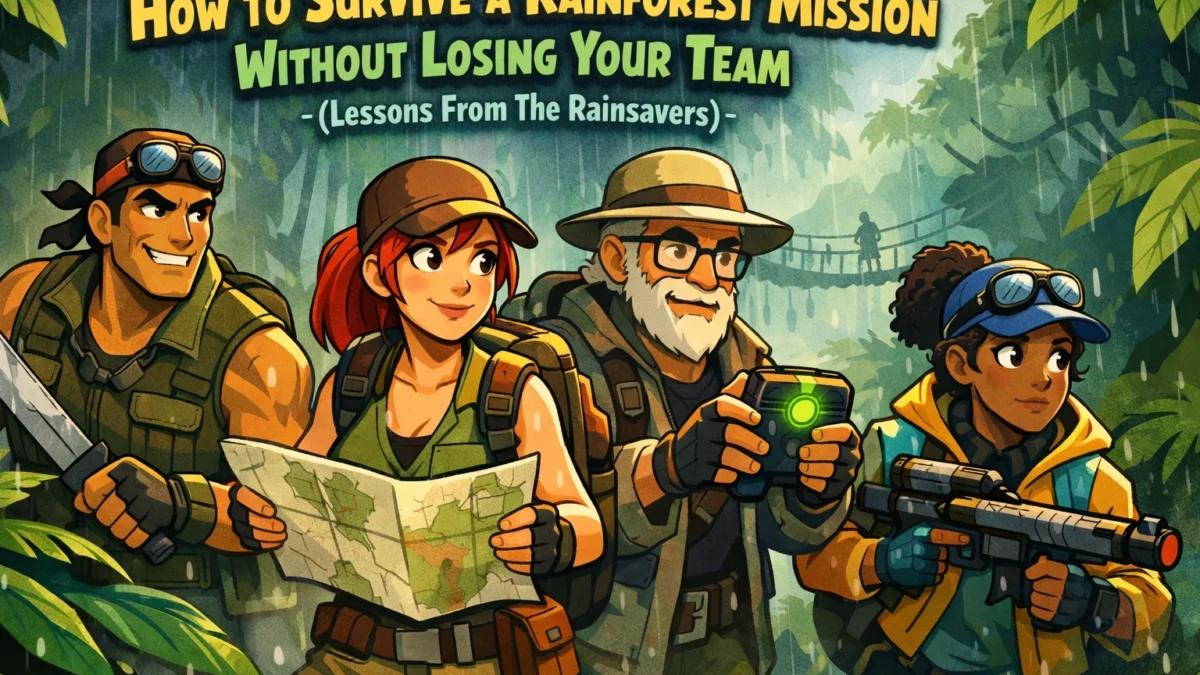
Meta description: Planning a high-stakes rainforest expedition in 2026? Learn survival lessons from The Rainsavers team, where biodiversity protection meets tactical teamwork, and losing a teammate is never an option.
Look, nobody wants to be that team leader who comes back from a mission short one biologist, one tactical expert, or, heaven forbid, one genius orangutan. Yet somehow, rainforest missions have a way of testing even the most elite squads. Throw in corporate mercenaries, experimental tech threats, and the occasional red mercury conspiracy, and you've got yourself a recipe for disaster.
Unless you learn from the best.
The Rainsavers have been running high-risk environmental protection ops in some of the world's most hostile terrain since the mid-2020s, and they've managed to keep their crew intact through it all. Here's how they do it, and how you can apply their methods to your own expeditions, whether you're fighting eco-criminals or just trying to document rare species without anyone wandering off a cliff.
Rule #1: Assign Roles Based on Actual Skills, Not Egos
Here's where most teams fall apart before they even hit the canopy layer: someone decides they're "naturally good at navigation" because they hiked the Appalachian Trail once in college. Spoiler alert, 2026's rainforests are not the Appalachian Trail.

The Rainsavers operate on a simple principle: every team member has a defined specialty, and they stick to it. Primal handles the tactical approach and threat assessment. Mortalis brings the biodiversity expertise and field medicine. Alpha? Well, when you've got an orangutan with engineering-level problem-solving skills, you let him handle the tech and traps.
Nobody tries to be the hero who does everything. That's how you end up with a marine biologist attempting to defuse a red mercury device or a combat specialist trying to identify venomous plants. (Both scenarios have roughly the same survival rate: not great.)
Your takeaway: Before you set foot in the jungle, conduct an honest skills audit. Who's your actual navigation expert? Who knows emergency medicine beyond "put pressure on it"? Who can jury-rig a water filtration system from bamboo and paracord? Write it down. Stick to it. Leave your ego at base camp.
Rule #2: Water First, Everything Else Second
In rainforest environments, you're surrounded by moisture yet somehow always one bad decision away from severe dehydration. It's ironic, really: like drowning in air.
The Rainsavers learned this the hard way during an early Amazon operation when they prioritized setting up surveillance equipment over establishing reliable water access. Three hours later, in 95% humidity and 90°F heat, the entire team was making questionable decisions. (Alpha almost traded their satellite phone for a can of coconut water from a passing river trader. Mortalis had to physically intervene.)
Here's their current protocol:
- Establish multiple water collection points within the first hour of arrival: rainfall catchers using large leaves, identified stream locations, bamboo reservoirs
- Assign one team member as "hydration monitor" (usually Mortalis, because he's annoyingly good at remembering things like "humans need water to live")
- Always boil or filter: no exceptions, even if it looks clean, even if you're tired, even if someone swears they have an "iron stomach"
Running water beats stagnant pools every time. And if you're following animal trails to find water sources (which works), remember that animals also poop near water sources. Filter accordingly.
Rule #3: Shelter Isn't Optional: It's Strategic
Most people think shelter is just about staying dry. In a rainforest mission, proper shelter is your tactical advantage. It's where you regroup, treat injuries, secure equipment, and: critically: hide from threats that range from hostile weather to even more hostile humans.

The Rainsavers' shelter philosophy: build it fast, build it hidden, build it functional. A proper lean-to structure made from branches and large leaves can go up in under an hour with a coordinated team. The key is camouflage: blending into the environment so thoroughly that even drones have trouble spotting your position.
During a 2025 operation in Borneo, the team evaded a corporate security sweep for three days by constructing shelters that mimicked natural debris piles. The pursuing team walked past them twice. Alpha added motion-sensor alerts using salvaged equipment. Primal insisted on multiple escape routes from each shelter.
No one complained about being "over-prepared" when they actually needed those escape routes.
Rule #4: Communication Protocols Prevent Panic
You know what happens when team communication breaks down in hostile territory? People make assumptions. Bad assumptions. Like "they probably headed back to camp" or "I'm sure someone else called for extraction" or "that screaming was definitely just a howler monkey."
The Rainsavers use scheduled check-ins every two hours, regardless of conditions. If someone misses a check-in, the entire team shifts to emergency protocols: no exceptions, no "they're probably fine" optimism.
They also establish clear signal systems for situations when radio silence is necessary:
- Visual signals using reflective markers
- Sound patterns (specific bird calls that don't exist in that ecosystem: locals notice, enemies don't)
- Physical markers along paths (Mortalis uses a system of arranged leaves that indicate direction, danger, or safe zones)
The rule: If you can't reach your team, assume the worst and act accordingly. It's better to over-respond to a false alarm than under-respond to a real crisis.
Rule #5: Food Is Team Effort, Not Competition
Survival shows love to make food procurement look like a solo sport. Reality check: in actual field operations, food acquisition works best as a coordinated team effort, and trying to "prove yourself" by hunting alone is how people get lost, injured, or eaten by something higher on the food chain.

The Rainsavers rotate food duties:
- Trap-setting teams (usually Alpha and whoever has patience for slow, methodical work) establish multiple snare points along animal trails
- Foraging teams (Mortalis leads this because his biodiversity expertise prevents the "is this edible or deadly" guessing game)
- Fishing teams (if near water: Primal's surprisingly good at spearfishing)
Energy conservation is key. Setting ten traps and checking them daily burns fewer calories than actively stalking prey for hours. Plus, traps work while you're doing other mission-critical tasks, like not dying from other causes.
Rule #6: Navigate Like Your GPS Doesn't Exist (Because It Might Not)
Modern tech is amazing until it encounters dense canopy cover, electromagnetic interference, or a well-placed EMP device from enemies who'd rather you stay lost. The Rainsavers learned to navigate using multiple redundant systems:
- Physical maps (actual paper, marked with waypoints and hazard zones)
- Natural navigation (sun position, star patterns, river flow direction)
- Predetermined evacuation routes (memorized by all team members before insertion)
During a 2026 operation, their entire electronic navigation suite went dark when they encountered experimental jamming tech. They successfully extracted using compass navigation and pre-mapped routes. Meanwhile, the hostile forces searching for them were wandering in circles, completely dependent on their malfunctioning GPS.
Irony appreciated.
Rule #7: Trust Your Team's Instincts (Especially the Non-Human Ones)
This might sound strange, but Alpha's saved the team more times than anyone's officially counted: not because he's got superhuman powers, but because orangutans notice things humans miss. Different perspective, literally and figuratively.
When Alpha refuses to cross a certain area, there's usually a reason. Could be unstable ground. Could be a predator scent marker. Could be that his pattern-recognition picked up surveillance equipment hidden in the vegetation. The Rainsavers stopped questioning it after the third time his "weird behavior" prevented an ambush.
Lesson: Every team member brings unique awareness. The marine biologist notices water quality changes. The combat veteran spots tactical vulnerabilities. The local guide recognizes weather pattern shifts. Listen to all of them, especially when their expertise flags something unusual.
The Bottom Line: Come Home Together
The Rainsavers operate under one non-negotiable principle: everyone who starts the mission finishes the mission. Not "most people." Not "everyone except casualties we couldn't prevent." Everyone.
That means:
- Planning for worst-case scenarios
- Cross-training so multiple people can handle critical tasks
- Establishing buddy systems
- Never prioritizing mission objectives over team safety
- Being willing to abort when conditions deteriorate beyond acceptable risk
It's not about being the toughest or the most hardcore. It's about being the team that's still operational, still together, and still capable of running the next mission.
Because there's always a next mission. The threats facing biodiversity in 2026 aren't getting smaller, the technology falling into the wrong hands isn't getting less dangerous, and the rainforests still need protection.
Ready to see how the Rainsavers handle their most challenging operations? Dive into Book One at The Rainsavers and discover what happens when environmental protection meets tactical precision: and nobody gets left behind.
