
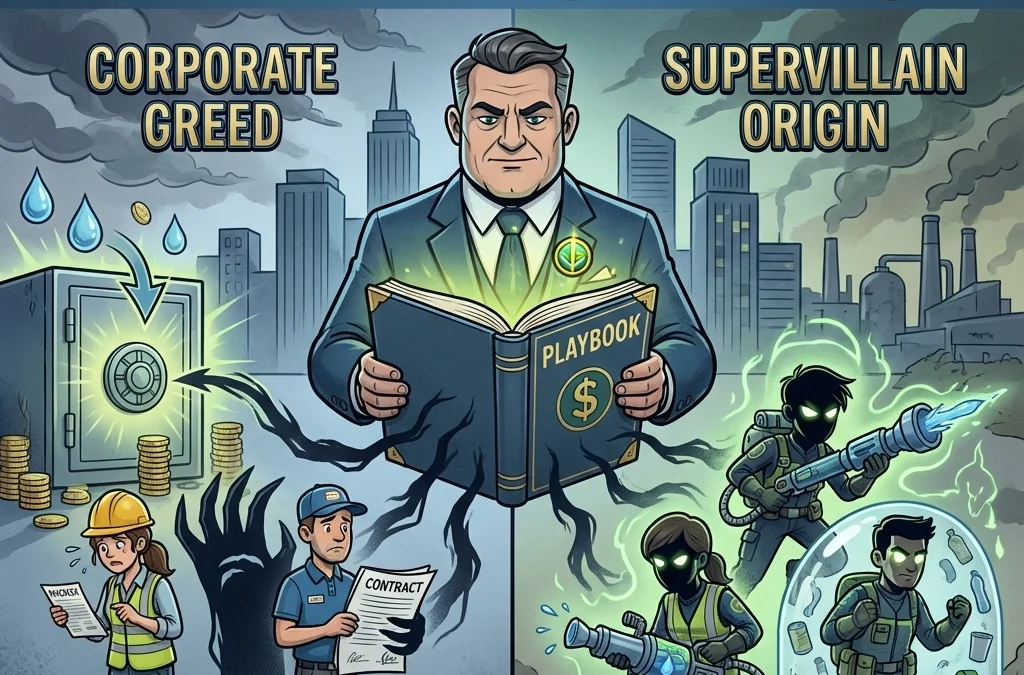
Meta Description: Discover how corporate greed creates the perfect supervillain origin story through Bossman's ruthless playbook in The Rainsavers series. 7 key ways power corrupts absolutely.
Image Alt Text: Dark corporate boardroom with shadowy figure representing the transformation from businessman to supervillain
Ever wonder how a regular CEO transforms into a world-threatening supervillain? In The Rainsavers series, we watch Bossman (aka Burner) follow the classic corporate-greed-to-evil-mastermind pipeline. His playbook isn't just fiction: it's a blueprint we see playing out in boardrooms everywhere.
Here are the 7 key moves that turn corporate ambition into supervillain origin stories.
1. Start With "Just Business" Mentality
Bossman didn't wake up one morning deciding to destroy the Amazon rainforest. It started with simple profit maximization. Every tree chopped down was just "efficient resource management." Every displaced community was "necessary for progress."
This is supervillain origin 101: convince yourself that human and environmental costs are just numbers on a spreadsheet. When Primal and Alpha first encounter Bossman's operations, they're not facing a mustache-twirling cartoon villain: they're up against someone who genuinely believes deforestation is good business.
The scariest villains always think they're the hero of their own story.
2. Isolate Yourself From Consequences

Corporate towers aren't just status symbols: they're isolation chambers. Bossman operates from air-conditioned boardrooms, far removed from the actual destruction his decisions cause. He never has to smell the smoke or hear the chainsaws.
Dr. Mubari sees this firsthand when studying the environmental impact. The further executives get from ground-level reality, the easier it becomes to make inhuman choices. Distance breeds detachment, and detachment breeds cruelty.
When you can't see the faces of the people you're harming, it's easier to harm more of them.
3. Surround Yourself With Yes-People
Every supervillain needs henchmen, and corporate culture breeds them perfectly. Bossman builds an empire of people who depend on him for their paychecks, their careers, their identities. Question the boss? Risk everything.
This echo chamber effect amplifies every bad decision. Instead of course-correcting, Bossman gets constant validation that his destructive path is brilliant strategy. His board meetings become villain monologue sessions where everyone nods along.
The Rainsavers team faces this when trying to expose Bossman's operations: his entire organization protects him, not out of loyalty, but out of self-preservation.
4. Scale Up The Damage

What starts as cutting down a few trees for profit quickly escalates. Bossman's appetite grows with success. One forest becomes ten. One country becomes a continent. Local environmental damage becomes global climate impact.
This is where corporate greed mirrors classic villain evolution. The stakes keep rising because the original thrill wears off. More profit requires more destruction, and more destruction requires more power to protect that destruction.
By the time Primal and the team realize the full scope of Bossman's plan, he's already thinking beyond Earth, literally. The moonbase operations we see in later books aren't just evil for evil's sake; they're the logical next step when you've already consumed everything available on one planet.
5. Weaponize Legal Systems
Real supervillains don't break laws: they rewrite them. Bossman uses lobbying, campaign contributions, and regulatory capture to make his destructive practices perfectly legal. Why fight the system when you can buy it?
This creates the most frustrating type of villain for heroes like Alpha and Jungle Dart to face. Traditional good-guy tactics don't work when the bad guy owns the referees. Environmental protection becomes "government overreach." Conservation efforts become "economic terrorism."
Legal invincibility breeds moral invincibility. When everything you do is technically allowed, it's easy to convince yourself everything you do is right.
6. Develop a God Complex

Power corrupts, but unchecked corporate power creates something worse than corruption: it creates delusions of omnipotence. Bossman starts believing his own press releases. He's not just a CEO; he's a visionary reshaping the world.
This psychological shift is what transforms a greedy businessman into a genuine threat to humanity. Bossman stops seeing himself as someone who works within natural systems and starts seeing himself as someone who controls them. Climate change isn't a problem to solve: it's a market to exploit.
When Dr. Mubari's research shows the catastrophic long-term effects of Bossman's operations, his response isn't concern: it's opportunity. Why prevent disaster when you can profit from it?
7. Create Your Own Existential Crisis
Here's the final step in the corporate-to-supervillain transformation: when you've destroyed everything that originally motivated you, you have to invent new purposes. Bossman's wealth becomes meaningless when there's no healthy planet to enjoy it on.
This is where we see the full evolution into mustache-twirling territory. Bossman's later schemes involving Leonard West, Mortalis, and ancient Nazi technology aren't really about money anymore: they're about proving he can reshape reality itself. The Spirit Tree becomes a target not because it's profitable to destroy, but because it represents something he can't control.
The most dangerous villains are the ones who've run out of rational motivations and started operating on pure ego.
The Human Stakes
What makes Bossman particularly chilling as a villain isn't his supernatural powers or alien technology: it's how familiar his path feels. We see real-world versions of his playbook every day. The difference is that in The Rainsavers universe, heroes like Primal, Alpha, Dr. Mubari, Jungle Dart, and Sunbyte actually show up to stop him.
These characters represent the human stakes that corporate villains like Bossman ignore. They're the voices of communities, ecosystems, and future generations that don't get boardroom representation. Their team dynamic works because they each bring different perspectives that Bossman's isolation has made him blind to.
Breaking the Cycle
The scariest thing about Bossman's playbook? It's not unique to him. It's a template that creates new villains every day. But that's also what makes The Rainsavers series feel relevant: it shows that these seemingly unstoppable forces can be challenged when people work together with different skills and shared values.
Corporate greed becomes supervillainy when it operates without accountability, consequence, or human connection. The antidote isn't just better regulation or environmental awareness: it's remembering that the people making these decisions are still people, and people can change course when confronted with the reality of their choices.
Or, if they can't, at least they can be stopped by heroes who refuse to give up.
Ready to see how this battle plays out? The fight between corporate destruction and environmental protection is just getting started.
Read Book One: Primal Awakening and witness the first clash between Bossman's empire and the team that won't let him destroy the world for profit.
