
Meta Description: Mortalis didn't start as a villain, he was created by a hero. Discover how The Rainsavers' most dangerous antagonist turned the tables on his creator in 2026's most twisted origin story.
You know that old saying, "never meet your heroes"? Well, in The Rainsavers universe, it's more like "never create your villain." Because when Primal's experimental biotech went sideways in the Amazon rainforest, the result wasn't just dangerous: it was personal.
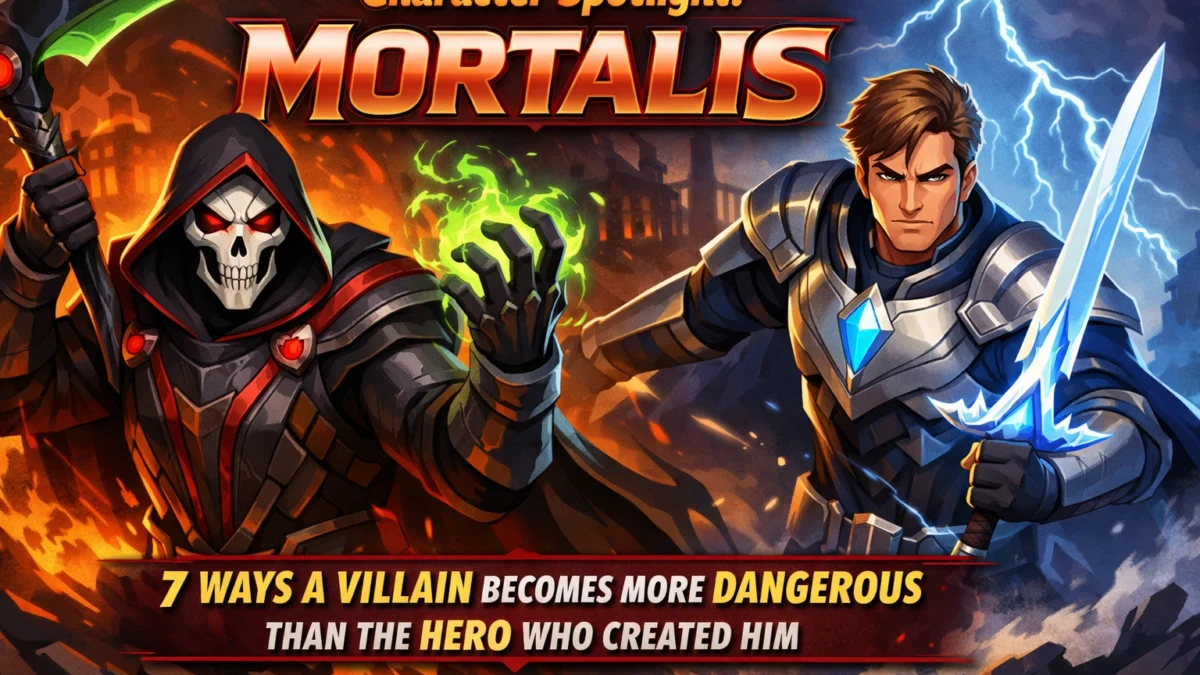
Meet Mortalis: the villain who knows every weakness, every secret, and every regret of the hero responsible for his existence. He's not just a threat. He's a mirror reflecting everything that went wrong.
Let's break down exactly why this guy is so terrifying.
1. He Knows the Hero's Playbook (Because He Lived It)
Mortalis didn't study Primal's tactics from afar. He experienced them firsthand during his transformation. Every decision, every improvisation, every moment of doubt: Mortalis was there for all of it.
Think about fighting someone who's been inside your head. Someone who knows how you react under pressure, what makes you hesitate, and which emotional buttons to push. That's not just a strategic advantage. That's psychological warfare at its finest.
In 2026's adventure fiction landscape, we're seeing more villains with this intimate knowledge of their heroes. But Mortalis takes it to another level because his connection to Primal isn't learned: it's lived.

2. Shared Biology Means Shared Weaknesses (Except He Fixed His)
Here's where it gets really messed up. Since Mortalis emerged from the same experimental red mercury compound that gave Primal his abilities, they share a biological foundation. Same source, same vulnerabilities… theoretically.
But Mortalis had something Primal didn't: time to evolve in the darkness.
While Primal was learning to be a hero and protect the rainforest, Mortalis was isolated, adapting, and: most importantly: fixing the flaws in their shared design. He turned every weakness into a strength. Every limitation into an advantage.
By the time they face off, Mortalis has become what Primal could have been if survival, not heroism, had been the only goal.
3. He Weaponizes the Guilt
Let's get real about what makes Mortalis truly dangerous: he's not just a physical threat. He's a constant reminder of Primal's greatest failure.
Every time Primal faces him, he's looking at a living consequence of his choices. That experimental tech that was supposed to save endangered species? It created a monster instead. The mission to protect the Amazon? It unleashed something that now wants to consume it.
Mortalis doesn't just attack with red mercury weapons and biotech. He attacks with words. With truth. With the question that keeps Primal up at night: "What else will you destroy trying to save the world?"
That's the kind of villain who gets under your skin and stays there.
4. The Perfect Counter-Strategy for Every Move
When you create something, you know its limitations. But when that creation becomes self-aware and hostile, you've essentially given your enemy a complete blueprint of your methodology.
Mortalis doesn't just know what Primal will do: he knows why he'll do it. He understands the moral framework, the environmental ethics, the team dynamics. He's seen how The Rainsavers operate because, in a twisted way, he was present at their founding moment.
Every heroic instinct Primal has? Mortalis can predict it, exploit it, and turn it against him. Want to save civilian lives? That's your weakness. Trying to minimize environmental damage? That's your constraint. Trusting your team? That's your vulnerability.

5. He Represents the Road Not Taken
Here's something that doesn't get talked about enough in adventure fiction: the most terrifying villains are the ones who show heroes what they could become.
Mortalis is the dark mirror. He's what happens when you take Primal's power, strip away the moral compass, and focus purely on survival and dominance. He's proof that heroism is a choice, not a destiny: and it's a choice that Primal has to keep making, even when it's easier not to.
In the rainforest depths, when Mortalis offers Primal a glimpse of "freedom" from responsibility, from guilt, from the weight of trying to save a world that doesn't always want saving… that's when the real battle begins. Not against the villain, but against the temptation to become the villain.
6. Access to the Same Ancient Tech (With None of the Ethics)
The red mercury connection isn't just biological: it's archaeological. Both Primal and Mortalis can access ancient technologies hidden in the Amazon, remnants of civilizations that understood things modern science is only beginning to glimpse.
The difference? Primal wants to preserve these sites. Mortalis wants to exploit them.
While The Rainsavers are carefully documenting and protecting ancient secrets, Mortalis is raiding them like a deranged treasure hunter with a PhD in destruction. He's weaponizing historical mysteries faster than the heroes can even understand them.
By 2026, this has become one of the most compelling aspects of modern villain design: giving antagonists access to the same power source as heroes, but removing all the safety rails. It's not about who's stronger: it's about who's willing to go further.
7. He Evolves Faster Than the Heroes Can Adapt
The final, and perhaps most chilling aspect of Mortalis: he's not static. He's not following some predetermined master plan. He's evolving in real-time, adapting to every encounter, learning from every failure.
The Rainsavers might win a battle, but Mortalis treats every defeat as a data point. Every clash makes him stronger, smarter, more unpredictable. He's running his own twisted version of adaptive learning, and the curriculum is survival at any cost.
This is what separates a dangerous villain from a memorable villain. Mortalis isn't just reacting to the heroes: he's growing alongside them, making sure that every victory The Rainsavers achieve today will be harder to repeat tomorrow.
Why This Origin Story Hits Different in 2026
The "villain created by the hero" trope isn't new, but The Rainsavers takes it somewhere unexpected. Mortalis isn't an accident or a random mutation. He's a consequence: a living reminder that even good intentions can create catastrophic results when you're messing with forces you don't fully understand.
In a year when environmental fiction is asking harder questions about intervention, preservation, and the cost of playing god with nature, Mortalis represents the uncomfortable answer: sometimes the monsters we create are far more dangerous than the threats we were trying to stop.
And that's exactly what makes him the perfect villain for this story.
Ready to see how this twisted origin story unfolds? Dive into The Rainsavers series and experience the rainforest adventure where every hero's decision has consequences: and one of those consequences has a name: Mortalis. Start reading now at rainsavers.com and discover why 2026's readers can't stop talking about the villain who knows his creator's every move.
