
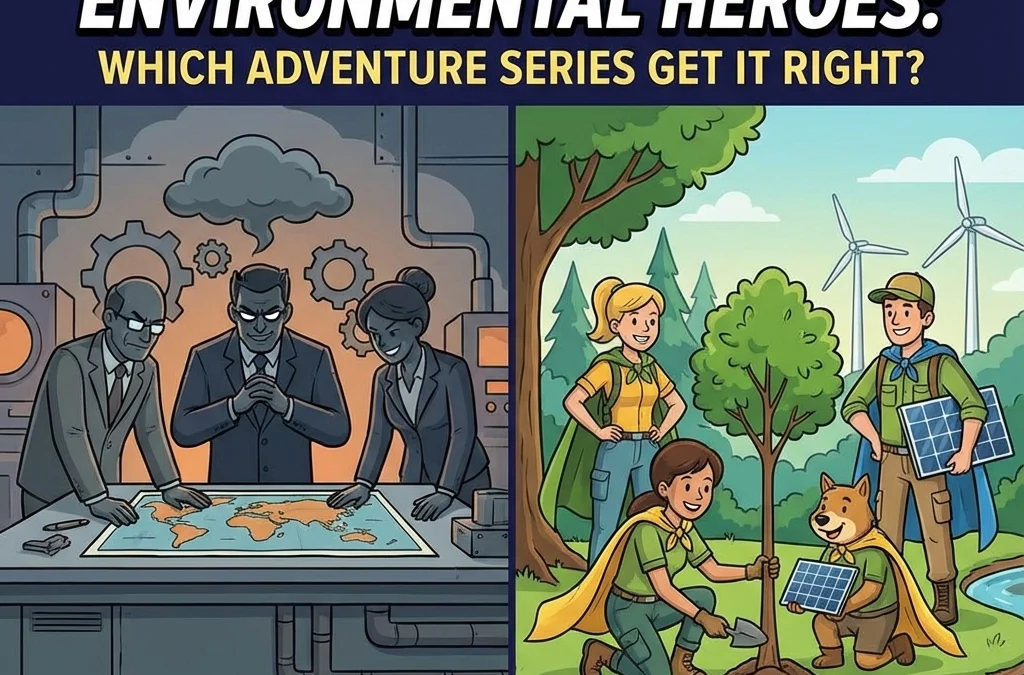

The boardroom versus the forest floor. Profit margins versus preservation. Corporate spreadsheets versus species survival.
In today's adventure fiction, this showdown has become one of the most compelling: and most botched: narrative frameworks out there. Some series nail the complexity of environmental heroism while others reduce it to cartoonish tree-huggers battling mustache-twirling CEOs.
So which adventure series actually get this dynamic right? Let's dive into what works, what doesn't, and why The Rainsavers stands out as the gold standard for this kind of storytelling.
The Problem with Most Corporate Villain Stories
Here's the thing: most adventure series treat corporate villains like they're still stuck in the 1980s. You know the type: evil executives in pristine suits who literally cackle while destroying rainforests for no reason beyond "more money."
But real environmental threats don't work that way. They're complex, systemic, and often driven by people who genuinely believe they're doing the right thing. The best corporate villains aren't evil for evil's sake: they're terrifying because their logic makes sense from a certain point of view.
This is where most series fall flat. They create strawman antagonists instead of exploring the real tension between economic necessity and environmental preservation. The result? Stories that feel preachy rather than compelling, with heroes who seem naive and villains who seem ridiculous.
What Environmental Heroes Actually Look Like

Real environmental heroes aren't just passionate activists (though passion matters). They're scientists, strategists, and survivors who understand that saving the planet requires both heart and smarts.
The best environmental heroes in fiction share a few key traits:
They're scientifically literate. They can explain why ecosystems matter without sounding like they're reading from a textbook. They understand interconnected systems, biodiversity, and the real stakes of environmental destruction.
They're pragmatic idealists. They want to save the world, but they understand that requires working within existing systems, not just against them. They know when to fight and when to negotiate.
They have personal stakes. The environment isn't abstract to them: it's home, livelihood, or legacy. Their motivation runs deeper than general do-goodery.
They're part of a team. Real environmental challenges are too big for lone heroes. The most effective environmental heroes work with diverse teams that bring different skills to the table.
Why The Rainsavers Gets It Right
The Rainsavers series understands something most adventure fiction misses: the best environmental stories aren't about good versus evil: they're about different visions of survival.
Take the corporate antagonists in The Rainsavers. They're not generic "profit at all costs" villains. They're people who genuinely believe that controlled exploitation of rainforest resources is the only way to prevent worse destruction. They have data, projections, and compelling arguments about sustainable extraction.
That's what makes them terrifying.

The environmental heroes in The Rainsavers: Jungle Dart, Leonard West, Alpha, and the rest: aren't naive idealists. They're former military, brilliant scientists, and tactical thinkers who understand that protecting the rainforest requires both environmental knowledge and strategic combat skills.
Jungle Dart, raised by the rainforest itself, doesn't just love nature: she understands it at a molecular level. Leonard West brings black ops expertise to environmental protection. Alpha combines orangutan intelligence with strategic thinking that outpaces most humans.
This isn't your typical "tree-huggers versus suits" dynamic. It's a complex clash between different approaches to planetary stewardship, with compelling characters on multiple sides of the conflict.
The Ancient Mystery Factor
What sets The Rainsavers apart from other environmental adventure series is how it weaves ancient mysteries into modern environmental threats. The rainforest holds secrets that predate human civilization: knowledge that both heroes and antagonists want to unlock.
This approach elevates the stakes beyond typical environmental messaging. It's not just about preserving pretty trees or cute animals (though those matter too). It's about protecting knowledge systems that could change everything we understand about life on Earth.
The corporate villains in The Rainsavers aren't just interested in timber or mineral rights. They're chasing ancient biotechnology that could revolutionize medicine, agriculture, or energy production. Their environmental destruction is a side effect of pursuing discoveries that could theoretically save millions of lives.
See the moral complexity? That's what makes for gripping adventure fiction.
Team Dynamics That Actually Work

Most environmental adventure series either feature lone wolf heroes or teams that feel artificially assembled. The Rainsavers team feels organic because each member brings skills that complement the others while maintaining their individual motivations.
The team dynamic works because each character has a different relationship with the environmental mission. Some are driven by scientific curiosity, others by personal loss, and still others by tactical challenges. They're not environmental clones: they're diverse people united by shared stakes.
This reflects real environmental movements, which succeed when they bring together scientists, activists, local communities, and strategic thinkers. The most effective real-world environmental protection happens when different skill sets collaborate toward shared goals.
Modern Tech Meets Ancient Wisdom
The Rainsavers excels at balancing cutting-edge technology with indigenous knowledge systems. The heroes use advanced gear and tactical intelligence, but they also respect and learn from traditional ecological wisdom.
This balance reflects real environmental science, where the most important discoveries often happen when modern research validates traditional practices. The series doesn't romanticize either approach: it shows how both scientific methods and ancestral knowledge contribute to understanding complex ecosystems.
The corporate antagonists, meanwhile, represent the danger of applying powerful technology without ecological wisdom. They have the tools to transform rainforest resources but lack the deep understanding needed to do so sustainably.
Where Other Series Go Wrong
Most environmental adventure fiction fails in predictable ways. Some treat environmentalism as simple moral superiority: good guys love trees, bad guys hate them. Others get so focused on the message that they forget to tell compelling stories with complex characters.
The worst environmental adventure series create heroes who seem to oppose all human progress and villains who seem to hate nature for no logical reason. These stories feel like lectures rather than adventures.
Better series understand that environmental protection often requires innovation, not just preservation. The best environmental heroes aren't anti-technology: they're pro-sustainability. They want progress that works with natural systems rather than against them.
The Stakes That Matter

What makes environmental adventure compelling isn't just the scope of potential destruction: it's the personal stakes for characters we care about. The best series make environmental threats personal without being manipulative.
The Rainsavers succeeds because the environmental threats directly impact each character's deepest motivations. Protecting the rainforest isn't just their job: it's protecting their home, their research, their found family, and their hope for the future.
When environmental destruction threatens everything the characters care about, readers feel those stakes too. The environmental message emerges naturally from character-driven storytelling rather than being imposed from outside.
Looking Forward: Environmental Adventure That Actually Adventures
The future of environmental adventure fiction lies in stories that treat environmentalism as the complex, urgent, and fascinating challenge it actually is. The best series won't choose between technology and nature: they'll explore how humanity can develop both in harmony.
The Rainsavers represents this evolution in environmental storytelling. It's adventure fiction that takes environmental science seriously while delivering the tactical action, ancient mysteries, and team dynamics that make for compelling reading.
Ready to experience environmental adventure done right? The Rainsavers series proves that protecting the planet can be the most thrilling mission of all. Discover the team that's redefining what environmental heroes can accomplish when they combine ancient wisdom with modern tactics.
The rainforest is calling. The question is: are you ready to answer?
