Let's be real for a second. It's 2026, and we're all tired.
Tired of the climate doom-scrolling. Tired of reading another article about how we're basically toast if we don't fix everything by Tuesday. Tired of feeling like we're supposed to save the planet single-handedly with our reusable straws while corporations do… whatever it is they do.
And you know what? That exhaustion is actually shifting how we consume stories. Big time.
The Great Pivot: From Panic to Purpose
Here's something interesting happening right now: The sustainability world is making a massive shift from "let's set ambitious targets for 2050" to "what are we actually doing TODAY?" Experts are calling it the move from "targets to traction," and honestly? It's about damn time.
People are over the aspirational stuff. We've had enough of organizations promising the moon while delivering, well, significantly less than lunar results. There's this growing realism about what actual decarbonization requires, the messy, complicated, everyone-needs-to-pitch-in kind of work.
And guess what readers are gravitating toward in their fiction? The exact same thing.

Why Nobody Wants Solo Hero Journeys Anymore
Remember when every story was about The Chosen One™ who single-handedly saves the world while everyone else just stands around being impressed? Yeah, we're collectively over that fantasy.
Because that's not how real change works. That's not how climate action works. That's not even how getting through a regular Tuesday works most of the time.
In 2026, readers want stories that reflect the reality we're living: Change happens when teams work together. When different people bring different skills to the table. When someone screws up and someone else has their back. When the scientist talks to the engineer who talks to the community organizer who talks to the kid with the wild idea that just might work.
This is why action-adventure series centered on teamwork are absolutely exploding right now. People aren't looking for escapism that ignores reality: they're looking for escapism that reframes reality. They want to see characters facing impossible odds and figuring it out together.
The Rainsavers Effect: High-Stakes Meets High-Hope
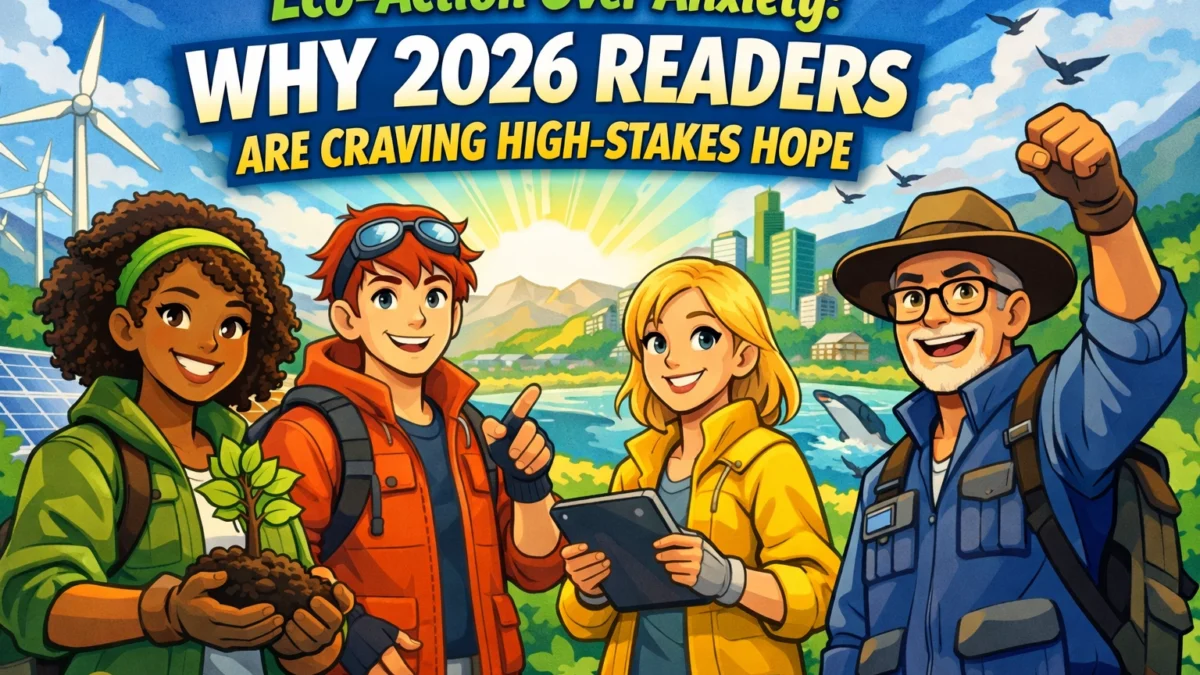
Look, I'm obviously biased, but there's a reason The Rainsavers resonates with readers dealing with climate anxiety. It's not because the books pretend environmental challenges don't exist. It's because they show a group of diverse characters actually doing something about those challenges.
No single hero carrying the entire weight of the world. No magical solution that fixes everything. Just smart, flawed, determined people working together and refusing to give up.

The series tackles real environmental threats: water scarcity, ecosystem collapse, corporate greed: but frames them through the lens of adventure and hope. Because here's the thing about climate anxiety: It thrives on hopelessness. It feeds on the feeling that nothing you do matters.
Action-adventure stories that center on effective teamwork? They're the antidote to that poison.
What 2026 Readers Actually Want (Spoiler: It's Not What You Think)
Based on what's happening in both the real sustainability world and the fiction landscape, here's what readers are craving:
Concrete action over abstract promises. Just like organizations are moving toward measurable results instead of distant targets, readers want to see characters taking tangible steps. They want the nuts and bolts of problem-solving, not just vague "and then they saved the day" hand-waving.
Collective effort over individual glory. Companies are investing heavily in employee engagement and stakeholder collaboration because they've realized top-down mandates don't work. Similarly, readers want stories where the victory belongs to the team, where different perspectives and skills matter, where everyone contributes.
Realistic stakes with optimistic outcomes. There's this growing acknowledgment in sustainability circles that we need both mitigation AND adaptation strategies: we're dealing with challenges that are already here. Readers want that same realism in their fiction. Show the stakes. Show the struggle. But also show the path forward.

The Science of Stories That Actually Help
Here's something fascinating: Reading action-focused, team-based adventure stories might actually help reduce climate anxiety. Not by avoiding the issues, but by modeling effective responses.
When you read about characters facing environmental catastrophes and responding with ingenuity, collaboration, and determination, your brain is essentially rehearsing those responses. You're building mental pathways that say "problems are solvable" and "working together gets results."
It's the literary equivalent of the workshops and challenges organizations are using to activate employees around climate strategy. Stories become training grounds for hope.
Why "Eco-Action" Beats "Eco-Anxiety" Every Time
The term "eco-anxiety" has become ubiquitous, but maybe we're focusing on the wrong prefix. What if the answer isn't managing our anxiety about the environment, but channeling it into eco-action?
That's exactly what's happening with the surge in action-adventure environmental stories. They're not therapy (though they might be therapeutic). They're inspiration engines. They're proof-of-concept for the idea that smart, committed groups of people can make a real difference.

The Rainsavers characters face threats that feel real because they are real: dressed up in fictional packaging but grounded in actual environmental science. And then they respond with exactly the kind of practical, collaborative, innovative action that the real world needs right now.
That's not escapism. That's practice.
The 2026 Reading Revolution
We're witnessing something pretty special in the fiction world right now. A whole generation of readers who are tired of feeling helpless, who are done with stories that either ignore environmental realities or present them as insurmountable, who are hungry for narratives that show what effective action actually looks like.
These readers understand that climate challenges are complex and ongoing. They're not looking for fairy-tale endings. They're looking for stories that model resilience, creativity, and teamwork in the face of genuine threats.
They're looking for high-stakes hope.
Your Move
If you're feeling that climate anxiety creeping in: and honestly, who isn't these days: maybe it's time to try a different approach. Instead of doom-scrolling through another apocalyptic think piece, pick up a story that shows you what solution-oriented action looks like.
Try The Rainsavers series. See what happens when you spend time with characters who face environmental catastrophes head-on, who bring different skills and perspectives to impossible problems, who refuse to give up even when the odds are stacked against them.
Because here's the truth: We need both kinds of action. The real-world kind where we support sustainable policies and make better choices. And the fictional kind that reminds us why those efforts matter, that shows us what effective teamwork looks like, that gives us permission to hope.
The world needs more people who believe change is possible. And sometimes, the best way to become one of those people is to read about characters who never doubted it for a second.
Ready to trade anxiety for action? Dive into The Rainsavers and join a team that's rewriting what eco-fiction can be.
