
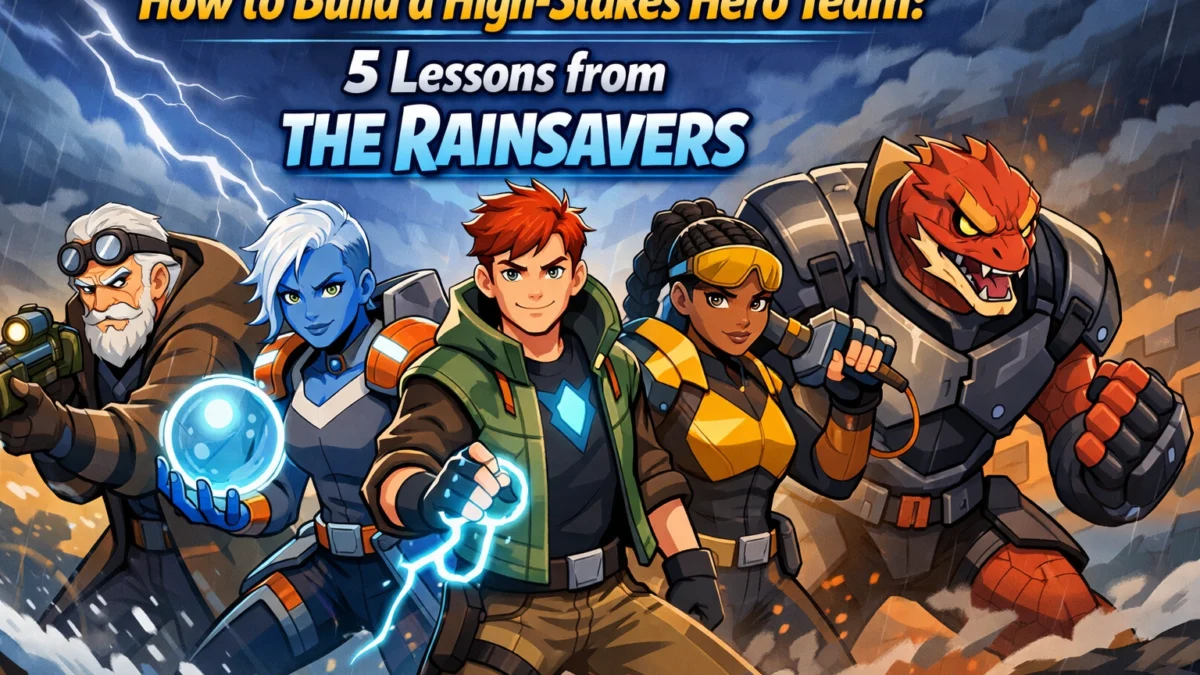
Meta description: Build a high-stakes hero team that actually feels real: clear roles, conflicting values, sci‑fi pressure (hello, red mercury), and consequences that stick: 5 skimmable lessons inspired by The Rainsavers (2026).
In 2026, “team stories” aren’t winning because there are more characters: they’re winning because the world is messier. Tech is weirder. Weather is wilder. Villains don’t just want money; they want leverage. And a lone hero can’t be everywhere at once.
That’s where high-stakes hero teams shine: you get built-in conflict, faster problem-solving, bigger risks, and the kind of momentum that keeps readers turning pages at 2 a.m.
Below are five practical lessons we use in the spirit of The Rainsavers: an eco-adventure team built for modern threats (environmental, technological, and human). No capes required. No superhero likenesses. Just a crew with pressure in the pipes.
A quick “team blueprint” memo (because formats should be fun)
INTERNAL MEMO : RAINFIELD OPS (Unofficial)
Subject: How to Build a Team That Doesn’t Collapse in Chapter 3
Date: March 20, 2026
To: Writers / Worldbuilders / Anyone assembling a crew under pressure
From: The part of your brain that hates plot holes
Status: Read before someone “mysteriously” goes off alone
High-stakes team =
- a mission that punishes mistakes
- a cast that can’t all want the same thing
- tools that solve problems and create new ones
- consequences that persist longer than a single scene
Alright. Let’s build.
Lesson 1: Give the team a mission that costs something every time
If your team can fail without fallout, it’s not high-stakes: it’s a group project with snacks.
In The Rainsavers flavor of storytelling, stakes land best when the mission hits three layers at once:
- Personal: someone’s past gets dragged into the light, or a promise gets tested
- Local: a community, habitat, or infrastructure is directly affected
- Systemic: the threat is bigger than one battle: supply chains, corruption, climate events, misinformation, or black-market tech
The rule of “paid progress”
Every step forward should come with a bill:
- they save the site, but lose the evidence
- they recover the device, but reveal their position
- they stop the spill, but trigger a political cover-up
- they win the fight, but fracture trust on the team
Quick writing check:
If the team succeeds, what did it cost them?
If the team fails, what changes tomorrow morning?
If you want more eco-adventure energy, The Rainsavers hub is here: https://rainsavers.com/category/eco-adventure-environmental-heroes
Lesson 2: Build roles that collide, not just complement
The usual team-building advice is “make everyone useful.” True. But high-stakes teams need something extra:
Make everyone useful in ways that sometimes make things worse.
A high-stakes team should have at least one of each:
- The Stabilizer: prevents catastrophe, tries to keep the group together
- The Accelerator: pushes action, breaks stalemates, creates risk
- The Skeptic: questions assumptions, catches traps, slows momentum
- The Specialist: solves niche problems (tech, medicine, survival, intel)
- The Wildcard: unpredictable leverage, emotional volatility, or odd connections
The trick is not to label them in dialogue. The trick is to design scenes where:
- the Stabilizer needs the Accelerator to act fast
- the Accelerator needs the Skeptic to stop them from walking into a trap
- the Specialist saves everyone but demands resources the team can’t spare
- the Wildcard gets the key… by making a promise nobody else approved
“Character spotlight” trick (without pausing the story)
Instead of backstory dumps, spotlight your team through field friction:
- Who argues about acceptable collateral damage?
- Who refuses to leave evidence behind?
- Who takes the blame in public and resents it privately?
If you want a quick refresher on the cast and vibes, you can browse: https://rainsavers.com/characters
Lesson 3: Put one piece of sci‑fi tech in the room…and make it a problem
In 2026 settings, technology doesn’t just “help.” It complicates motives and creates fresh kinds of threat.
A great way to raise the stakes fast is to introduce one advanced object everyone cares about: then force the team to disagree on what it means.
For The Rainsavers-style stories, red mercury is a perfect example of “tech as narrative fuel”:
- it’s rare enough to spark black markets
- dangerous enough to justify fear
- valuable enough to warp alliances
- mysterious enough to hide multiple interpretations (weapon? energy? bait?)
Tech should come with three kinds of risk
When you introduce a sci‑fi element (red mercury or anything adjacent), give it:
- Physical risk: contamination, instability, chain reactions, exposure
- Social risk: panic, propaganda, exploitation, a “hero vs villain” smear campaign
- Moral risk: does securing it justify breaking laws, lying, or endangering innocents?
When tech carries those three risks, every scene automatically gets tension:
- even a conversation becomes a standoff
- even a rescue becomes a negotiation
- even a win becomes a liability
ALT text: A fictional eco-hero team’s field kit with sealed sample vials, sensors, rugged tablets, and hazard tags on a workbench.
Lesson 4: Design “team fights” as argument + obstacle (not just action)
A high-stakes hero team scene is rarely just “go punch the problem.” The best team scenes run like a two-track collision:
- Track A: an external obstacle (storm surge, sabotage, time pressure, hostile terrain)
- Track B: an internal argument (values, trust, blame, strategy, secret agendas)
When both tracks move at once, your team feels alive.
A simple scene recipe: The 3-Beat Team Crisis
Use this when you want a sequence that feels tense but still skimmable:
- Constraint lands: the environment or clock tightens (flood gates closing, air quality dropping, comms jammed)
- Disagreement ignites: two characters interpret the risk differently
- Third variable strikes: an unexpected factor forces a compromise (or a split)
The team should not always agree: and they shouldn’t always split. The sweet spot is when they almost split… and then choose the mission anyway.
Adventure tip: “One voice must be wrong”
In each argument, make sure at least one character is confidently wrong.
Not evil. Not stupid. Just operating on incomplete info.
That gives you:
- natural reversals
- earned consequences
- a reason for the team to change tactics later
ALT text: A stormy coastline with a flooded road and a distant research facility under dark clouds, suggesting urgent eco-adventure stakes.
Lesson 5: Make consequences stick: especially inside the team
If you want high stakes, you need high memory. Teams shouldn’t reset after each mission like nothing happened.
In The Rainsavers approach, consequences land best in three places:
1) Reputation (public consequences)
- a rescue gets spun as sabotage
- the team’s name gets attached to a disaster they didn’t cause
- allies distance themselves to avoid political heat
Reputation is powerful because it follows them into every new location. It also creates tension with the “do the right thing quietly” instinct.
2) Logistics (practical consequences)
- gear breaks and stays broken
- a safehouse becomes unsafe
- a contact stops answering
- funding dries up
- travel gets harder, slower, riskier
Logistics sound boring until you realize they force tough choices:
- help the town… or keep the last filter cartridge for later
- reveal the truth… or keep the only ally you have
3) Trust (internal consequences)
Trust is the real high-stakes currency.
If someone lies for a “good reason,” don’t make the fallout vanish in a single apology scene. Let it linger:
- clipped dialogue
- someone double-checking someone else’s work
- quiet exclusions from planning
- the team voting without one member present (ouch)
That kind of residue makes the next mission feel heavier without adding extra villains.
A skimmable “Team Stress Test” checklist (steal this for your next draft)
Use this to see if your hero team is truly high-stakes:
- The mission has a visible countdown (literal or emotional)
- At least one character wants to stop the mission for a believable reason
- The team’s best tool has a downside
- Someone’s personal goal conflicts with the team’s objective
- A win creates a new problem
- A loss changes the map (resources, allies, locations, access)
- A secret exists that would reshuffle loyalties if revealed
- The environment is not neutral (weather, terrain, ecosystems, infrastructure)
If you can’t check at least 5 of these, raise the pressure: don’t add more characters.
Mini “field notes” from a chaotic training day (oops edition)
FIELD NOTES : Team Assembly Drill #19
- We tried “simple coordination.” It was not simple.
- Someone labeled the sample containers “DO NOT SHAKE” and then… shook one.
- The Stabilizer said, “Nobody panic.” This caused 14% more panic.
- The Specialist insisted the plan was “airtight.” The plan had two holes and a missing zipper.
- The Wildcard found a shortcut. It was technically a shortcut. Through a place we were explicitly told not to go.
Result:
We learned that a high-stakes team isn’t built on perfect decisions. It’s built on fast recovery, honest debriefs, and roles that don’t pretend the world is calm.
(Also: don’t shake the containers.)
Want more Rainsavers team energy?
If you’re building a team-based adventure (or just want to read one that’s already in motion), head to The Rainsavers main site and dive in:
Start here: https://rainsavers.com
If you want episodes and ongoing story content: https://rainsavers.com/episodes
If you want to browse books and extras: https://rainsavers.com/shop
ALT text: A fictional eco-adventure team standing on a ridge with backpacks and environmental monitoring gear, facing a distant storm front at sunrise.
