
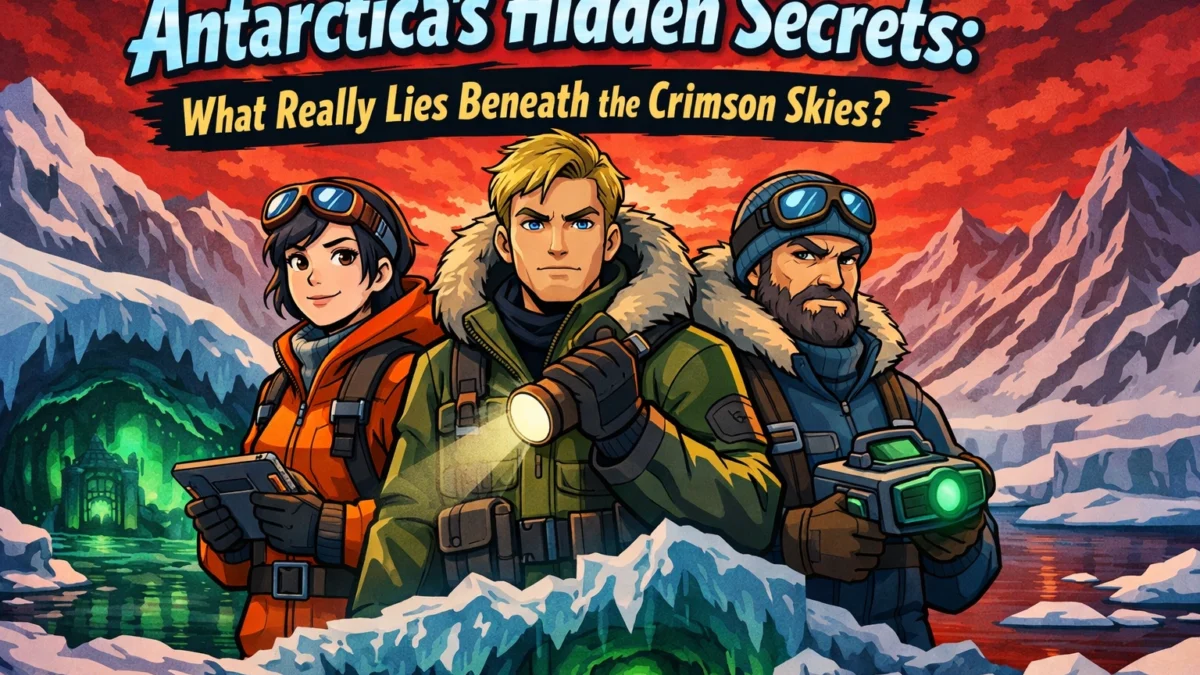
Okay, let's talk about Antarctica for a second. Not the cute penguin documentaries or the "look at all that ice!" tourism brochures. I'm talking about what's actually down there: the stuff that makes scientists lose sleep and fiction writers like us completely geek out.
Because here in 2026, we're finally getting answers to questions we didn't even know to ask. And trust me, reality might be even stranger than the fiction we cooked up for Tempest of the Crimson Skies.
The Underworld Isn't Just a Myth
Picture this: roughly 400 underground lakes, buried under three kilometers of ice, where the water stays liquid despite temperatures that should turn everything into a popsicle. Scientists actually found this. In 2014, they drilled into Lake Whillans and discovered an entire ecosystem of microorganisms partying down there: no sunlight, no fresh air, just methane and ammonium keeping the lights on (metaphorically speaking).

But wait, it gets weirder. In 2022, researchers stumbled upon a massive aquifer of "fossil seawater" under West Antarctica's Whillans Ice Stream. Water that's been sealed away for potentially thousands of years. Just… hanging out. Waiting.
Sound familiar? If you've read Book Three of The Rainsavers series, you know exactly where I'm going with this.
Rivers Full of Tiny Shrimp-Things (And Maybe More?)
December 2021 brought another plot twist. Scientists drilled 1,600 feet into the Larsen Ice Shelf and found a subsurface river: not just any river, but one teeming with amphipods. These tiny shrimp-like creatures are living their best lives under more ice than you'd find in a thousand freezers.
Here's what keeps me up at night: if tiny crustaceans can thrive down there, what else could be hiding in Antarctica's hidden waterways? The researchers were shocked to find any life in these conditions. Which makes you wonder what they haven't found yet.
In our fictional world, those underground rivers serve a very different purpose. The red mercury deposits that power the ancient weapons in Tempest of the Crimson Skies needed somewhere to hide for millennia. Beneath the ice, suspended in prehistoric water, preserved perfectly until someone came looking…

Volcanic Surprise Party
Just when you thought Antarctica couldn't get any more dramatic, enter the volcanoes. A whole volcanic province stretching from the Antarctic Peninsula to the Ross Sea, hiding under the ice sheet like nature's worst-kept secret. Scientists identified close to 140 subglacial volcanoes in a 2017 study, with 91 of them previously unknown.
Near Mount Erebus, they found warm caves: and I mean warm, like 77°F warm: with DNA from algae, mosses, and mysterious animal life. Potentially new species just vibing in their cozy volcanic hideout.
Now, let's play a little game. If you were an ancient civilization looking to store incredibly dangerous technology, would you:
A) Leave it somewhere obvious
B) Hide it in the most inhospitable environment on Earth
C) Bury it under kilometers of ice near active volcanoes where nobody would think to look
Yeah. Option C sounds about right.
The Crimson Connection
Here's where fiction crashes into reality in the most delicious way possible. In Tempest of the Crimson Skies, the protagonists discover that Antarctica's secrets aren't just geological: they're archaeological. The crimson skies aren't just a weather phenomenon; they're a warning system, ancient tech activating after centuries of dormancy.

The red mercury isn't just McGuffin material. It's based on the very real (and very controversial) substance that's sparked debates among scientists and conspiracy theorists alike. In our story, it's the power source for weapons so advanced that modern technology looks like stone tools in comparison.
But here's the thing: the real Antarctica keeps revealing hidden depths that make our fiction seem almost quaint. Massive valleys and mountain ranges buried under the ice. The deepest canyon on Earth beneath the Denman Glacier. Over 450 submarine canyons, some longer than major European rivers, carving through the continental margin.
How much could you hide in all that space? How many secrets could survive, perfectly preserved, for thousands of years?
The Temperature Drop That Changed Everything
Antarctica wasn't always a frozen wasteland. Scientists have found fossilized tropical rainforest wood, leaf impressions, and evidence of a climate warm enough for beetles to thrive 14-20 million years ago. Dinosaurs roamed there during the Cretaceous Period.
Something changed. The temperature plummeted. The ice came. And everything underneath got… archived.
In The Rainsavers universe, that dramatic climate shift wasn't entirely natural. But you'll have to read the book to find out why. (See what I did there?)

Why This Matters in 2026
We're living in weird times. Climate patterns are shifting, ice is melting in places it shouldn't, and Antarctica is revealing its secrets faster than scientists can catalog them. Every new discovery raises ten new questions.
What happens when the ice melts enough to expose things that were meant to stay hidden? What if those sealed aquifers contain more than just ancient water? What if those warm volcanic caves are home to something that's been waiting?
These aren't just thought experiments for fiction writers anymore. These are questions real scientists are grappling with right now.
Fiction Meets Future
The beauty of adventure fiction in 2026 is that we don't have to work as hard to suspend disbelief. Reality keeps catching up with our wildest ideas. The line between "plausible sci-fi" and "what scientists actually found last Tuesday" gets blurrier by the day.
Tempest of the Crimson Skies takes these real discoveries and asks the question every good adventure story should ask: "But what if it's even crazier than that?"
What if those underground ecosystems are guarding something? What if the volcanic activity isn't random? What if the crimson skies are trying to tell us something, and we're finally starting to listen?
Come Down the Rabbit Hole

Look, I could keep going. We could talk about the massive magnetic anomalies beneath the ice, or the strange seismic activity that doesn't match known geological patterns, or the satellite images that show features no one can quite explain.
But honestly? You should just read the book. Because what we've created in Tempest of the Crimson Skies takes all these real-world mysteries and weaves them into a story that'll make you question everything you thought you knew about Earth's frozen continent.
Plus, it's got ancient weapons, red mercury that defies physics, and skies that literally turn crimson when the old tech wakes up. What's not to love?
Antarctica's keeping secrets. Some of them are real. Some of them are fiction. The fun part? Figuring out which is which.
Ready to discover what lies beneath the ice? Check out the full Rainsavers series and dive into the mysteries that blend cutting-edge science with ancient legends at rainsavers.com.
Trust me: the truth is way more interesting than you think. And the fiction? Even better.
