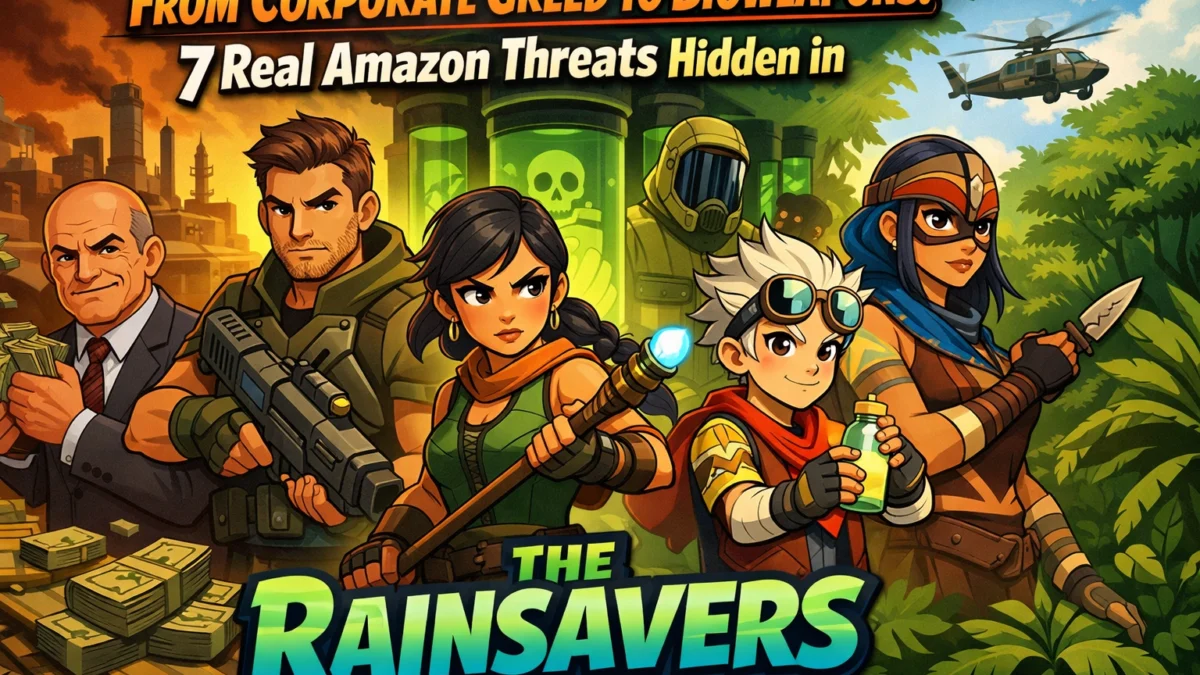
Meta Description: The Rainsavers isn't just fiction, it's a mirror. Discover the 7 real Amazon threats that inspired Bossman and Leonard West's reign of terror, from illegal logging to bioweapons.

You think Michael "Bossman" Carbón and Leonard West are just villains cooked up for a good adventure story? Think again.
Every destructive move they make in The Rainsavers, every tree felled, every bioweapon experiment, every ounce of greed, is ripped straight from the playbook of real-world Amazon exploitation happening right now in 2026.
Here's the uncomfortable truth: The fiction is barely fiction at all.
Let's break down the 7 real Amazon threats hiding in plain sight across the series, and why they hit way too close to home.
1. Corporate Deforestation: Bossman's Bread and Butter
Michael "Bossman" Carbón didn't become a timber mogul by asking nicely. In the series, his illegal logging empire mirrors a devastatingly real crisis: 60% to 80% of all logging in Brazil is illegal.
That's not a typo. The majority of trees being harvested for flooring, furniture, and construction materials? Stolen. Cut without permits. Hauled away under the noses of overwhelmed enforcement agencies.
Bossman's fleet of chainsaws and bulldozers in The Rainsavers reflects operations happening across the Amazon basin today, corporations slicing through protected land, indigenous territories, and biodiversity hotspots to feed global demand for cheap wood.
The series doesn't sugarcoat it: deforestation is big business, and the villains aren't twirling mustaches in dark rooms. They're wearing suits, signing contracts, and calling it "economic development."

2. Mining Operations That Poison Everything
Bossman isn't satisfied with just timber. His mining operations, copper, tin, nickel, gold, represent one of the Amazon's most toxic threats.
Gold mining, in particular, is a nightmare. Miners use mercury to separate gold from sediment, and that mercury doesn't just disappear. It poisons rivers, contaminates fish, and seeps into the food chain, affecting both wildlife and indigenous communities who depend on those waterways.
In The Rainsavers, you see the environmental carnage firsthand: rivers running toxic, ecosystems collapsing, and a corporate machine that treats the rainforest like a quarry instead of the planet's lungs.
Real-world Amazon mining operations cover massive swaths of land, and the devastation lasts for generations.
3. Military Exploitation and Operation Black Rain
Leonard West's Operation Black Rain is where the series takes a darker, more covert turn. While the bioweapon plot is fictional (we hope), the idea of governmental and military interests exploiting the Amazon for strategic gain? That's not far-fetched.
Governments have long viewed the Amazon as more than just trees, it's a geopolitical asset. Rich in resources, strategically located, and home to compounds that could revolutionize medicine or weaponry, the rainforest has always attracted covert attention.
Leonard West's transformation into Mortalis, the series' ultimate antagonist, symbolizes what happens when that exploitation goes unchecked: power corrupts, nature fights back, and the consequences spiral out of control.
4. Cattle Ranching: The Silent Forest Killer
Here's a stat that should make you put down your burger: cattle ranching has caused about 65% of all Amazon deforestation.
Slash-and-burn agriculture, exactly the method depicted when Bossman's crews torch forests to clear land, remains the go-to technique for creating pastures. The problem? Amazon soil is terrible for long-term grazing. After a few years, the land's depleted, so ranchers move on and burn more forest.
It's a cycle of destruction, and it's accelerating.
The Rainsavers doesn't shy away from showing the brutal efficiency of these operations. Forests that took millennia to grow? Gone in days. And for what? Short-term profit that leaves permanent scars.

5. Bioweapon Development and Genetic Experimentation
Okay, so the Black Rain bioweapon designed to mutate rainforest life into controllable assets is next-level fictional villainy. But the underlying concern: unregulated genetic research and bioprospecting in biodiverse regions: is very real.
The Amazon is a treasure trove of undiscovered compounds, genetic material, and biological secrets. Pharmaceutical companies, research labs, and yes, military contractors have all shown interest in what the rainforest can offer.
In the series, Leonard West weaponizes this potential, creating enhanced operatives like Primal through forced mutations. It's science fiction, but it's rooted in the uncomfortable reality that the Amazon's biodiversity makes it a target for exploitation beyond just logging and mining.
What happens when profit-driven science operates without ethics? The Rainsavers gives you one terrifying answer.
6. Oil and Gas Extraction in Sacred Lands
While not the primary focus of Bossman's empire, oil and gas extraction threads through The Rainsavers as another layer of corporate greed.
In 2026, oil and gas fields cover over 283,000 square miles of the Amazon: much of it within indigenous territories. Pipelines fracture ecosystems, spills contaminate water sources, and indigenous communities find themselves displaced or forced into unwanted negotiations with energy giants.
The series highlights this through side plots and background operations: corporations carving up the rainforest like it's up for auction, leaving communities and wildlife to deal with the fallout.
7. Wildlife Trafficking: A $10 Billion Shadow Industry
The Rainsavers puts biodiversity front and center: protecting rainforest species is literally the team's mission. And that mission mirrors a very real crisis.
Wildlife trafficking is a $10 billion-per-year illicit industry, the third most profitable after drugs and weapons. Amazon manatees, river turtles, jaguars, exotic birds: hunted for food, traditional medicine, fashion, and the illegal pet trade.
In the books, you see the consequences: ecosystems collapsing when keystone species disappear, poachers operating with impunity, and a black market that treats living creatures like commodities.
Bossman and his network profit from every angle of Amazon exploitation, and wildlife trafficking is just another line item on the balance sheet.

Fiction That Hits Different
What makes The Rainsavers so gripping isn't just the action, the tech, or the larger-than-life characters. It's that every villain move is grounded in something happening right now.
Michael "Bossman" Carbón isn't a caricature: he's a composite of real corporate executives prioritizing profit over preservation. Leonard West's Operation Black Rain isn't just a plot device: it's a warning about what unchecked power and scientific exploitation could become.
The Amazon is under siege from all seven of these threats simultaneously in 2026, and the series doesn't let you look away.
So What Can You Do About It?
Read the books, for starters. Not just for the adventure (though that's reason enough), but because stories like The Rainsavers make these abstract global crises feel immediate and personal.
When you see Bossman's logging crews destroying a centuries-old forest in Book One, you're not just reading fiction: you're witnessing a dramatized version of what's happening across millions of acres of the Amazon today.
When Leonard West unleashes Black Rain, you're confronting the ethical nightmare of bioweapons and genetic manipulation in an age where both are increasingly possible.
Want to see how fiction and reality collide in the most action-packed way possible? Dive into The Rainsavers series now and experience the Amazon's fight for survival through characters who won't back down: even when the odds are stacked against them.
Because the real question isn't whether these threats exist.
It's whether we're going to do something about them before it's too late.
