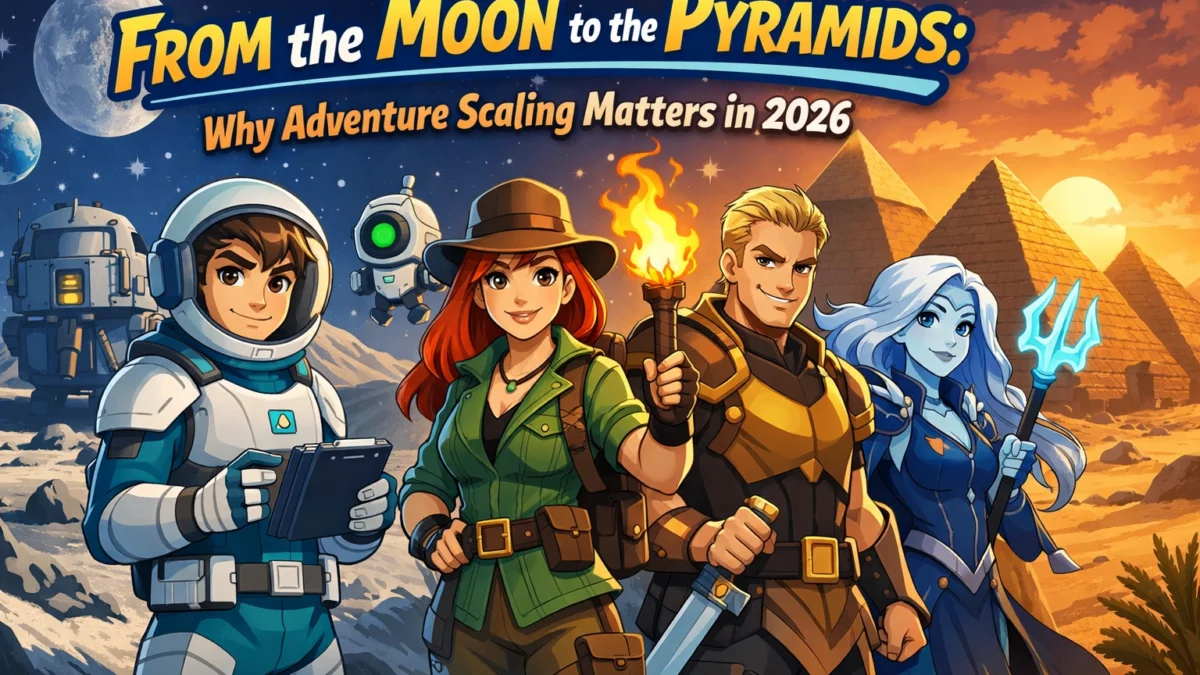
Meta Description: From the moon to the pyramids, learn why high-stakes adventure scaling is critical for thrillers in 2026.
Hey everyone, Steven G. Samuels here.
If you’ve been following The Rainsavers for a while, you know we don’t do "small." We don’t do "quiet." We live for the moments where the ground shakes, the oxygen levels drop, and the stakes are so high they’re practically in orbit.
It’s March 2026, and the landscape of adventure fiction is shifting. We’re moving past the era of the "neighborhood hero" and stepping into something much bigger. We’re talking about adventure scaling.
But what does that actually mean? And why is it the only way to write a thriller that keeps you up until 3:00 AM in 2026? Let’s break down why we’re taking readers from the dusty chambers of the Great Pyramid all the way to the dark side of the Moon.
The 2026 Thriller: Go Big or Go Home
In 2026, readers are smarter and more connected than ever. A simple bank heist or a chase through a city doesn't carry the same weight it used to. We’ve seen it all. To really capture the imagination, authors have to scale the adventure.
Adventure scaling is the art of expanding the scope of a story while keeping the emotional core grounded. It’s about realizing that a mystery discovered in an ancient tomb isn’t just a "local" problem: it’s a global, or even interplanetary, threat.
At The Rainsavers, we’ve embraced this fully. We believe that if our characters aren't facing a world-ending catastrophe that spans from historical Earth to the lunar surface, we’re just not trying hard enough.

Why the Moon? (And Why Now?)
There’s a reason the Moon is the ultimate "high ground" for modern sci-fi. It represents the frontier. But in 2026 fiction, the Moon isn't just a cold rock. It’s a repository for secrets that Earth wasn't ready to handle.
Imagine finding a transmission signal. It’s coming from a crater that shouldn't have any human activity. You track the tech, and it’s… familiar. It’s clunky, it’s mechanical, and it’s terrifyingly efficient. This is where we start blending the "high-stakes" with the "high-concept."
When you scale an adventure to the lunar surface, you change the physics of the story. You add the ticking clock of oxygen supplies, the isolation of the vacuum, and the sheer awe of looking back at a "Blue Marble" that is currently under threat. It’s the ultimate pressure cooker for our heroes.
The Pyramid Anchor: Grounding the Sci-Fi
You can’t just fly to the Moon and expect the audience to stay grounded. You need an anchor. For us, that anchor is history. Specifically, the ancient mysteries of the Pyramids.
Why do the Pyramids matter in a 2026 sci-fi thriller? Because they represent the "Old World" mysteries that modern science still can't quite explain. When you link a lunar base to a subterranean chamber in Giza, you create a narrative bridge.
This is a core pillar of our storytelling. We love exploring ancient technology vs. modern threats. It’s not just about cool gadgets; it’s about the idea that humanity has been dealing with these high-stakes challenges far longer than we realize.

The Ghost in the Machine: German WWII Tech
Here’s where things get really interesting: and a bit darker. To make adventure scaling work, you need a villainous force that feels grounded in real-world history but capable of futuristic destruction.
Enter the mystery of German WWII tech.
In the world of high-stakes thrillers, there’s a persistent fascination with what was happening in those secret laboratories in the 1940s. We’re talking about the "Wunderwaffen" (Wonder Weapons). In 2026, we’re seeing a resurgence in stories where this lost, terrifyingly advanced German WWII tech wasn't actually destroyed: it was moved.
Imagine a scenario where the propulsion systems used to reach the Moon in secret weren't developed by NASA, but were actually refined versions of designs found in a bunker in 1945. When our heroes encounter this tech, it adds a layer of historical grit to the sci-fi shine. It makes the threat feel "earned." It’s not just magic space tech; it’s tech with a blood-stained pedigree.
How to Scale Adventure Without Losing the Plot
Writing these stories is a balancing act. If you go too "space-heavy," you lose the tension. If you stay too "historical," you lose the excitement. Here’s how we at The Rainsavers keep the balance:
- Start Local, Think Global: Our stories usually begin with a problem someone can touch. A leak, a map, a missing person.
- The "Oh Crap" Moment: This is the scaling point. This is when the hero realizes the map doesn't lead to a treasure chest: it leads to a launchpad.
- The Tech Bridge: We use keywords like German WWII tech to bridge the gap. It provides a logical (if terrifying) explanation for how ancient mysteries became modern weapons.
- High Stakes, High Empathy: No matter how big the explosion is on the Moon, the reader has to care about the person holding the detonator.

Why 2026 is the Year of the "Eco-Hero"
Adventure scaling also allows us to tackle real issues, like the environment. In our series, we focus on how modern eco-heroes are saving fiction.
When you scale a story to the Moon, you realize how fragile Earth actually is. It’s the ultimate "overview effect." Our protagonists aren't just fighting guys in suits; they’re fighting to protect the only home we have, often against villains who are using ancient secrets or repurposed WWII tech to exploit the planet’s remaining resources.
It’s about why eco-fiction changes the way you think. By raising the stakes to a lunar or pyramid-sized level, we make the environmental message feel like a pulse-pounding race against time rather than a lecture.
The Rainsavers Blueprint
We’re not just writing books; we’re building a universe where the past and the future collide. Whether it's exploring the depths of the ocean or the craters of the Moon, our goal is to provide that "big screen" feeling on every page.
We know that 2026 audiences want more. They want the tactical gadgets, the historical conspiracies, and the sense that the world is much bigger and more mysterious than it looks on the news.

Quick Hits: Why You’ll Love Adventure Scaling
- Variety: You get the claustrophobia of a pyramid and the vastness of space in one sitting.
- History: You get to nerd out over things like German WWII tech and ancient Egyptian architecture.
- Urgency: When the scale is this big, there's no room for filler. Every chapter has to move the needle.
So, if you’re tired of the same old "detective in a rainy city" tropes, it’s time to look up. And maybe look back. The answers are hidden in the sand of the Giza plateau and the dust of the lunar plains.
At The Rainsavers, we’re dedicated to bringing you those stories. We blend the grit of historical thrillers with the limitless potential of science fiction.
See how we blend both.
Explore our latest missions and see why adventure scaling is the future of storytelling.
Check us out at https://rainsavers.com.
Stay adventurous,
Steven G. Samuels
CEO, The Rainsavers
