Meta Description: Discover why blending eco-thrillers, Nazi technology, and ancient mysteries creates the ultimate 2026 adventure. The Rainsavers proves genre-mixing is the future of fiction.
Let's be honest: single-genre stories are getting stale. Readers in 2026 want more, they want eco-disasters and ancient conspiracies and secret Nazi tech all rolled into one wild ride. And guess what? The Rainsavers delivers exactly that.
If you've been wondering why genre-blending is dominating bookstores and streaming platforms this year, buckle up. We're about to break down how mixing eco-thrillers, historical villains, and ancient mysteries creates the kind of story you can't put down.
Why Genre-Blending Works in 2026
Here's the thing: readers are smarter and more demanding than ever. They've binged every superhero franchise, read every dystopian YA series, and watched every climate documentary on Netflix. They're over predictable formulas.
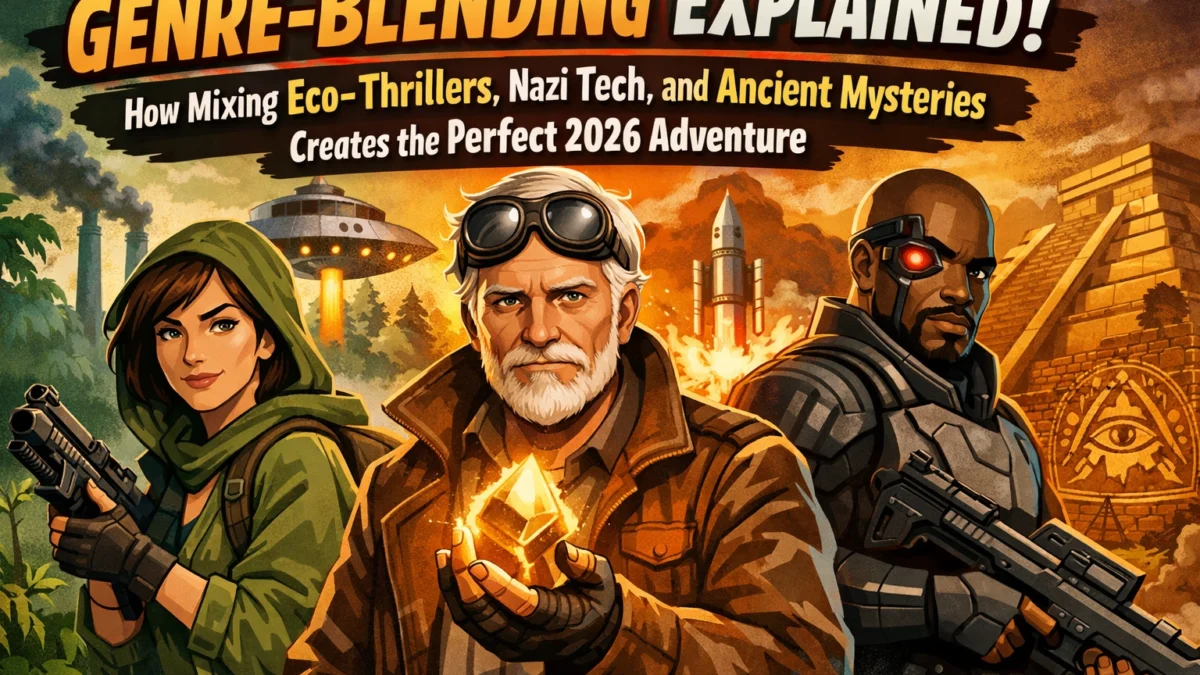
Genre-blending solves that problem by creating unexpected collision points. When you throw eco-activism, Nazi technology, and ancient Egyptian mysteries into the same narrative blender, you get something nobody saw coming, but everyone wants to read.
The Rainsavers proves this works. Instead of picking one lane, it creates a six-book universe where Dr. Mubari decodes hieroglyphics in a high-tech lab while the team battles bioweapons engineered from World War II blueprints while trying to save the Amazon rainforest from corporate greed.
Confusing? Nope. Addictive? Absolutely.

The Eco-Thriller Foundation: Real Stakes, Real Urgency
Every great genre-blend needs a solid foundation, and eco-thrillers provide exactly that. Climate anxiety is the defining emotion of the 2020s, which means stories about environmental collapse hit harder than ever.
But here's where The Rainsavers gets clever: instead of making the eco-threat some vague, future disaster, it anchors everything in today's Amazon crisis. Illegal logging. Corporate biopiracy. Indigenous land grabs. These aren't science fiction, they're headlines.
That real-world urgency gives the story weight. When Tom Swift and his team race to protect the Spirit Tree, a 2,000-year-old giant that might hold the key to healing the rainforest, you're not just worried about fictional characters. You're worried about the actual Amazon.
Nazi Tech: The Villain Upgrade Nobody Expected
Now let's talk about the Nazi technology angle, because this is where things get wild.
Most eco-thrillers stick with predictable villains: evil CEOs, corrupt politicians, maybe a rogue scientist. Yawn. The Rainsavers flips the script by introducing weaponized Nazi science that somehow survived into the 21st century.
We're talking Red Mercury conspiracy theories, Operation Paperclip secrets, and experimental bioweapons that were this close to winning World War II. These aren't cartoonish bad guys, they're historical nightmares that got loose.
Why does this work? Because it adds a layer of "wait, could this actually be real?" paranoia that makes the thriller elements hit harder. Readers know Nazi scientists fled to South America after the war. Readers know classified experiments happened. So when The Rainsavers suggests some of that tech ended up in the wrong hands decades later, it feels disturbingly plausible.

Ancient Mysteries: The Secret Ingredient
Here's where the genre-blend becomes irresistible: ancient Egyptian knowledge.
Enter Dr. Mubari, the Egyptologist who realizes that old wisdom might be the key to solving new problems. The Spirit Tree isn't just a big tree, it's connected to ancient practices, forgotten botanical knowledge, and maybe even pre-colonial science that modern researchers dismissed as myth.
This is genre-blending at its finest. You've got:
- Eco-thriller stakes (save the rainforest or humanity suffers)
- Historical villain tech (Nazi bioweapons threaten global ecosystems)
- Ancient mystery solutions (Dr. Mubari's research unlocks secrets hidden for millennia)
Each element makes the others stronger. The eco-threat feels more urgent when you realize ancient civilizations understood something we forgot. The Nazi tech becomes scarier when it's reverse-engineered from stolen historical artifacts. The ancient mystery gets modern relevance because it might actually save the world.
Why This Mix Feels Fresh (Not Messy)
You might be thinking: "Okay, but doesn't this sound like throwing spaghetti at the wall?"
Fair question. Bad genre-blending is messy, it feels like the author couldn't pick a lane and just jammed everything together. But The Rainsavers makes it work because each genre serves a purpose:
The eco-thriller provides urgency and real-world stakes.
The Nazi tech creates villains with terrifying resources and zero morals.
The ancient mysteries offer hope, proof that solutions exist if we're smart enough to find them.
It's not three separate stories fighting for attention. It's one story told through three lenses, and each lens reveals something the others can't.

The 2026 Reader Wants Complexity
Here's the uncomfortable truth: single-genre stories feel simplistic now. Climate change isn't just an environmental issue, it's tangled up with corporate greed, historical exploitation, indigenous rights, technological ethics, and global politics.
Genre-blending reflects that complexity. When Tom Swift's team fights to protect the Amazon, they're not just fighting pollution, they're fighting a conspiracy that stretches back 80 years and involves stolen knowledge, weaponized science, and corporate cover-ups.
That's realistic. Real problems don't fit in neat boxes, and neither should fictional solutions.
What Makes The Rainsavers Stand Out
Plenty of stories attempt genre-blending. Most fail because they treat each genre as a checkbox: "Okay, we've got our eco moment. Now here's the history lesson. Now here's the mystery."
The Rainsavers succeeds because everything is integrated. Dr. Mubari isn't a random Egyptologist: his research on ancient botanical practices directly connects to the Spirit Tree's survival. The Nazi bioweapons aren't random villains: they're specifically targeting rainforest ecosystems because someone realized indigenous knowledge threatened their profits.
Every element serves the story, and the story couldn't exist without all three genres working together.
The Future of Adventure Fiction
If you're still reading single-genre thrillers in 2026, you're missing out. The best stories now pull from multiple traditions, creating something that feels both familiar and completely new.
The Rainsavers proves that eco-thrillers don't have to be preachy, historical mysteries don't have to be dusty, and Nazi villains don't have to be clichés. When you blend them right, you get a six-book series that keeps readers guessing from the Amazon to Antarctica to ancient Egypt.
Want to see how genre-blending creates unstoppable adventure fiction? See how we blend both in a series that refuses to play by the rules: and is better for it.
Because in 2026, the best stories don't pick a genre. They invent one.
