
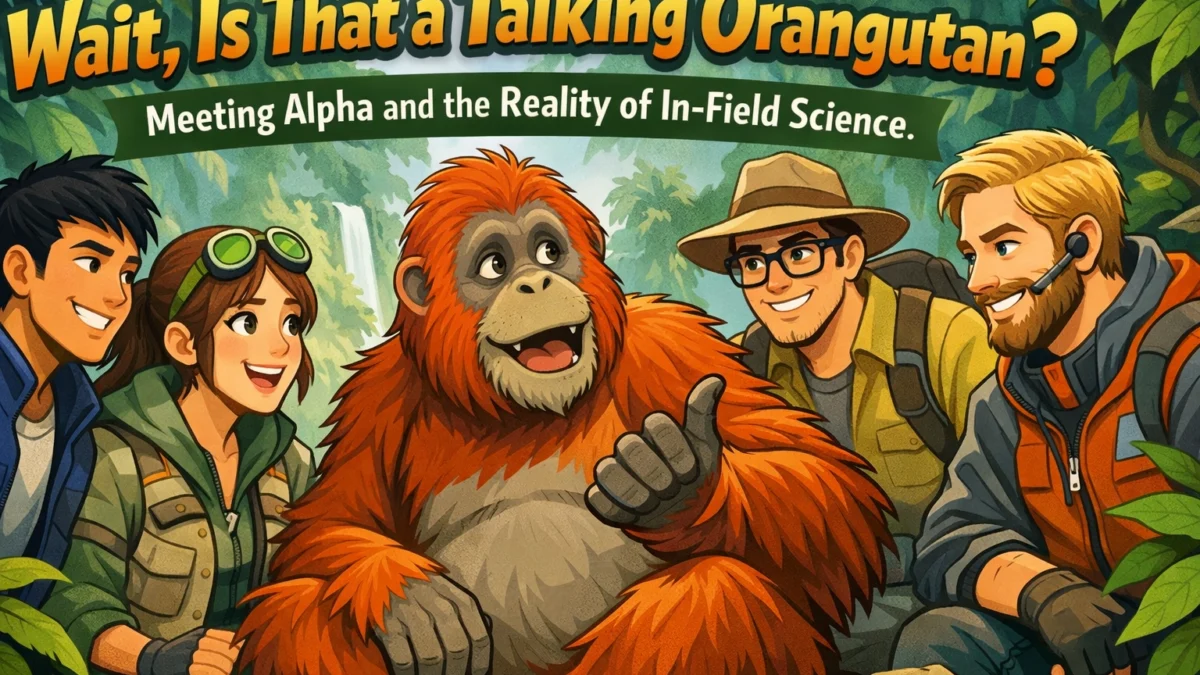

Look, I'm just going to say it: nobody warned me about the orangutan.
The briefing covered eco-terrorists, ancient tech, questionable field rations, and the very real possibility of ending up in a situation where you're arguing about bug spray in the middle of the Amazon. But a highly intelligent orangutan wearing a tactical headset and giving you the side-eye when you pronounce something wrong? That was conspicuously absent from the orientation materials.
Welcome to Alpha's world. And yes, before you ask, he's that kind of field partner.
When Science Fiction Meets Actual Science (Sort Of)
Here's the thing about orangutans: they're already borderline terrifying in terms of intelligence. Real-world research shows that orangutans can actively control their vocal apparatus in ways scientists previously thought impossible. A famous case involved Rocky, an orangutan at the Indianapolis Zoo, who successfully mimicked human vocalizations, not just random sounds, but deliberate pitch and tone variations. This wasn't arousal-driven hooting. This was learning.
Wild orangutans use complex communication systems featuring consonant-like calls: smacks, clicks, kiss-sounds, splutters, and raspberries. And get this, their calls exhibit recursive structure, which means layered, self-embedded patterns across multiple levels. That's the kind of linguistic complexity researchers used to think was uniquely human.
So when you meet Alpha in The Rainsavers series, and he's wearing tech that amplifies his already-sophisticated communication abilities? Yeah, that tracks. It's grounded in actual orangutan capabilities, just… turned up to eleven.

Alpha Doesn't Talk. Alpha Communicates. There's a Difference.
Let's clear something up right away: Alpha isn't sitting around having philosophical debates about Kant. He's not reciting Shakespeare or complaining about the Wi-Fi. What he does do is communicate with stunning clarity, through gestures, vocalizations, expressions, and yes, occasionally through modified tech that bridges the gap between species.
Think of it less like "talking" and more like having a field partner who:
- Knows exactly when you're about to make a terrible decision
- Will absolutely judge you for it
- Communicates that judgment with surgical precision
- Is usually right
The scientific reality is that orangutans' arboreal lifestyle gave them exceptional oral motor control. Living in trees meant they needed fine control over lips, tongue, and jaw to manipulate food and tools while maintaining their grip. This created a biological foundation for complex vocal production. Alpha just happens to have access to tech that makes those abilities even more useful in the field.
That Awkward Moment When the Orangutan Is Smarter Than You
Field science in The Rainsavers universe isn't exactly your typical research expedition. You're navigating ancient mysteries, corporate conspiracies, hidden tech, and ecosystems that might be trying to kill you. And in the middle of all that chaos, you've got Alpha, who, let's be honest, is often the most sensible member of the team.
There's something deeply humbling about realizing an orangutan is better at:
- Spotting danger before you do
- Navigating jungle terrain
- Reading social situations
- Not panicking when things go sideways
And he knows it. That look he gives you when you're about to touch something you absolutely should not touch? That's not projection. That's experience.

The Science of Why This Actually Makes Sense
Female Sumatran orangutans use layered communication complexity to convey meaningful information about predators and their environment. That's not fiction, that's documented field research. These animals process spatial reasoning, tool use, and social dynamics at levels that rival many human problem-solving scenarios.
Now add in the reality that orangutans share about 97% of their DNA with humans. They have long-term memory, they use tools creatively, and they can plan for future events. They can even deceive, which means they understand theory of mind (the concept that others have thoughts different from their own).
So when you're reading about Alpha working alongside human scientists in high-stakes situations, you're not reading pure fantasy. You're reading a "what if" scenario that's closer to reality than you might think. What if we gave orangutans access to communication tech that matched their cognitive abilities? What kind of partnership could that create?
The answer in The Rainsavers series: a partnership that's equal parts brilliant and absolutely chaotic.
Alpha's Greatest Hits (According to Field Reports)
Without getting into spoiler territory, here are some Alpha moments that have cemented his status as a fan favorite:
The Packing List Incident – When even a superintelligent orangutan can't prevent humans from arguing about what to bring on a jungle expedition. Spoiler: nobody remembered enough bug spray. Alpha remembered. Alpha was not impressed.
Navigation Superiority – That time when GPS failed, compasses went haywire, and the one team member who confidently insisted they "knew the way" absolutely did not know the way. Alpha knew the way. Alpha always knows the way.
The Side-Eye Heard Round the World – There are moments in field research when you make a decision, and even before the consequences hit, you know you messed up. You know because Alpha is looking at you like that. You learn to trust that look.
Banana Diplomacy – Look, everyone has their price. Alpha's just happens to be more straightforward than most.

Why Readers Keep Coming Back for More Alpha
Here's what makes Alpha work as a character: he's not a gimmick. He's not there for cheap laughs or to fill a "quirky animal sidekick" quota. He's a fully realized team member with his own personality, intelligence, and narrative weight. He makes mistakes. He has preferences. He absolutely has opinions, and he's not shy about expressing them.
In a genre that sometimes leans too heavily on lone-wolf protagonists or paper-thin supporting casts, Alpha represents something different: collaboration across species, intelligence that doesn't require human speech to be respected, and the reminder that survival often depends on listening to the team member who sees the situation from a completely different perspective.
Plus, he's funny. Not in a slapstick way, but in the way that real intelligence is funny, observational, timing-based, and sometimes inadvertently cutting.
The Reality of Writing Believable Non-Human Intelligence
Creating a character like Alpha requires walking a tightrope. Make him too human, and you lose what makes him unique. Make him too "animal," and you undercut the scientific foundation. The sweet spot is respecting actual orangutan cognition and behavior while exploring what happens when that intelligence is given better tools for expression.
Real orangutans are already escape artists, problem-solvers, and long-term planners. They recognize faces, hold grudges, and show empathy. They modify tools for specific tasks. They teach their young complex skills that take years to master.
Alpha isn't a stretch. He's an extrapolation. And that's what makes him feel real even in a series full of ancient tech, corporate conspiracies, and globe-spanning mysteries.
Meet Alpha (And Try to Keep Up)
If you're ready to experience field science with the kind of partner who will absolutely roast you for your decisions but also has your back when things get dangerous, meet Alpha in Book One. Fair warning: you'll never look at orangutans, or your own problem-solving skills, the same way again.
Just maybe bring extra bananas. Trust us on this one. Alpha will thank you.
And if you don't? Well, that's between you and the most expressive primate side-eye you'll ever experience.
Ready to meet the team's most intelligent member? Start reading The Rainsavers series now and discover why Alpha has become one of the most beloved characters in modern eco-adventure fiction.
