Meta Description: Forget the lone wolf hero. Learn why your eco-adventure team needs diverse skills (yes, even an orangutan hacker). Build a fictional dream team in 5 minutes with this quick guide.
Look, we need to talk about your hero problem.
You've got one character trying to save the rainforest, stop corporate villains, decode ancient mysteries, AND fight climate disasters. That's not a hero, that's a nervous breakdown waiting to happen.
Welcome to 2026, where solo heroes are officially retired and team-based eco-adventures are taking over. And if you're building a fictional eco-team (whether you're writing your own story or just appreciating how series like The Rainsavers nail the formula), you need more than "generic hero plus sidekick."
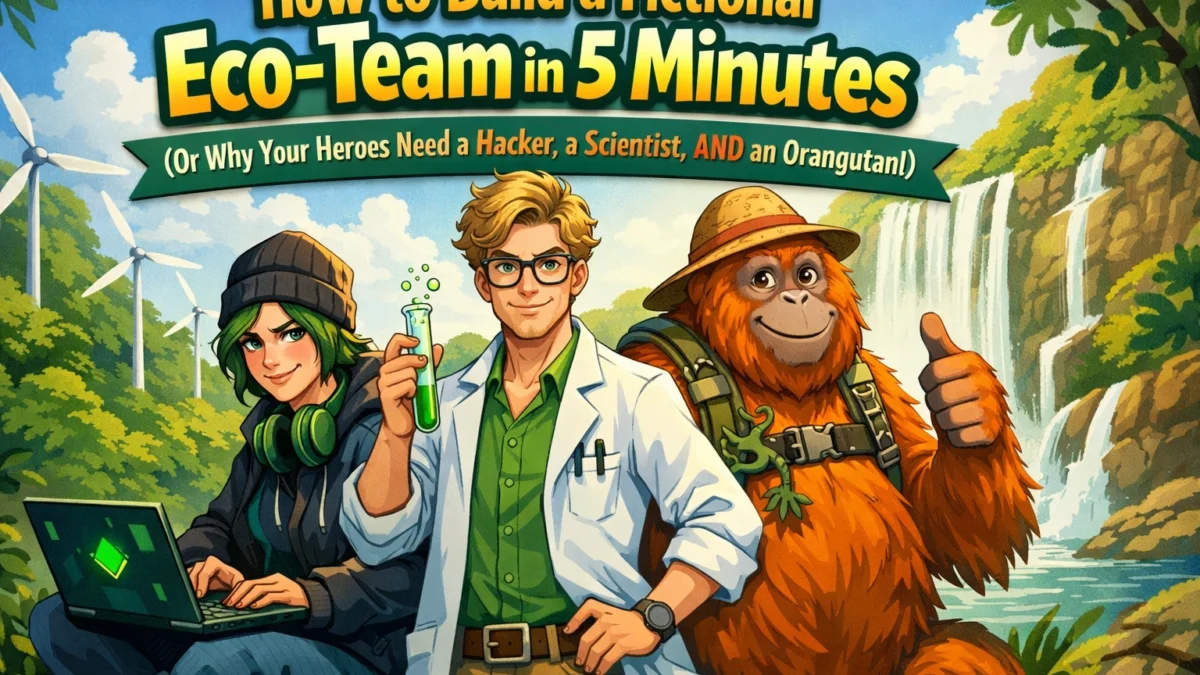
You need a hacker. A scientist. And honestly? An orangutan wouldn't hurt.
Let me show you how to assemble your dream team faster than you can say "environmental thriller."
The 5-Minute Team Assembly Formula
Minute 1: The Tech Genius (Your Hacker)
Every eco-team needs someone who can break into corporate databases, trace illegal logging operations, and disable security systems without breaking a sweat. In The Rainsavers, this is Mortalis, a brilliant mind who understands that saving the planet in the modern age means understanding the digital battlefield.
Your hacker isn't just about cool keyboards and hoodies. They're your team's eyes and ears in a world where the real battles happen in server rooms and encrypted files. They expose the villains who hide behind shell corporations and fake permits.
Pro tip: Make your hacker care deeply about something tangible. Mortalis isn't just coding for fun, there's personal stakes involved. Nobody fights harder than someone protecting something they love.

Minute 2: The Science Brain
You can't fight environmental disasters without understanding the science behind them. Your team needs someone who can explain why that mysterious red substance is dangerous, how ecosystems collapse, and what's actually happening to the climate.
But here's the thing, your scientist shouldn't just rattle off facts. They should be passionate, occasionally wrong, and definitely human. The best science characters get excited about discovering new species, frustrated when politicians ignore data, and absolutely geeked out over ancient environmental mysteries.
In good eco-fiction, the scientist is often the bridge between "we should care about nature" and "here's exactly WHY we're all doomed if we don't act now."
Minute 3: The Wild Card (Yes, That Orangutan)
This is where things get fun.
Meet Primal from The Rainsavers: an orangutan who's not just comic relief or a cute mascot. Primal represents the intersection between human and nature worlds, bringing a perspective that your human characters simply can't.
Your "wild card" doesn't have to be an orangutan (though honestly, why wouldn't it be?). But your team needs someone: or something: that reminds everyone what they're fighting for. This character keeps the team grounded when the tech gets too complicated or the science too abstract.
Plus, let's be real: an orangutan on your team automatically makes your story 400% more interesting.
Minute 4: The Reluctant Leader
Every team needs someone to make the final call when things go sideways. But in 2026's best eco-adventures, that leader isn't a fearless commander: they're reluctant, flawed, and figuring it out as they go.
Your leader doubts themselves. They make mistakes. They wonder if they're the right person for this job. And that's exactly why readers connect with them.
The Rainsavers nails this with characters who didn't sign up to save the world: they just couldn't sit by and watch it burn. That's way more compelling than "chosen one with perfect instincts."

Minute 5: The Insider Who Knows Too Much
Here's your secret weapon: someone who used to work for the other side. An ex-corporate executive. A former government agent. Someone who knows how the villains think because they used to be one.
This character brings crucial intel, moral complexity, and trust issues that create amazing team dynamics. Can they really be trusted? Are they seeking redemption or playing a long game?
In eco-fiction, this is often someone who saw the environmental damage firsthand and couldn't live with themselves anymore. Their arc from complicit to crusader is storytelling gold.
Why This Combination Actually Works
You might be thinking: "That's a weird mix of skills. Why not just have five scientists? Or five hackers?"
Because real environmental problems require diverse solutions.
Your hacker can find the illegal operation, but they need the scientist to prove it's dangerous. The scientist can explain the threat, but they need the insider to know where to look. The leader coordinates everyone, but the wild card reminds them why they started.
It's like assembling the Avengers, except instead of fighting aliens, they're stopping rainforest destruction and unraveling mysteries involving ancient technology. (Which, between you and me, is way cooler than aliens in 2026.)
The Secret Sauce: Make Them Clash
Here's what separates good eco-teams from great ones: your characters should disagree.
The hacker thinks rules are suggestions. The scientist needs peer-reviewed evidence. The ex-insider wants to use questionable methods. The leader is trying to keep everyone from killing each other.
These conflicts aren't distractions from your environmental message: they ARE the message. Because in real life, people who care about the planet don't always agree on how to save it. Your eco-team should reflect that reality.
The Rainsavers excels at this. Characters argue about tactics, question each other's motives, and sometimes make the wrong call. But they stay together because the mission matters more than their egos.

What About the Villain?
Quick sidebar: your eco-team is only as good as what they're fighting against.
In 2026's best environmental fiction, villains aren't cartoon monsters. They're corporations that legally destroy ecosystems. Politicians who ignore science for profit. Systems that make it easier to exploit nature than protect it.
Your team needs diverse skills because they're fighting diverse threats. You can't hack your way out of every problem or science-explain your way past armed security.
Building Your Own Eco-Team Checklist
Ready to assemble your team? Here's your quick reference:
□ Tech specialist who can navigate the digital battlefield
□ Science expert who understands environmental systems
□ Wild card who represents nature's perspective
□ Reluctant leader who makes tough calls
□ Insider who knows how villains operate
Optional but recommended:
□ Personality conflicts that feel real
□ Personal stakes for each character
□ Skills that complement (not duplicate) each other
□ At least one character who's unexpectedly funny
Why This Matters in 2026
Look, we're living in a year where environmental fiction isn't just entertainment: it's preparation. Climate anxiety is real. People want stories that acknowledge the problems but also show solutions.
Your eco-team gives readers hope. Not naive "everything will be fine" hope, but "look what happens when different people with different skills unite for something bigger" hope.
That's why series like The Rainsavers resonate. It's not about one perfect hero saving the day. It's about flawed people with complementary skills choosing to fight together.
Your Five-Minute Timer Is Up
There you have it. Five minutes (okay, maybe ten if you read slowly), and you've got the blueprint for a fictional eco-team that actually works.
Hacker? Check.
Scientist? Check.
Orangutan? Absolutely check.
The beauty of this formula is that it's flexible. Swap the hacker for a journalist. Trade the scientist for an indigenous knowledge-keeper. Make your wild card a different species entirely.
But keep the core principle: diverse skills, unified mission, genuine conflicts, and stakes that matter.
Because in 2026, we don't need more solo heroes trying to do everything alone. We need teams that show us how to work together: even when we disagree: to protect what matters most.
Ready to see an eco-team in action? Check out The Rainsavers series where hackers, scientists, and yes: an incredibly intelligent orangutan: team up to protect the rainforest and unravel ancient mysteries. Visit rainsavers.com to meet the full team and dive into an adventure that proves saving the planet is better with backup.
