
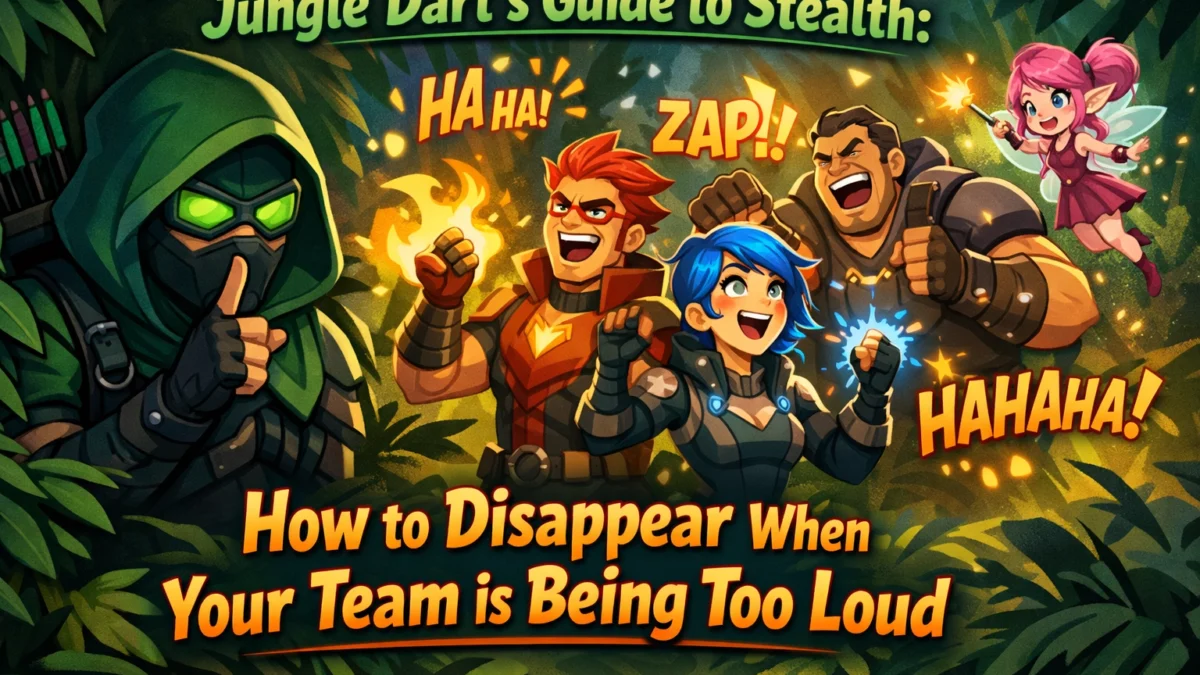

Meta Description: Meet Jungle Dart, The Rainsavers' stealth operative who knows exactly how to vanish when teammates get too noisy. Tactical tips, rainforest expertise, and one very annoyed specialist.
Look, I get it. You've assembled a team of brilliant, passionate people to save the planet. That's great. But does everyone need to announce their presence like they're hosting a wildlife documentary?
If you're reading this, you're probably the loud one. Or you're dating the loud one. Either way, someone on your team needs to learn how to move through a jungle without alerting every hostile operative within a three-kilometer radius.
I'm not naming names. But if your codename rhymes with "Mega Mind" and you insist on explaining quantum physics while we're trying to infiltrate a facility, this guide is for you.
Rule #1: Sound Travels Differently in the Rainforest
Here's what they don't teach you in urban combat training: the Amazon has acoustics. Dense canopy, humidity that sits on your skin like a wet blanket, and approximately seventeen million insects that stop buzzing the second you snap a twig.
When everything goes silent, you've already been made.

I've spent years perfecting the art of disappearing into green. You learn to read the forest, how bird calls shift when humans approach, which vines will hold your weight without creaking, where the ground is soft enough to muffle footsteps. It's a language most people never bother learning.
Then someone on your team decides to have a feelings check-in. At full volume. While we're 200 meters from a guarded compound.
The solution? Create distance. Not emotional distance (though honestly, that helps too), but physical space. When your team is being too loud, you need an exit strategy that doesn't involve shouting "I'M GOING AHEAD" and defeating the entire purpose.
The Three-Point Disappearance Method
Point One: Establish a Pattern
Before any mission, I make sure the team knows I work in layers, forward reconnaissance, perimeter sweeps, elevated positions. It's not being antisocial. It's called operational security. When people expect you to vanish periodically, they don't panic when you actually do it.
Point Two: Use Natural Distractions
The rainforest provides constant cover. A macaw screaming overhead. Howler monkeys staging their morning concert. A sudden downpour that sounds like a freight train hitting sheet metal. Time your movement with nature's noise, and you can slip away while everyone's focused on staying dry.
Point Three: Leave Breadcrumbs (The Right Kind)
I'm not abandoning my team. I'm giving them space to be loud while I handle the quiet work. Small markers, a specific dart configuration stuck in a tree, a particular knot in a vine, tell the people who need to know exactly where I've gone. Everyone else? They can keep arguing about whether we should've brought more protein bars.

Why Stealth Matters More Than Ever in 2026
Let's be real: the threats we face aren't patient. Corporate mercenaries trying to strip-mine sacred sites don't wait for you to finish your team huddle. Ancient technology buried under ice doesn't care about your feelings.
What separates a successful mission from a disaster? The person who saw the threat coming before it arrived. The specialist who positioned themselves where they could provide overwatch. The operative who stayed quiet long enough to hear the actual problem.
That's the role I play on The Rainsavers team. Not because I'm antisocial (okay, maybe 30% because I'm antisocial), but because someone needs to be the early warning system when everyone else is busy being heroic.
Tactical Gear Makes Silence Possible
You can't vanish into jungle shadows wearing cargo pants that swish with every step. You can't climb silently if your vest has seventeen dangling carabiners that clank like a hardware store in a windstorm.
My loadout is specific: lightweight tactical vest with integrated dart sheaths, moisture-wicking layers that don't hold scent, boots with custom tread that grips without gouging. Every piece of equipment serves the same purpose, help me become part of the environment instead of fighting against it.
The specialized darts? Those are non-negotiable. Tranquilizer compounds derived from rainforest sources, weighted for accuracy in humid conditions, color-coded for different scenarios. When your job is stopping threats without alerting everyone within earshot, precision matters.
The Loudest People Make the Best Decoys (Accidentally)
Here's something I've learned: I don't actually need my teammates to be quieter. I need them to be strategically loud.
When Mega Mind starts explaining their latest breakthrough at top volume, every guard in the area focuses on that location. Which means I can circle around undetected. When the team "accidentally" triggers an alarm on the facility's west side, I'm already inside through the service entrance on the east.

Are they doing this on purpose? Absolutely not. Do I correct them? Also no. Why ruin a perfect system?
What Stealth Actually Looks Like (Hint: It's Boring)
People think stealth is dramatic. They imagine shadow-rolling between cover, dramatically pressing against walls, somehow running silently despite physics.
Real stealth is waiting. For hours. In a tree. While mosquitos the size of hummingbirds try to make you their next meal. It's watching a patrol route repeat twelve times so you can map the seven-second gap between guards. It's breathing so slowly your body temperature drops to match the ambient air.
It's profoundly, intensely boring until it suddenly isn't.
That moment when you spot the threat before anyone else? When you can warn your team about the ambush three minutes before it happens? When you've already neutralized the sniper they didn't know was tracking them? That's when boring becomes essential.
Why Every Team Needs Someone Who Can Disappear
The Rainsavers wouldn't function if everyone operated like me. We need Leonard's strategic thinking, Mega Mind's technological brilliance, Alpha's… unique perspective. We need people willing to charge through the front door when necessary.
But we also need someone watching from the trees. Someone mapping escape routes while everyone else is focused on the objective. Someone who treats silence like a weapon and uses it just as effectively.
That's where I come in. The annoyed specialist who vanishes when things get loud, who returns with intel everyone needed but nobody thought to gather, who keeps the team alive by staying one step ahead of whatever's hunting us.
Field Notes: Real Situations Where Stealth Saved Everything
Amazon Basin, 2025: Team gets pinned down by corporate security. While everyone's exchanging fire, I've circled around and disabled their communications array. Suddenly they're coordinating via hand signals like it's the stone age, and we extract without casualties.
Antarctic Research Station, Early 2026: Facility goes dark. Unknown hostiles inbound. Team wants to investigate as a group. I slip ahead, identify the threat (automated defense systems responding to our heat signatures), and neutralize them before anyone walks into a kill zone.
Every Other Tuesday: Someone suggests we "just walk in and ask nicely." I'm already inside, confirming that no, we definitely can't just ask nicely, and here's the actual security layout.
The Truth About Teamwork
I complain about my team being loud. I roll my eyes when someone suggests we should "communicate more." I disappear into the jungle for hours without warning.
But here's what I don't say often enough: they trust me to come back. They trust that when I vanish, it's for a reason. They trust that I'm watching their backs even when they can't see me.
That's not antisocial. That's just a different kind of partnership.
Want to see how Jungle Dart's stealth expertise plays out in actual missions? Read about Jungle Dart's missions in Book Two and discover why sometimes the quietest team member is the most dangerous.
Because here's the thing about stealth: it only works when everyone else is making noise. And my team? They're really good at being loud.
I wouldn't have it any other way.
(Okay, maybe 20% quieter. But I'm not holding my breath.)
