
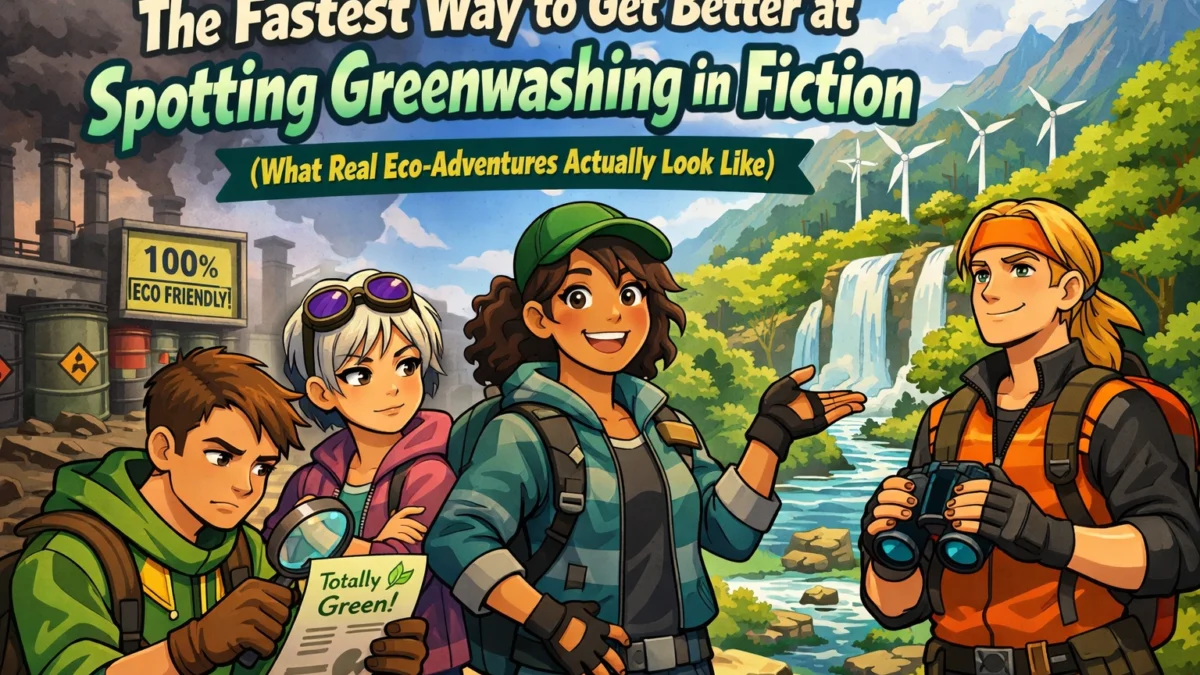
Let's be honest: in 2026, everyone is writing "eco-thrillers." But somewhere between "corporate villain wants to drill the rainforest" and "mystical tree saves humanity," a lot of fiction started feeling like…well, greenwashing with better dialogue.
You know the type. Beautiful cover. Tagline about saving the planet. Then you crack it open and realize the "environmental message" is basically: "Nature good. Pollution bad. Also, here's a car chase."
So how do you spot the difference between genuine eco-adventure storytelling and fiction that's just slapping a green sticker on the same old plot? Let's break it down.
The Fast Checklist: Real vs. Greenwashed Eco-Fiction
Here's your field guide to separating the authentic adventures from the surface-level stuff:
✅ Real Eco-Adventures Show Consequences
A real environmental story doesn't let characters walk away clean. Actions have ripple effects. Ecosystems are interconnected. If someone detonates a bioweapon or strip-mines a jungle, the story shows what that actually means, not just for the heroes, but for the species, the soil, the water, the people downstream.
Greenwashed fiction? The villain gets defeated, everyone high-fives, and somehow the rainforest is…fine now? The ecosystem magically bounces back in the epilogue with zero follow-through.
In The Rainsavers, when corporate goons mess with red mercury fusion reactors or unleash experimental bio-agents, the team doesn't just fight bad guys, they're racing against ecological collapse, tracking contamination patterns, and dealing with the messy aftermath. Because that's how real environmental disasters work.

✅ Real Eco-Adventures Don't Preach at You
There's a difference between a story with environmental stakes and a story that pauses every chapter to lecture you about recycling.
Authentic eco-fiction integrates the themes into the action. The environmental threat is the tension. The characters are dealing with immediate, high-stakes problems, illegal logging operations, bioweapon contamination, endangered species trafficking, and the "message" emerges naturally from their decisions and struggles.
You shouldn't feel like you're reading a National Geographic article with explosions randomly sprinkled in.
✅ Real Eco-Adventures Feature Experts, Not Just Generic "Scientists"
Quick test: Does the story treat its environmental characters like actual professionals with specialized knowledge, or are they just vaguely "good with nature"?
Real eco-adventures employ field biologists, toxicologists, conservation experts, indigenous knowledge-keepers, people with specific skills solving specific problems. They argue about methodology. They have conflicting approaches. They use actual terminology (even if it's explained accessibly).
The Rainsavers team includes a primatologist who tracks animal behavior patterns, ex-military operatives who understand tactical biosecurity, and characters who know the difference between primary and secondary rainforest canopy layers, because those details matter when you're trying to stop a bioweapon from spreading through an ecosystem.

✅ Real Eco-Adventures Acknowledge Complexity
Here's where a lot of eco-fiction falls apart: it treats environmental problems like they have simple good-vs-evil solutions.
Real environmental threats are messy. There are economic pressures. Political complications. Local communities caught in the middle. Corporations with legal teams. Governments with competing interests. Indigenous land rights. Scientific uncertainty.
Greenwashed fiction gives you a cartoonish villain in a boardroom twirling his mustache about profits. Real eco-adventures show you why people make destructive choices, what systems enable them, and why stopping them requires more than just punching the CEO.
When The Rainsavers tackles corporate exploitation, pharmaceutical bioweapon development, or illegal extraction operations, the stories don't pretend there's an easy fix. Victory looks like mitigation, damage control, exposing corruption, protecting what's left, not magical healing crystals that reverse deforestation.
✅ Real Eco-Adventures Get the Science Right (Mostly)
Look, we're talking about adventure fiction, not peer-reviewed journals. Nobody expects perfect accuracy when there's an orangutan helping defuse a bio-bomb.
But real eco-adventures respect the science. They consult experts. They build speculative threats on actual scientific principles. The tech feels grounded, even when it's advanced. The biology makes sense, even when it's fictionalized.
Greenwashed stories throw around terms like "toxins" and "mutations" without any internal logic. Real eco-adventures might feature red mercury fusion reactors (speculative tech), but they'll anchor it in real physics concepts and show realistic consequences.

The Biggest Red Flag: Nature as a Prop
Here's the ultimate test: Does nature exist in the story as an actual ecosystem, or just as pretty set dressing?
Greenwashed fiction uses jungles, oceans, and forests as backdrops, exotic locations where the hero does cool stuff. The environment is interchangeable. Swap the Amazon for Antarctica, and the story basically stays the same.
Real eco-adventures make the environment itself a character. The ecosystem has its own logic, its own threats, its own rhythms. The setting shapes the plot. Characters adapt their tactics based on terrain, climate, local species. The story couldn't happen anywhere else.
The Rainsavers sends teams to the Amazon basin, Antarctic research stations, Central American cloud forests, and each location demands different expertise, creates unique challenges, and reveals distinct environmental threats. Alpha the orangutan isn't just "the cute animal sidekick", he's a cognitively complex great ape whose intelligence and behavior reflects real primatology, adding both humor and genuine emotional stakes.
Why This Matters in 2026
We're drowning in content that claims to care about the environment but doesn't actually engage with environmental realities. It's exhausting. And it dilutes actually thoughtful storytelling.
When you learn to spot authentic eco-adventure fiction, you're not just finding better books, you're supporting storytellers who did the research, consulted the experts, and built narratives that respect both the science and the stakes.
The Rainsavers Difference
So what does all this look like in practice?
The Rainsavers series doesn't pull punches. The environmental threats are grounded in real scientific concerns (bioweapon development, illegal extraction, pharmaceutical industry exploitation). The team includes actual experts with conflicting methodologies. The victories are hard-won and incomplete. The consequences ripple across books.
And yeah, there's also an orangutan with a banana obsession and tactical field gear that looks like it came from a high-end expedition catalog, because eco-adventures can be fun and serious at the same time.
The science is solid (enough). The humor is present. The stakes are real. The characters argue about packing lists and then save endangered ecosystems using actual conservation tactics mixed with thriller-level intensity.
That's what authentic eco-fiction looks like.
Ready to see our mission in action? Explore the full series at The Rainsavers and join a team that treats environmental storytelling with the respect: and adventure( it deserves.)
